On eBird ↗
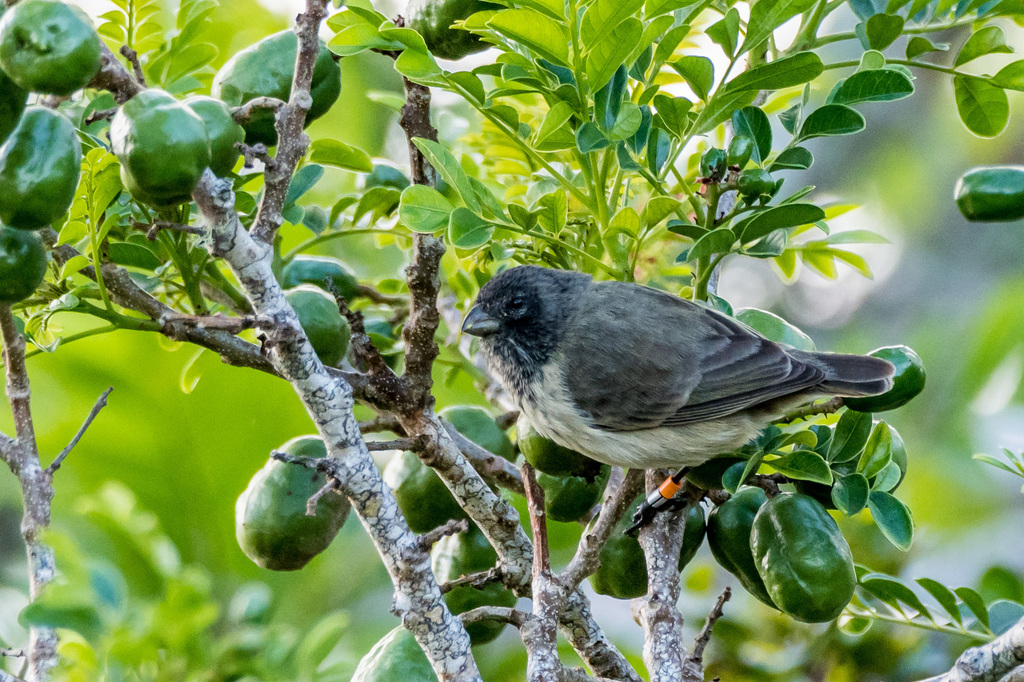
Medium Tree-Finch
Live sightings near you, the range map, bar charts of when it is seen, and Macaulay Library photos and recordings.
Medium Tree-Finch
Camarhynchus pauper
The medium tree finch (Camarhynchus pauper) is a species of Darwin's finch. It is endemic to the Galápagos Islands, where it occurs only on Floreana Island. Its name derives from its intermediate size between the small tree finch and large tree finch. Due to its limited geographic range and its high breeding mortality following the introduction of the parasitic avian vampire fly, the medium tree finch is listed as critically endangered on the IUCN Red List.
From the article Medium tree finch on Wikipedia (CC BY-SA), quoted section by section
Range & habitat
This species is only found on Floreana Island at elevations above 250 meters (820 ft) in moist highland forest habitats, across an range of about 24 km². Prime breeding habitat is dominated by Scalesia pedunculata trees, although the species also occurs in the surrounding agricultural zones. A 2008 survey estimated the number of medium tree finches as 1,620, while a series of surveys between 2014 and 2016 put the number of medium tree finch territories at between 3900 and 4700.
Wikipedia: “Distribution”
What it does
The diurnal Galapagos short-eared owl is its only remaining natural predator. Medium tree finches generally lay two to three eggs. Eggs are incubated for approximately 12 days, and nestlings are fed by both parents at the nest for approximately 14 days before becoming fledglings. The beak of the medium tree finch is intermediate in size between the small tree finch and large tree finch.
Wikipedia: “Ecology”
Listen
Looking for field recordings…
Where it lives
Recorded sightings
—
geo-referenced records in GBIF, from museums, herbaria and field observers.
Drag the globe to turn it. Dots are where records exist, not a range map; darker means more records.
In the stacks
Searching the stacks…
Every page naming Camarhynchus pauper in the Biodiversity Heritage Library →
This page is assembled live from iNaturalist, GBIF, Wikipedia, the Source Library and the Internet Archive. It is not yet part of the hand-edited codex. iNaturalist taxon 9475.