On eBird ↗
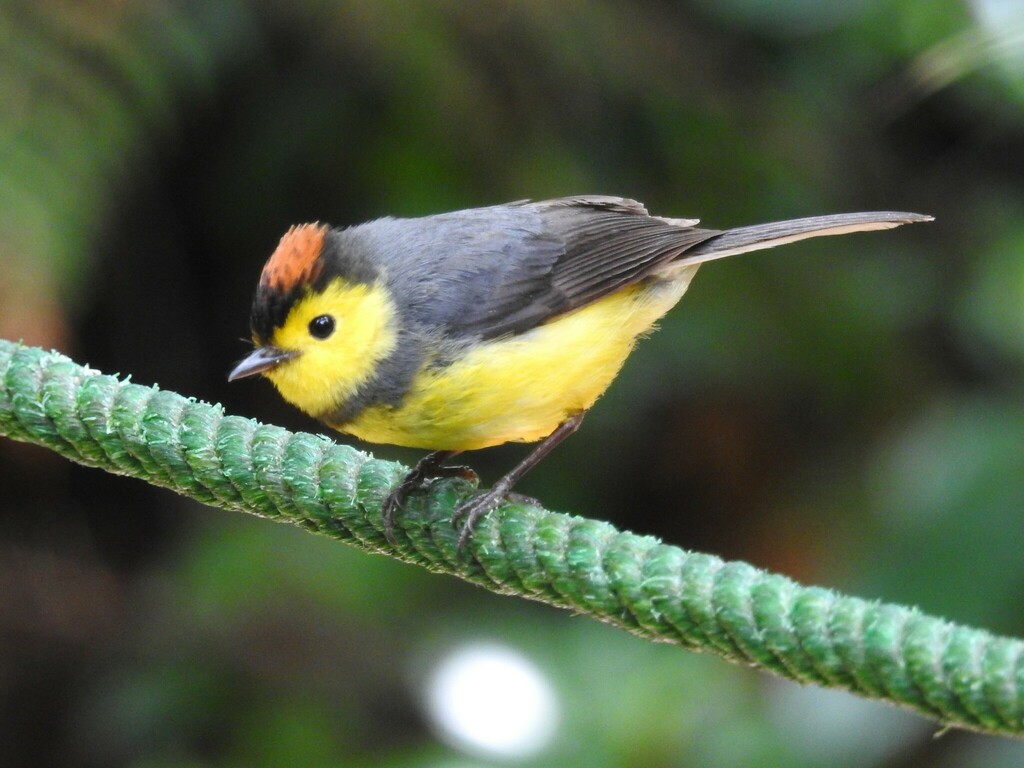
Collared Redstart
Live sightings near you, the range map, bar charts of when it is seen, and Macaulay Library photos and recordings.
Collared Redstart
Myioborus torquatus
The collared whitestart or collared redstart (Myioborus torquatus) is a tropical New World warbler endemic to the mountains of Costa Rica and western Panama. Like other members of Myioborus, it is often called a "whitestart" rather than a "redstart".
From the article Collared whitestart on Wikipedia (CC BY-SA), quoted section by section
Description
The collared whitestart is about 12 to 13.5 cm (4.7 to 5.3 in) long and weighs about 10 to 11 g (0.35 to 0.39 oz). The sexes have the same plumage. Adults have rufous central crown with a black border beneath it that extends to the nape; the rest of their head including the throat is yellow. Their upperparts and wings are slate gray. Their tail is blackish with much white on the outer two pairs of feathers. Their underparts are yellow with a slate gray band across the upper breast. They have a mouse-brown iris, a black bill, and dusky brown or black legs and feet. Juveniles have a slate gray head with no rufous or yellow. Their upperparts are dark slate gray with a brown wash. Their throat and breast are slate gray and their belly dull yellow.
Range & habitat
The collared whitestart is found intermittently through Costa Rica on the Cordillera de Tilarán, Cordillera Central, and Cordillera de Talamanca and continuing as far as Veraguas Province in western Panama. It primarily inhabits the edges and gaps of humid montane forest both primary and secondary. It also occurs in nearby brushy ravines and pastures. In Costa Rica it ranges in elevation from 1,500 m (4,900 ft) to tree line at about 3,500 m (11,500 ft).
Wikipedia: “Distribution and habitat”
What it does
The collared whitestart's diet has not been studied but is known to be mostly arthropods. It forages by gleaning and with sallies in mid-air. It forages mostly from the forest's mid-level canopy but will feed at all levels including near the ground. While foraging it flicks its outer tail feathers, apparently to flush ("start") prey that it then pursues. It also attends army ant swarms to capture prey fleeing the ants and has been observed following cattle and people, apparently for the same reason. Pairs and family groups often join mixed-species feeding flocks.
Wikipedia: “Feeding”
Listen
Looking for field recordings…
Where it lives
Recorded sightings
—
geo-referenced records in GBIF, from museums, herbaria and field observers.
Drag the globe to turn it. Dots are where records exist, not a range map; darker means more records.
In the stacks
Searching the stacks…
Every page naming Myioborus torquatus in the Biodiversity Heritage Library →
This page is assembled live from iNaturalist, GBIF, Wikipedia, the Source Library and the Internet Archive. It is not yet part of the hand-edited codex. iNaturalist taxon 9449.