- Animals
- ›Arthropods
- ›Hexapods
- ›Insects
- ›Winged and Once-winged Insects
- ›Dragonflies and Damselflies
- ›Dragonflies
- ›Aeshnoidea
- ›Darners
- ›Anax
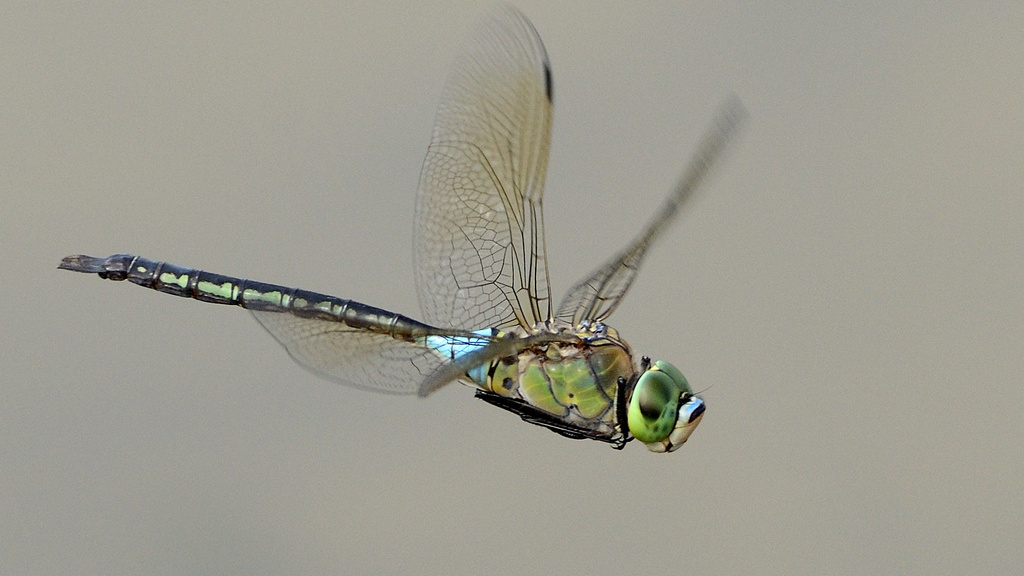
Lesser Emperor
Anax parthenope
Anax parthenope, the lesser emperor, is a dragonfly of the family Aeshnidae. It is found in Southern Europe, North Africa, West Asia.
From the article Anax parthenope on Wikipedia (CC BY-SA), quoted section by section
Description
It is a crepuscular dragonfly, active in the dusk. This species can be easily distinguished by the multicolored upper surface of frons and by the shape and relative lengths of the anal appendages. Its labium and labrum are golden-yellow and face and frons are greenish yellow and eyes are green, bluish when aged. Its thorax is pale olivaceous brown with dark brown sutures. Its segment two of the abdomen is turquoise blue. Segment three has a large blue patch at each side. Segments 4 to 9 have an irregular black middorsal stripe. Segment 10 is black.
Range & habitat
This species occurs in much of southern and central Europe, including most Mediterranean islands, across Asia to Japan, the Korean Peninsula, and China, and on to North Africa. It has been found on the Canary Islands and the Madeira Archipelago. It is spreading north and was first seen in Great Britain in 1996, where it has since bred.
Wikipedia: “Distribution and habitat”
What it does
In the south of its range A. parthenope can be on the wing in March. It is most commonly seen from June to September, but can still be around in November. Often seen patrolling around ponds, lakes, and other still water, it occurs with A. imperator, but it is usually less abundant. When A. parthenope and A. imperator occur at the same ponds, A. imperator is dominant. Males and females mate in the normal dragonfly manner and after mating, the pair stay in tandem and egg-laying usually occurs whilst still in tandem. This behaviour is not seen in other European hawkers with the exception of Aeshna affinis, although two migrants to Europe, A. ephippiger and A. junius also oviposit in tandem. Eggs are inserted into plants or in mud and hatch out in two months. Larval development takes two years.
Wikipedia: “Behaviour”
Listen
Looking for field recordings…
Where it lives
Recorded sightings
—
geo-referenced records in GBIF, from museums, herbaria and field observers.
Drag the globe to turn it. Dots are where records exist, not a range map; darker means more records.
In the stacks
Searching the stacks…
Every page naming Anax parthenope in the Biodiversity Heritage Library →
This page is assembled live from iNaturalist, GBIF, Wikipedia, the Source Library and the Internet Archive. It is not yet part of the hand-edited codex. iNaturalist taxon 94048.