- Plants
- ›Vascular Plants
- ›flowering plants
- ›Dicots
- ›Sunflowers, Bellflowers, Fanflowers, and Allies
- ›korokio family
- ›Corokia
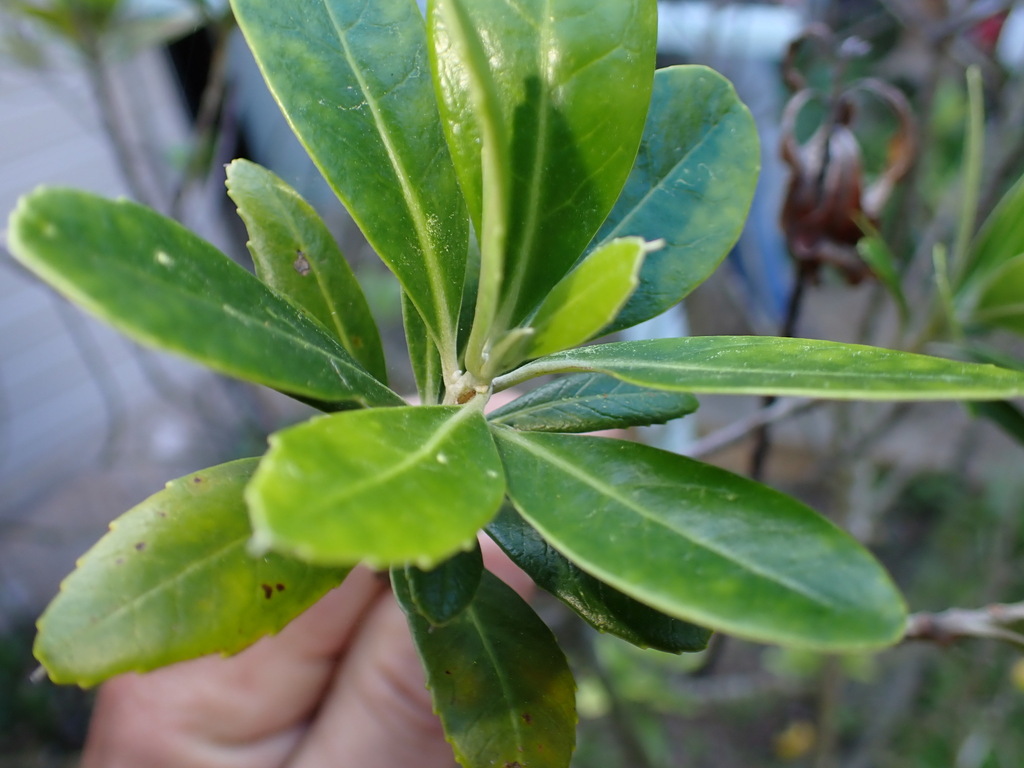
Corokia carpodetoides
Corokia carpodetoides, simply known locally as corokia, is a flowering plant in the Argophyllaceae family. The specific epithet derives from a resemblance to the genus Carpodetus, with the addition of the Latin suffix -oides (“resembling”).
From the article Corokia carpodetoides on Wikipedia (CC BY-SA), quoted section by section
Description
It is a shrub, usually growing to about 2 m (6.6 ft) in height, but occasionally up to a tree-like 5 m (16 ft). The young stems have a covering of short, matted hairs. Its narrowly oblanceolate to narrowly elliptic leaves, 2–6 cm (0.8–2.4 in) long and 1–2 cm (0.4–0.8 in) wide, are crowded towards the ends of the branches. The terminal, corymbose inflorescences bear many small yellow flowers. The ovoid fruits are single-seeded and about 3 mm long, becoming brown and dry. The main flowering season is December to January.
Range & habitat
The tree is endemic to Australia’s subtropical Lord Howe Island in the Tasman Sea. It is locally common at higher elevations on Mounts Lidgbird and Gower at the southern end of the island.
== References ==
Wikipedia: “Distribution and habitat”
Where it lives
Recorded sightings
—
geo-referenced records in GBIF, from museums, herbaria and field observers.
Drag the globe to turn it. Dots are where records exist, not a range map; darker means more records.
In the stacks
Searching the stacks…
Every page naming Corokia carpodetoides in the Biodiversity Heritage Library →
This page is assembled live from iNaturalist, GBIF, Wikipedia, the Source Library and the Internet Archive. It is not yet part of the hand-edited codex. iNaturalist taxon 938701.