On eBird ↗
Campo Troupial
Live sightings near you, the range map, bar charts of when it is seen, and Macaulay Library photos and recordings.
Campo Troupial
Icterus jamacaii
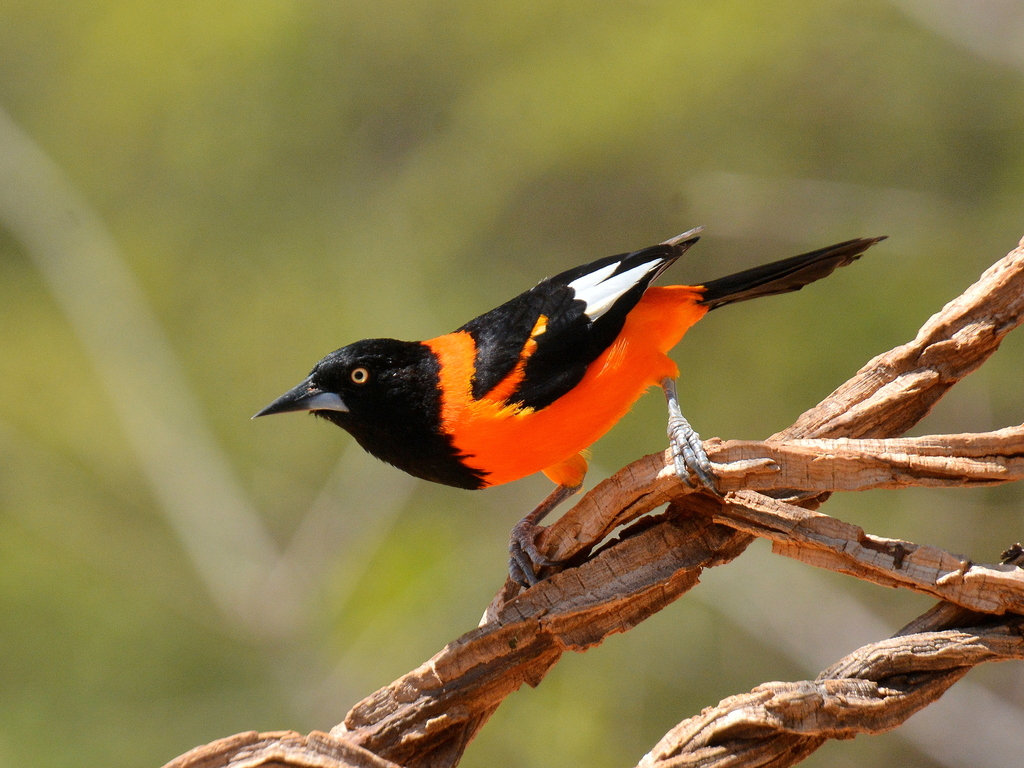
The campo troupial or campo oriole (Icterus jamacaii) is a species of bird in the family Icteridae that is found in northeastern Brazil. At one time thought to be conspecific with the Venezuelan troupial and orange-backed troupial, it is now accepted as a separate species. It is a fairly common bird and the International Union for Conservation of Nature has rated it as a "least-concern species".
From the article Campo troupial on Wikipedia (CC BY-SA), quoted section by section
Description
The campo troupial is very similar in appearance to the Venezuelan troupial (Icterus icterus) with which it was at one time thought to be conspecific. It is a robust bird about 23 cm (9 in) long with a long tail and a broad beak. It is bright orange apart from a black hood and bib, back, wings and tail. There is an uneven line dividing the bib from the breast. It differs from the Venezuelan troupial in having only a small patch of white on its wings and hardly any bluish skin around its eye, and it has orange epaulettes on its shoulders whereas the Venezuelan bird does not. It could also be confused with the orange-backed troupial (Icterus croconotus), with which it was also once considered conspecific, but that species has an orange head apart from a patch of black on its forehead, a sharp dividing line between its bib and its breast, and rather more orange on its back.
Range & habitat
The campo troupial is endemic to northeastern Brazil, where its area of occurrence is estimated to be over 2,000,000 square kilometres (770,000 sq mi). It typically inhabits dry scrubland and deciduous woodland, at elevations up to 700 m (2,300 ft) or more. The ranges of the Venezuelan troupial, the campo troupial and the orange-backed troupial do not overlap.
Wikipedia: “Distribution and habitat”
What it does
The diet consists of insects and other small invertebrates, fruits and nectar; one individual was found to have 126 fly larvae in its stomach. Breeding takes place during the wet season, between December and March.
Wikipedia: “Behaviour”
Listen
Looking for field recordings…
Where it lives
Recorded sightings
—
geo-referenced records in GBIF, from museums, herbaria and field observers.
Drag the globe to turn it. Dots are where records exist, not a range map; darker means more records.
In the stacks
Searching the stacks…
Every page naming Icterus jamacaii in the Biodiversity Heritage Library →
This page is assembled live from iNaturalist, GBIF, Wikipedia, the Source Library and the Internet Archive. It is not yet part of the hand-edited codex. iNaturalist taxon 9356.