- Plants
- ›Vascular Plants
- ›flowering plants
- ›Dicots
- ›Sunflowers, Bellflowers, Fanflowers, and Allies
- ›Sunflowers, Daisies, Asters, and Allies
- ›Asteroideae
- ›asters and allies
- ›Asterinae
- ›Aster
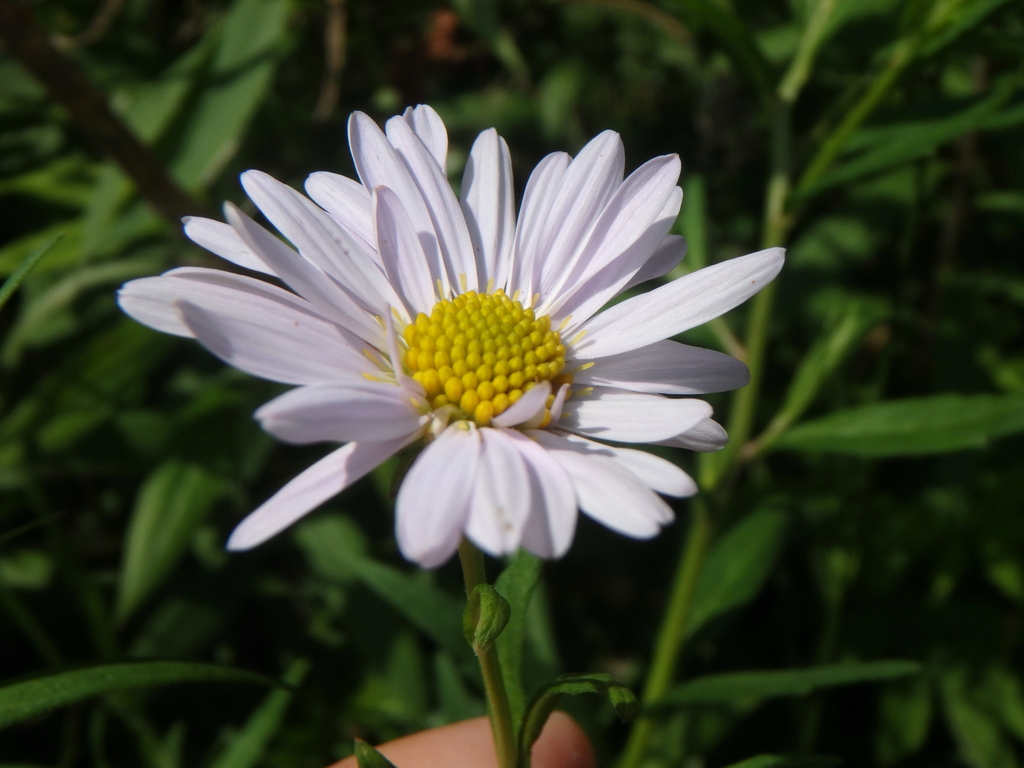
Incised-leaf aster
Aster incisus
Aster incisus (syn. Kalimeris incisa), is a species of flowering plant in the family Asteraceae. It is native to the Eastern Asia; Chita Oblast in Siberia, the southern Russian Far East, Inner Mongolia, Manchuria, the Korean peninsula, and Japan.
From the article Aster incisus on Wikipedia (CC BY-SA), quoted section by section
Description
Aster incisus (common names include kalimeris and Japanese cutleaf aster) is a herbaceous perennial, growing to a height of 30 to 120 cm, with a spread of approximately 50 cm. Stems are erect, glabrous, and branched in the upper part. Leaves are lanceolate, alternating along the stem. The Latin name refers to the toothed or incised appearance of the leaves. Flowers are stellate, with ray florets pink to bluish-purple in colour, and disk florets yellow. Flowers appear from June to October. The fruit is an achene. Achenes are brownish, ovoid, measuring 3 - 3.5 mm. It can take two to five years for a plant to reach maturity. Over time a group of plants will spread to form a colony.
In medicine
A. incisa has been used in Korean traditional medicine. Research in Korea indicates that A. incisa has antioxidant and anti-inflammatory properties, and may potentially be useful in treating several types of cancer.
Wikipedia: “Medicinal use”
Where it lives
Recorded sightings
—
geo-referenced records in GBIF, from museums, herbaria and field observers.
Drag the globe to turn it. Dots are where records exist, not a range map; darker means more records.
In the stacks
Searching the stacks…
Every page naming Aster incisus in the Biodiversity Heritage Library →
This page is assembled live from iNaturalist, GBIF, Wikipedia, the Source Library and the Internet Archive. It is not yet part of the hand-edited codex. iNaturalist taxon 933840.