On eBird ↗
Martinique Oriole
Live sightings near you, the range map, bar charts of when it is seen, and Macaulay Library photos and recordings.
Martinique Oriole
Icterus bonana
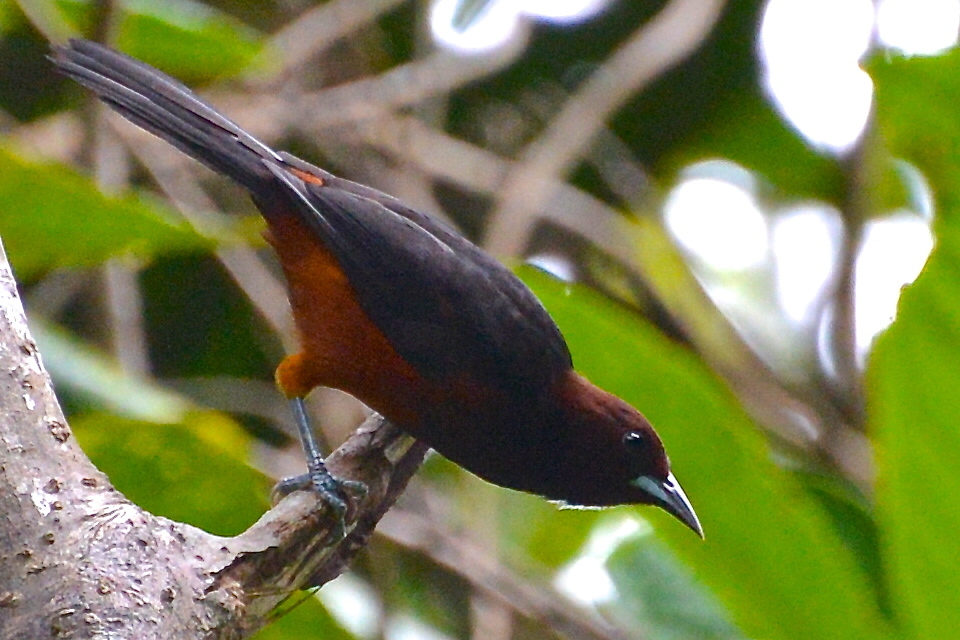
The Martinique oriole (Icterus bonana) is a species of bird in the family Icteridae. It is endemic to Martinique, French West Indies. Martinique is a part of the Lesser Antilles, and is located in the Eastern Caribbean.
The orioles' habitats are subtropical or tropical dry forests, subtropical or tropical moist lowland forests, subtropical or tropical mangrove forests, and plantations.
From the article Martinique oriole on Wikipedia (CC BY-SA), quoted section by section
Description
Compared to the other orioles of the Lesser Antilles, this oriole spots the most unusual plumage coloration. The Martinique oriole has mainly black plumage with a reddish-orange belly, and grows to 18–21 cm. The males of this species are slightly brighter than the females. It makes harsh scolding calls, and whistles. Whether females sing or not is currently being researched. It eats fruit from the canopy, berries and various insects, foraging alone, in pairs or with a group of family members. Breeding is generally observed between February–July, however breeding has been recorded in December. It is closely related to several other orioles found in the Caribbean.
Range & habitat
Martinique orioles are found in Martinique, French West Indies. They appear in a density of 2.4 birds/ha in central Martinique. Originally present in many habitat-types below 700 m, the Martinique oriole is now mainly found in mangroves and dry forests. The Martinique oriole generally likes to distance itself from heavily urbanized communities. It places its nest on the underside of wide leaves such as that of a banana plant, palm or Heliconia. Once the nests have been formed, they typically lay two, or sometimes three eggs. Its preferred habitat is in moist highland habitats; however, it could also be found in lowland dry forest habitats. Birds of this species do not form flocks, yet still communicate with each other via whistling, uttering harsh, scolding calls and singing a soft, warbling song. It is a territorial bird, however the territory they control is relatively small, as they have not been seen to feed more than 100 meters from their nest. Much more research is needed on this species.
Wikipedia: “Distribution, behavior, and habitat”
Listen
Looking for field recordings…
Where it lives
Recorded sightings
—
geo-referenced records in GBIF, from museums, herbaria and field observers.
Drag the globe to turn it. Dots are where records exist, not a range map; darker means more records.
In the stacks
Searching the stacks…
Every page naming Icterus bonana in the Biodiversity Heritage Library →
This page is assembled live from iNaturalist, GBIF, Wikipedia, the Source Library and the Internet Archive. It is not yet part of the hand-edited codex. iNaturalist taxon 9327.