- Plants
- ›Vascular Plants
- ›flowering plants
- ›Dicots
- ›pinks, cactuses, and allies
- ›Amaranth family
- ›Salsoloideae
- ›Salsoleae
- ›Halothamnus
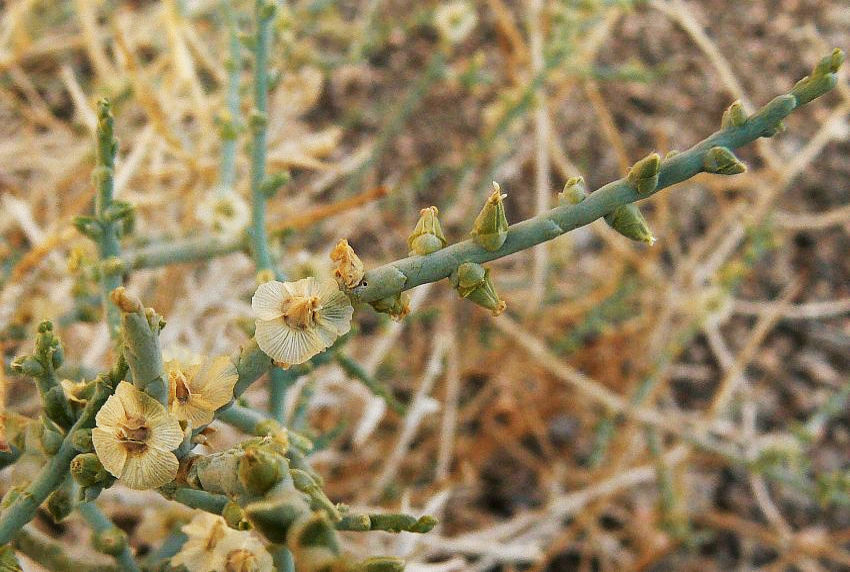
Halothamnus bottae
Halothamnus bottae is a species of the plant genus Halothamnus, that belongs to the subfamily Salsoloideae of the family Amaranthaceae. It occurs on the Arabian peninsula.
From the article Halothamnus bottae on Wikipedia (CC BY-SA), quoted section by section
Description
Halothamnus bottae is a shrub 30–50 cm high, with blueish-green, thorny branches. The leaves are standing off from the branches, they are triangular, and only 0,7-3 (rarely 8) mm long. The flowers are 2,6-3,6 mm long. The winged fruit is 6–9 mm in diameter. The bottom of the fruit tube has large ovate shallow pits alternating with five prominent radial veins (from the navel to the tepals). The subspecies H. bottae subsp. niger differs by green twigs soon becoming black, and by dark brown wings of fruit.
Wikipedia: “Morphology”
Range & habitat
Halothamnus bottae is endemic on the Arabian peninsula (Saudi Arabia, Yemen, Oman, United Arab Emirates). It grows in open shrubland and semidesert on dry stony ground, from 0–2000 m above sea level. The subspecies H. bottae subsp. niger occurs only on southern Arabian peninsula, in hot arid lowlands up to 100 m above sea level (similar plants from eastern Africa belong to Halothamnus somalensis).
Wikipedia: “Distribution”
Where it lives
Recorded sightings
—
geo-referenced records in GBIF, from museums, herbaria and field observers.
Drag the globe to turn it. Dots are where records exist, not a range map; darker means more records.
In the stacks
Searching the stacks…
Every page naming Halothamnus bottae in the Biodiversity Heritage Library →
This page is assembled live from iNaturalist, GBIF, Wikipedia, the Source Library and the Internet Archive. It is not yet part of the hand-edited codex. iNaturalist taxon 929407.