On eBird ↗
Scrub Euphonia
Live sightings near you, the range map, bar charts of when it is seen, and Macaulay Library photos and recordings.
Scrub Euphonia
Euphonia affinis
The scrub euphonia (Euphonia affinis) is a species of bird in the family Fringillidae. It is found in Belize, Costa Rica, El Salvador, Guatemala, Honduras, Mexico, and Nicaragua. Its natural habitats are subtropical or tropical dry forest, subtropical or tropical moist lowland forest, and heavily degraded former forest.
From the article Scrub euphonia on Wikipedia (CC BY-SA), quoted section by section
Description
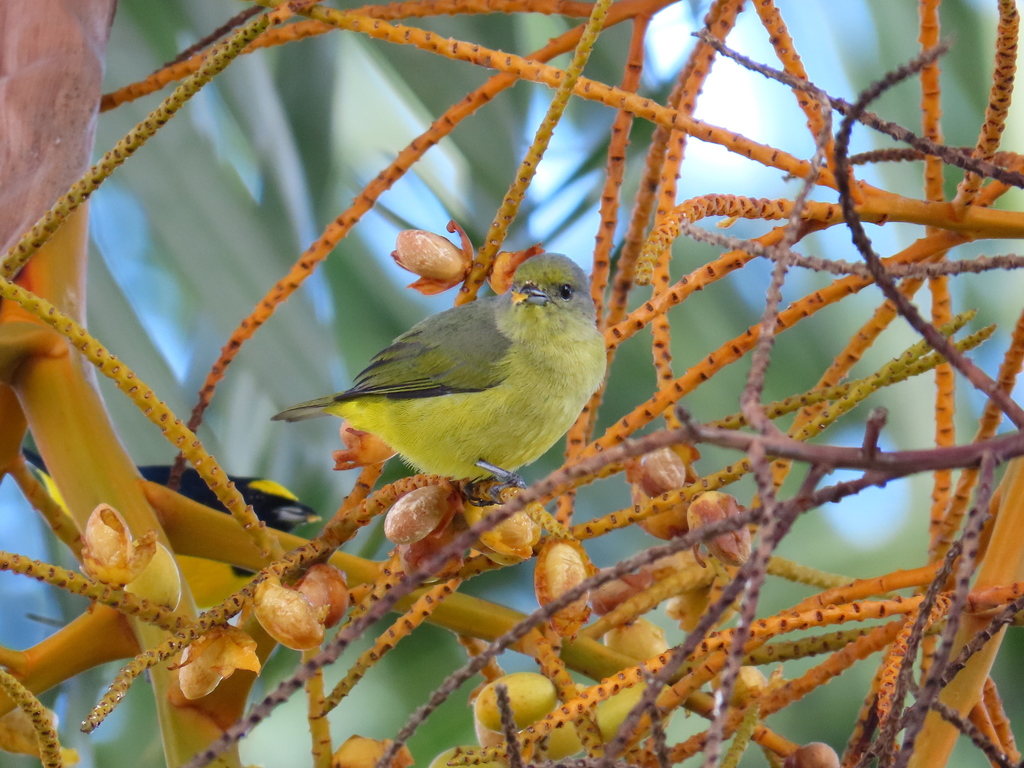
The scrub euphonia is about 10 cm (3.9 in) long. It weighs 8.5 to 12.8 g (0.30 to 0.45 oz). It has a short stubby bill. The species is sexually dimorphic. Adult males of the nominate subspecies have a small yellow forecrown; the color extends just to the eye. The rest of their head and nape are glossy blue-black with a purplish sheen. Their upperparts are glossy blue-black. Their tail is mostly blackish with white inner webs on the outer two pairs of feathers. Their upperwing coverts and flight feathers are blackish with some dark blue gloss. Their chin and throat are glossy blue-black with a purplish sheen and their breast, belly, and undertail coverts are bright yellow. Adult females have an olive-yellow forehead, a grayish crown and nape, and an olive-yellow face. Their upperparts, wings, and tail are olive with a gray tinge on the back. Their underparts are mostly olive-yellow with a yellow belly and undertail coverts. Males of subspecies E. a. olmecorum are like the nominate. Females are overall paler than the nominate. Their rump, uppertail coverts, and the edges of their tail feathers are greener. Their underparts are more grayish and their belly a duller yellow. Both sexes of both subspecies have a dark brown iris, a black maxilla with a grayish base, a light bluish gray mandible with a blackish tip, and dark gray legs and feet.
Range & habitat
Subspecies E. a. olmecorum is the more northerly of the two. It is found on the Gulf slope of Mexico from Nuevo León, southern Tamaulipas, and eastern San Luis Potosí south to northern Chiapas. The nominate subspecies is found in the east from Mexico's Yucatán Peninsula south through Belize and Guatemala into the western half of Honduras. In the west it is found from western Oaxaca in southwestern Mexico south along the Pacific slope through Guatemala, El Salvador, Honduras, and Nicaragua into northwestern Costa Rica as far as the Tárcoles District in Puntarenas Province. The scrub euphonia inhabits several somewhat open landscapes in the tropical zone. These include deciduous forest, gallery forest, secondary forest, the edges of evergreen forest, scrublands, agricultural areas and pastures with some trees, gardens, and clearings. Overall it ranges in elevation from sea level to 2,250 m (7,400 ft) but is mostly below 1,000 m (3,300 ft). In northern Central America it is mostly found below 1,300 m (4,300 ft) but reaches 2,200 m (7,200 ft). In Costa Rica it reaches only 1,000 m (3,300 ft).
Wikipedia: “Distribution and habitat”
What it does
The scrub euphonia feeds primarily on the fruits of mistletoe (Loranthaceae) and other small fruits including those of figs (Ficus) and probably cultivated fruits. It also includes small numbers of insects in its diet. It forages mostly in pairs and small groups, often with yellow-throated euphonias (E. hirundinacea), and often joins mixed-species feeding flocks. It forages from trees' mid-level to their canopy.
Wikipedia: “Feeding”
Listen
Looking for field recordings…
Where it lives
Recorded sightings
—
geo-referenced records in GBIF, from museums, herbaria and field observers.
Drag the globe to turn it. Dots are where records exist, not a range map; darker means more records.
In the stacks
Searching the stacks…
Every page naming Euphonia affinis in the Biodiversity Heritage Library →
This page is assembled live from iNaturalist, GBIF, Wikipedia, the Source Library and the Internet Archive. It is not yet part of the hand-edited codex. iNaturalist taxon 9291.