- Animals
- ›Chordates
- ›Vertebrates
- ›Mammals
- ›Therians
- ›Placental Mammals
- ›Ungulates, Carnivorans, and Allies
- ›Carnivorans
- ›Mongooses
- ›Solitary Mongooses
- ›Urva
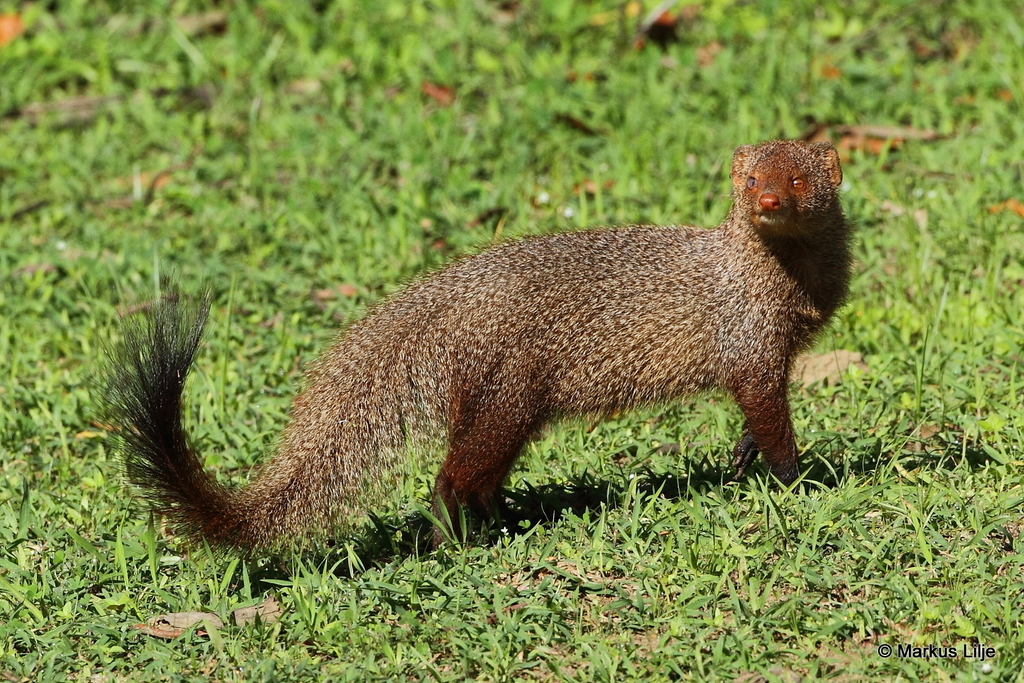
Ruddy Mongoose
Urva smithii
The ruddy mongoose (Herpestes smithii) is a species of mongoose found in hill forests of peninsular India and Sri Lanka. This mongoose, along with the striped-neck and Indian grey mongeese, are the only mongoose species endemic to India and Sri Lanka. The ruddy mongoose is very closely related to Indian grey mongoose, but distinguished by its slightly larger size and black-tipped tail extending for 2 to 3 inches at the distal end. There are two subspecies...
From the article Ruddy mongoose on Wikipedia (CC BY-SA), quoted section by section
Description
The ruddy mongoose is a large mongoose with a greyish-brown fur. It has an average head to body length of 40–45 cm (16–18 in) and a 36 cm (14 in) long tail. The long tail features a darker tasseled tip, which is usually curved upward, and is visible from a distance.
Range & habitat
The ruddy mongoose is found in forests and shrub lands in India and Sri Lanka. It is mainly a forest dweller and prefers more secluded areas. It has also been recorded to forage in secluded paddy fields in the region. It is classified as least concern in the IUCN Red List.
Wikipedia: “Distribution and habitat”
What it does
The ruddy mongoose hunts during both day and night, and feeds on birds, rat snakes, land monitors, rodents and snails. It is generally considered a solitary animal, though it has been recorded in monogamous pairs during the mating season. Family groups of up to five animals consisting of a mother and pups have been observed in the wild. While they are generally found in thick jungles, and edges of the forests, they occasionally venture into paddy fields and tea estates. They quickly withdraw into a crevice or underneath a rock shelf on confrontation with humans. When they are cornered, they often show aggressive behaviour while making loud and shrill noises.
Wikipedia: “Ecology and behavior”
Listen
Looking for field recordings…
Where it lives
Recorded sightings
—
geo-referenced records in GBIF, from museums, herbaria and field observers.
Drag the globe to turn it. Dots are where records exist, not a range map; darker means more records.
In the stacks
Searching the stacks…
Every page naming Urva smithii in the Biodiversity Heritage Library →
This page is assembled live from iNaturalist, GBIF, Wikipedia, the Source Library and the Internet Archive. It is not yet part of the hand-edited codex. iNaturalist taxon 925969.