- Plants
- ›Vascular Plants
- ›flowering plants
- ›Dicots
- ›Nances, Willows, and Allies
- ›Passionfruit Family
- ›Passifloroideae
- ›Passifloreae
- ›Passiflora
- ›Passiflora
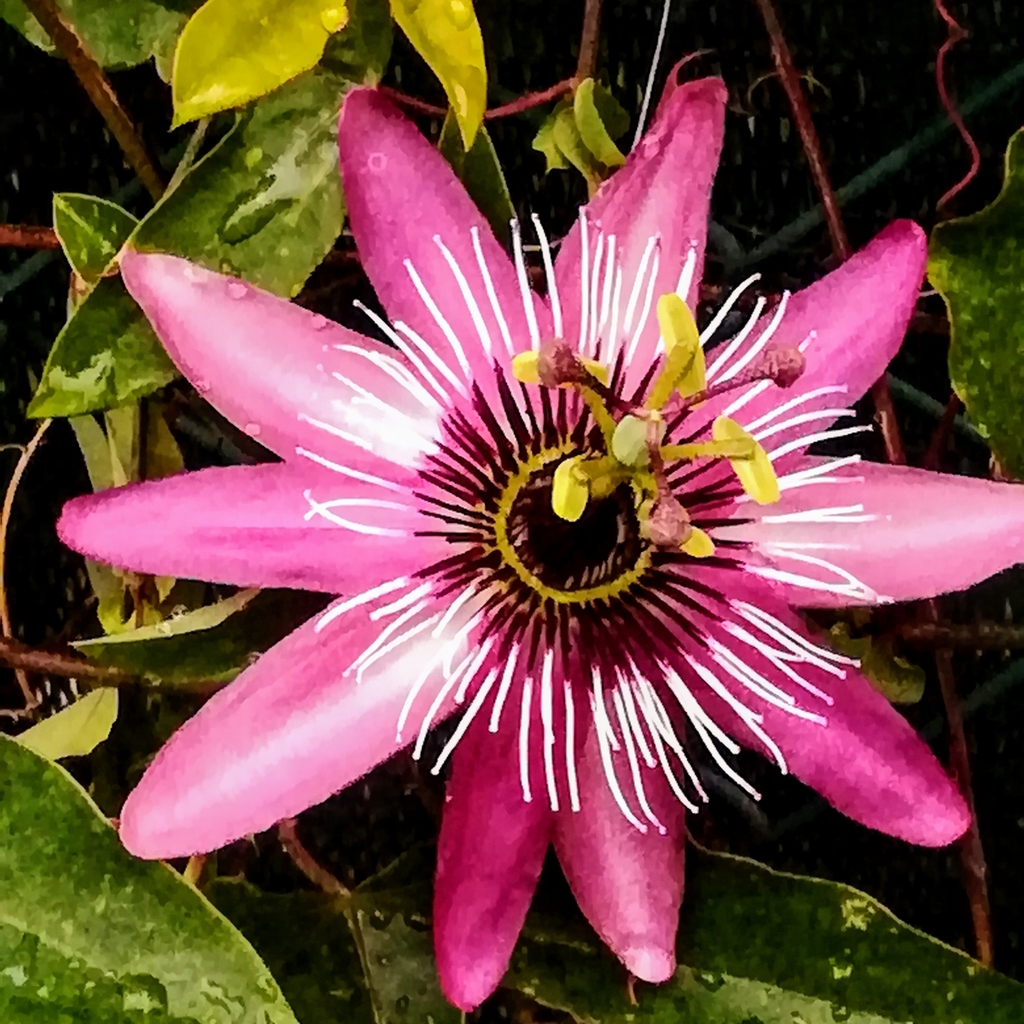
Passiflora 'Victoria'
Passiflora × violacea
Passiflora × violacea, the violet passion flower, is a hybrid between two species of flowering plants, Passiflora racemosa × Passiflora caerulea, in the family Passifloraceae. The name Passiflora × violacea has yet to be resolved as a correct scientific name; nevertheless it is widely found in the horticultural literature.
It is an evergreen climber growing to 6 m (20 ft) with five-lobed leaves, clinging spiral tendrils, large showy purple flowers with maroon and white filaments, and the prominent stigmas and anthers typical of the genus. While somewhat hardier than one of its parents, P. racemosa, it is considerably less hardy than the other, P. caerulea (which can be grown outside in warm or coastal areas). P. × violacea will tolerate temperatures down to −1 °C (30 °F), but in most temperate zones is grown under glass, for instance in an unheated conservatory or greenhouse.
Where it lives
Recorded sightings
—
geo-referenced records in GBIF, from museums, herbaria and field observers.
Drag the globe to turn it. Dots are where records exist, not a range map; darker means more records.
In the stacks
Searching the stacks…
Every page naming Passiflora × violacea in the Biodiversity Heritage Library →
This page is assembled live from iNaturalist, GBIF, Wikipedia, the Source Library and the Internet Archive. It is not yet part of the hand-edited codex. iNaturalist taxon 919362.