- Plants
- ›Vascular Plants
- ›flowering plants
- ›Dicots
- ›Heathers, Balsams, Primroses, and Allies
- ›heath family
- ›Epacrids, Styphelias and Allies
- ›Epacrideae
- ›Epacris
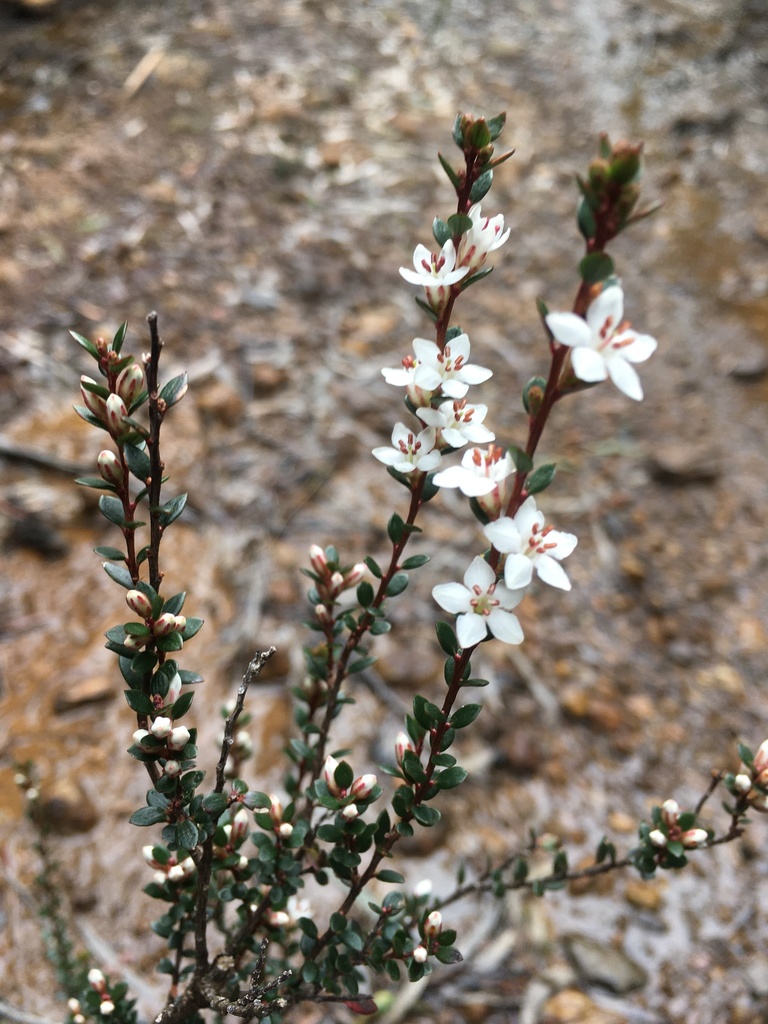
Epacris glabella
Epacris glabella, commonly known as smooth heath, is a species of flowering plant in the heath family, Ericaceae, and is endemic to Tasmania. It is a shrub with erect branches, egg-shaped to elliptic leaves and white, tube-shaped flowers.
From the article Epacris glabella on Wikipedia (CC BY-SA), quoted section by section
Description
Epacris glabella is an erect shrub that typically grows to a height of 1–2 m (3 ft 3 in – 6 ft 7 in) and has slender, more or less glabrous branches. The leaves are egg-shaped to elliptic, glabrous, thick and shining, 3.5–7 mm (0.14–0.28 in) long and 2.0–3.5 mm (0.079–0.138 in) wide on a petiole less than 1 mm (0.039 in) long. The flowers are arranged singly in leaf axils and are more or less sessile, the petal tube bell-shaped and 2.5–3.5 mm (0.098–0.138 in) long with five lobes 3–5 mm (0.12–0.20 in) long. The anthers and style protrude beyond the petal tube. Flowering occurs in spring.
Range & habitat
Smooth heath grows in soils derived from serpentinite in heath or woodland in hilly places in disjunct populations in north-west Tasmania.
Wikipedia: “Distribution and habitat”
Where it lives
Recorded sightings
—
geo-referenced records in GBIF, from museums, herbaria and field observers.
Drag the globe to turn it. Dots are where records exist, not a range map; darker means more records.
In the stacks
Searching the stacks…
Every page naming Epacris glabella in the Biodiversity Heritage Library →
This page is assembled live from iNaturalist, GBIF, Wikipedia, the Source Library and the Internet Archive. It is not yet part of the hand-edited codex. iNaturalist taxon 918334.