On eBird ↗
Rufous-collared Sparrow
Live sightings near you, the range map, bar charts of when it is seen, and Macaulay Library photos and recordings.
Rufous-collared Sparrow
Zonotrichia capensis
The rufous-collared sparrow or Andean sparrow (Zonotrichia capensis) is an American sparrow found in a wide range of habitats, often near humans, from the extreme south-east of Mexico to Tierra del Fuego, and the island of Hispaniola in the Caribbean. It has diverse vocalizations, which have been intensely studied since the 1970s, particularly by Paul Handford and Stephen C. Lougheed (UWO), Fernando Nottebohm (Rockefeller University) and Pablo Luis Tubaro (UBA). Local names for this bird include the Portuguese tico-tico and mariquinha, the Aymara Pichitanka the Spanish copetón ("tufted") in Colombia, as well as chingolo and chincol, comemaíz "corn eater" in Costa Rica, chincol in Chile and Cigua de Constanza in the Dominican Republic.
From the article Rufous-collared sparrow on Wikipedia (CC BY-SA), quoted section by section
Description
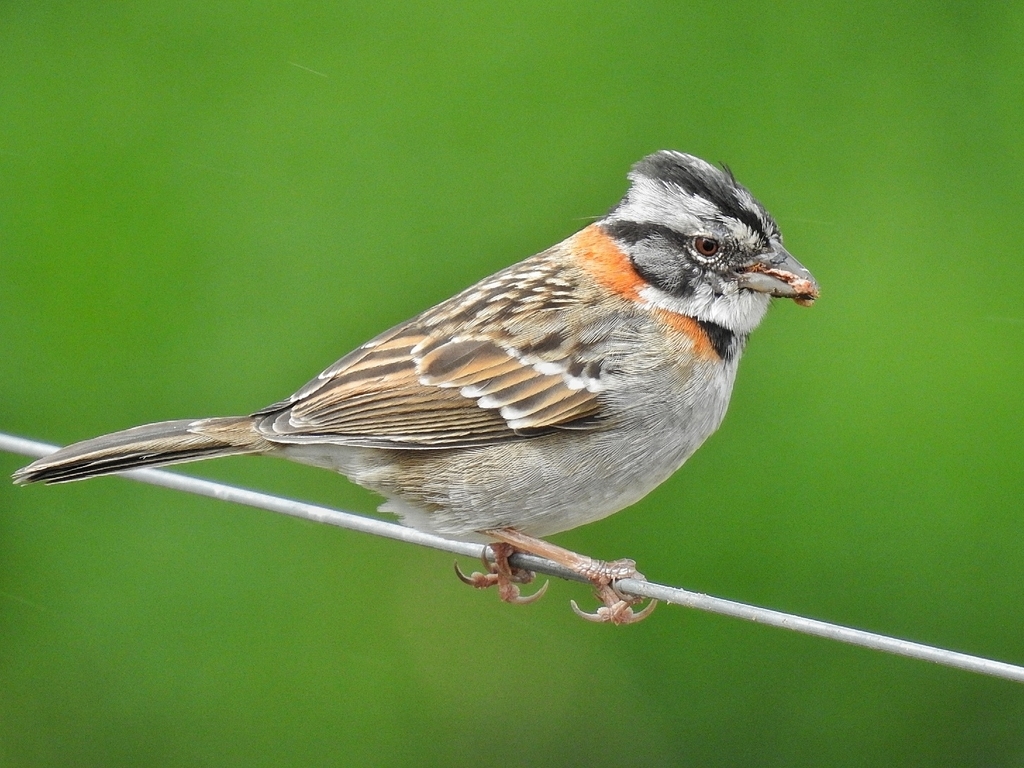
The rufous-collared sparrow is 13.5–15 cm (5+1⁄4–6 in) long and weighs 20–25 g (0.71–0.88 oz). The adult has a stubby grey bill, and a grey head with broad black stripes on the crown sides, and thinner stripes through the eye and below the cheeks. The nape and breast sides are rufous, and the upperparts are black-streaked buff-brown. There are two white wing bars. The throat is white, and the underparts are off-white, becoming brown on the flanks and with a black breast patch. Young birds have a duller, indistinct head pattern, with brown stripes and a buff ground colour. They lack the rufous collar and have streaked underparts. There are 27 subspecies of the rufous-collared sparrow. In general, the smaller forms occur in coastal mountains, intermediate birds in the Andes, and large, darker, forms breed on the tepuis. The largest of the tepui subspecies, Z. c. perezchincillae, has grey underparts, and the rufous collar extends as a black band of freckles across the breast. This form might be separable as a distinct species, or it might just be a particularly distinct population due to genetic bottleneck effects.
Range & habitat
In the northern and western parts of its range, this generally abundant bird is typically found at altitudes of 600–4,000 m (2,000–13,100 ft), but in the southern and eastern parts, it is commonly found down to near sea level. It can be seen in virtually any open or semi-open habitat, including cultivations, gardens, parks, grasslands, and scrubby second growth or cerrado. It copes well with urban and suburban environments but is absent from the densely forested sections of the Amazon Basin. It is also scarce on the Guiana Shield, occurring mainly on some tepuis and in the Pakaraima Mountains of Guyana. The species was likely more widespread across the Caribbean region during the much cooler climes of the last glacial period, but was left marooned in the highest Hispaniolan mountains (the highest in the Caribbean) once warming began. This pattern is mirrored in the population of the Hispaniolan crossbill (Loxia megaplaga), a sympatric bird. However, it is also known to exist in Aruba and some other Caribbean islands.
Wikipedia: “Distribution and habitat”
What it does
The rufous-collared sparrow feeds on the ground on seeds, fallen grain, insects and spiders. It will sometimes join mixed-species feeding flocks and has been observed to pick termites from spider webs. It is usually seen in pairs which hold small territories, or in small flocks. Tame and approachable, it is common throughout its large range and not considered threatened by the IUCN.
Wikipedia: “Diet”
Listen
Looking for field recordings…
Where it lives
Recorded sightings
—
geo-referenced records in GBIF, from museums, herbaria and field observers.
Drag the globe to turn it. Dots are where records exist, not a range map; darker means more records.
In the stacks
Searching the stacks…
Every page naming Zonotrichia capensis in the Biodiversity Heritage Library →
This page is assembled live from iNaturalist, GBIF, Wikipedia, the Source Library and the Internet Archive. It is not yet part of the hand-edited codex. iNaturalist taxon 9183.