- Plants
- ›Vascular Plants
- ›flowering plants
- ›Dicots
- ›pinks, cactuses, and allies
- ›Amaranth family
- ›Salsoloideae
- ›Salsoleae
- ›Halothamnus
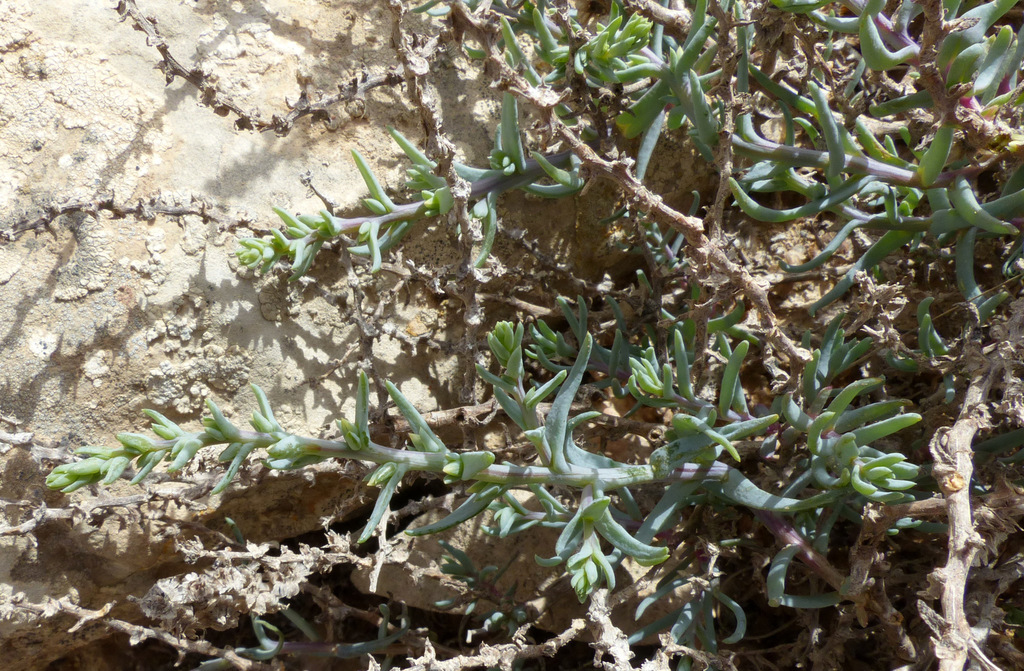
Halothamnus lancifolius
Halothamnus lancifolius is a species of the plant genus Halothamnus, that belongs to the subfamily Salsoloideae within the family Amaranthaceae, (formerly Chenopodiaceae). It occurs in Southwest Asia.
From the article Halothamnus lancifolius on Wikipedia (CC BY-SA), quoted section by section
Description
Halothamnus lancifolius is a sub-shrub up to 45 cm high, with blueish-green pale-striped branches. The leaves are flat, somewhat fleshy, lanceolate-triangular or linear-triangulate, and up to 43 mm long and 1,9-4,5 mm wide, decurrent at their base for 1–5 mm along the stem. The bracts and bracteoles are flat and lanceolate, the bracteoles obliquely standing off, basally with membraneous margins. The flowers are 3,8-4,8 mm long with lanceolate-oval tepals, the stigmas are rounded at their tip. The winged fruit is 9–14 mm in diameter, their wings inserting below the middle, the tepal lobes forming a steep cone. The tube of the fruit is cylindric, its bottom with deep furrow-like, linear or curved pits.
Wikipedia: “Morphology”
Range & habitat
The distribution of Halothamnus lancifolius covers Syria, Israel and Palestine, Jordan, western Iraq, Egypt (Sinai) and northwestern Saudi Arabia. It grows on stony ground, often on salty soils, from 400 m below sea level up to 1500 m above sea-level.
Wikipedia: “Distribution”
Where it lives
Recorded sightings
—
geo-referenced records in GBIF, from museums, herbaria and field observers.
Drag the globe to turn it. Dots are where records exist, not a range map; darker means more records.
In the stacks
Searching the stacks…
Every page naming Halothamnus lancifolius in the Biodiversity Heritage Library →
This page is assembled live from iNaturalist, GBIF, Wikipedia, the Source Library and the Internet Archive. It is not yet part of the hand-edited codex. iNaturalist taxon 910478.