- Plants
- ›Vascular Plants
- ›flowering plants
- ›Dicots
- ›Mints, Plantains, Olives, and Allies
- ›Mint Family
- ›Nepetoideae
- ›Mentheae
- ›balms, mints, and thymes
- ›Thymbra
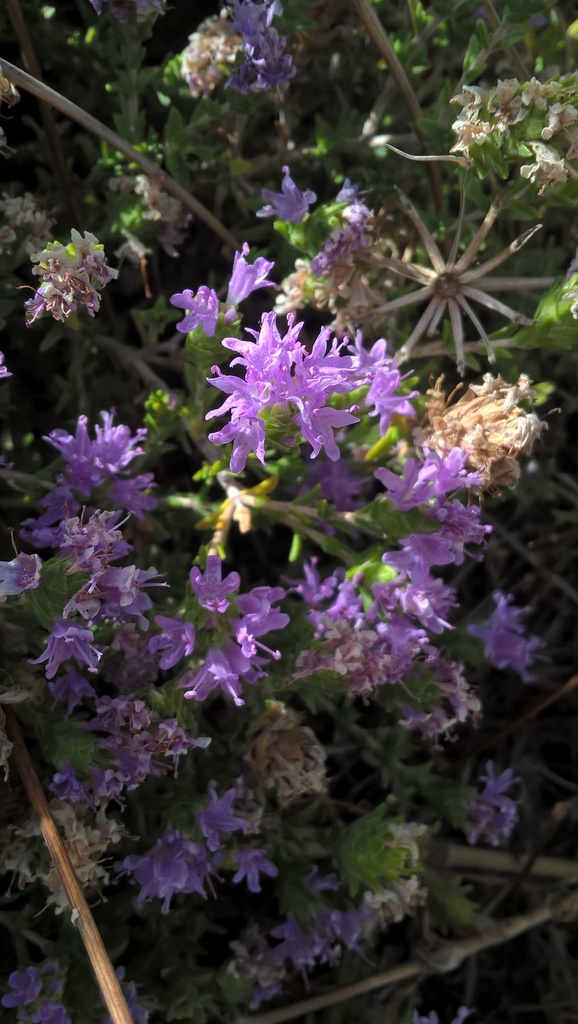
Spanish Oregano
Thymbra capitata
Thymus capitatus is a compact, woody perennial native to Mediterranean Europe and Turkey, more commonly known as conehead thyme, Persian-hyssop and Spanish oregano. It is also known under the name Thymbra capitata.
From the article Thymus capitatus on Wikipedia (CC BY-SA), quoted section by section
Description
The plant has rising stems and narrow, fleshy, oil-gland-dotted green leaves that reach a length of 12 mm (0.47 in). The pink, 10 mm (0.39 in)-long flowers are held in cone-shaped clusters at the ends of their stems in mid to late summer; they are protected by overlapping, 6 mm (0.24 in)-long, red-tinged bracts, edged in tiny hairs. In Eurasia, a species of leafless parasitic dodder (Cuscuta epithymum) would often attach itself to the conehead thyme (Thymus capitatus), taking on the plant's pungency and from whence it also derived its host's Arabic name, al-ṣaʿitrah. Thymus capitatus is hardy from USDA Zones 7–10. In Israel and Malta, the plant Thymus capitatus has protected status, making it a criminal offence to harvest it.
Where it lives
Recorded sightings
—
geo-referenced records in GBIF, from museums, herbaria and field observers.
Drag the globe to turn it. Dots are where records exist, not a range map; darker means more records.
In the stacks
Searching the stacks…
Every page naming Thymbra capitata in the Biodiversity Heritage Library →
This page is assembled live from iNaturalist, GBIF, Wikipedia, the Source Library and the Internet Archive. It is not yet part of the hand-edited codex. iNaturalist taxon 905463.