On eBird ↗
Short-tailed Antthrush
Live sightings near you, the range map, bar charts of when it is seen, and Macaulay Library photos and recordings.
Short-tailed Antthrush
Chamaeza campanisona
The short-tailed antthrush (Chamaeza campanisona) is a South American species of bird in the family Formicariidae. Its distribution is highly disjunct with populations in the Atlantic Forest in eastern Brazil, eastern Paraguay and northeastern Argentina, isolated highland forests in northeastern Brazil, forests on the tepuis in southern Venezuela, Guyana and northern Brazil, and in forests along the east Andean slope from Venezuela to Bolivia.
From the article Short-tailed antthrush on Wikipedia (CC BY-SA), quoted section by section
Description
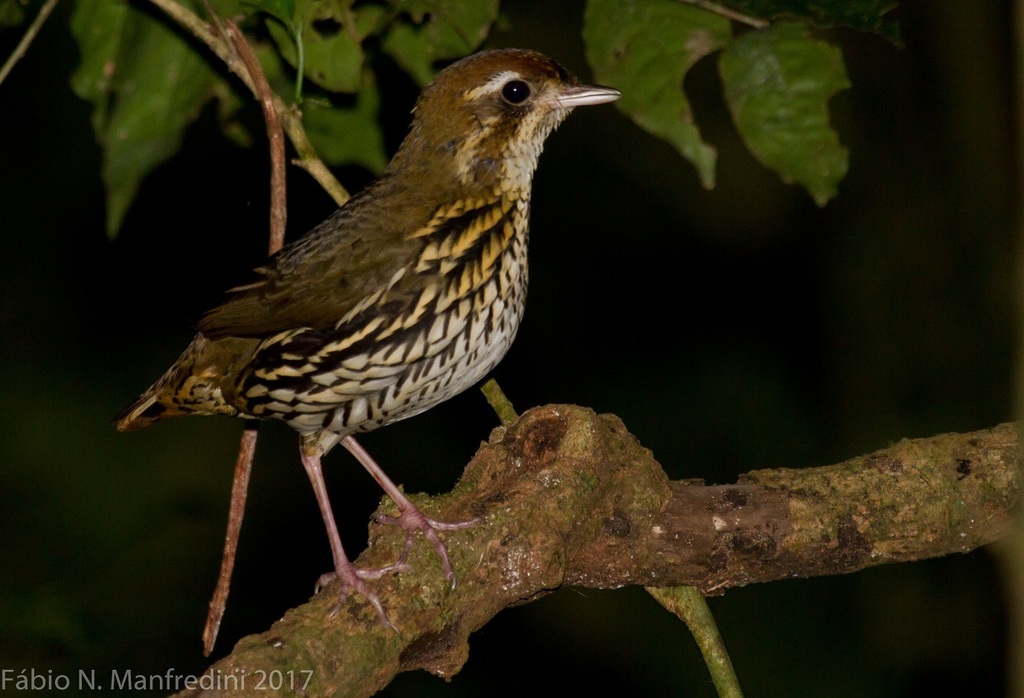
The short-tailed antthrush is 19 to 25 cm (7.5 to 9.8 in) long and weighs 64 to 112 g (2.3 to 4.0 oz). The sexes are alike. Adults of the nominate subspecies have a rufescent brown or brown crown with a black spot on their forecrown. They have white lores and a white streak behind their eye on an otherwise brown face. Their back, wings, and uppertail coverts are olive brown. Their tail is brown with a black band near the end and thin buff or whitish tips on the feathers. Their throat is white. Their underparts are mostly rich buff with wide black streaks on their breast and flanks and some black bars or spots on their crissum. Their iris is dark brown, their bill black with a paler base to the mandible, and their legs and feet brown or brownish gray. The other subspecies of the short-tailed antthrush share the nominate's basic pattern with some color variations. Their crowns can be blacker, their lores and postocular streak can be buffy, their upperparts can be less olive and more reddish brown, their underparts' base color can be whiter, and the amount of underpart streaking can be more or less.
Range & habitat
The short-tailed antthrush has a highly disjunct distribution. The subspecies are found thus:
C. c. columbiana: east slope of Colombia's Eastern Andes C. c. punctigula: from eastern Ecuador's Napo and Pastaza provinces south into northern Peru to the Marañon River C. c. olivacea: east-central Peru from the Department of Junín to the Department of Madre de Dios C. c. huachamacarii: Cerro Huachamacari and perhaps other tepuis in southern Venezuela C. c. berlepschi: from eastern Department of Cuzco in southern Peru east just into western Bolivia's La Paz Department C. c. venezuelana: Venezuelan Coastal Ranges C. c. yavii: Cerro Yavi and perhaps other tepuis in south-central Venezuela C. c. obscura: tepuis in southeastern Venezuela's Bolívar and southern Amazonas states and adjoining Brazilian tepuis C. c. fulvescens: Mt. Roraima in eastern Venezuela and tepuis in western Guyana and central Suriname C. c. boliviana: across central Bolivia from La Paz Department to Santa Cruz Department C. c. campanisona: eastern Brazil separately in Ceará, Alagoas, and from Bahia south to Rio Grande do Sul, eastern Paraguay, and northeastern Argentina The short-tailed antthrush inhabits humid foothill and montane forests and woodlands throughout its several discrete ranges. In eastern Brazil it also occurs in lowland evergreen forest. …
Wikipedia: “Distribution and habitat”
What it does
The short-tailed antthrush's diet and foraging behavior are not known, though it is assumed to eat mostly insects and other arthropods and perhaps also small vertebrates. It is almost entirely terrestrial. It walks slowly and deliberately, pumping its tail and meandering through thick vegetation and along roots and logs. It has been observed following army ants but generally forages apart from them.
Wikipedia: “Feeding”
Listen
Looking for field recordings…
Where it lives
Recorded sightings
—
geo-referenced records in GBIF, from museums, herbaria and field observers.
Drag the globe to turn it. Dots are where records exist, not a range map; darker means more records.
In the stacks
Searching the stacks…
Every page naming Chamaeza campanisona in the Biodiversity Heritage Library →
This page is assembled live from iNaturalist, GBIF, Wikipedia, the Source Library and the Internet Archive. It is not yet part of the hand-edited codex. iNaturalist taxon 9021.