- Plants
- ›Vascular Plants
- ›flowering plants
- ›Dicots
- ›magnolias, nutmegs, and allies
- ›custard-apples
- ›Malmeoideae
- ›Miliuseae
- ›Pseuduvaria
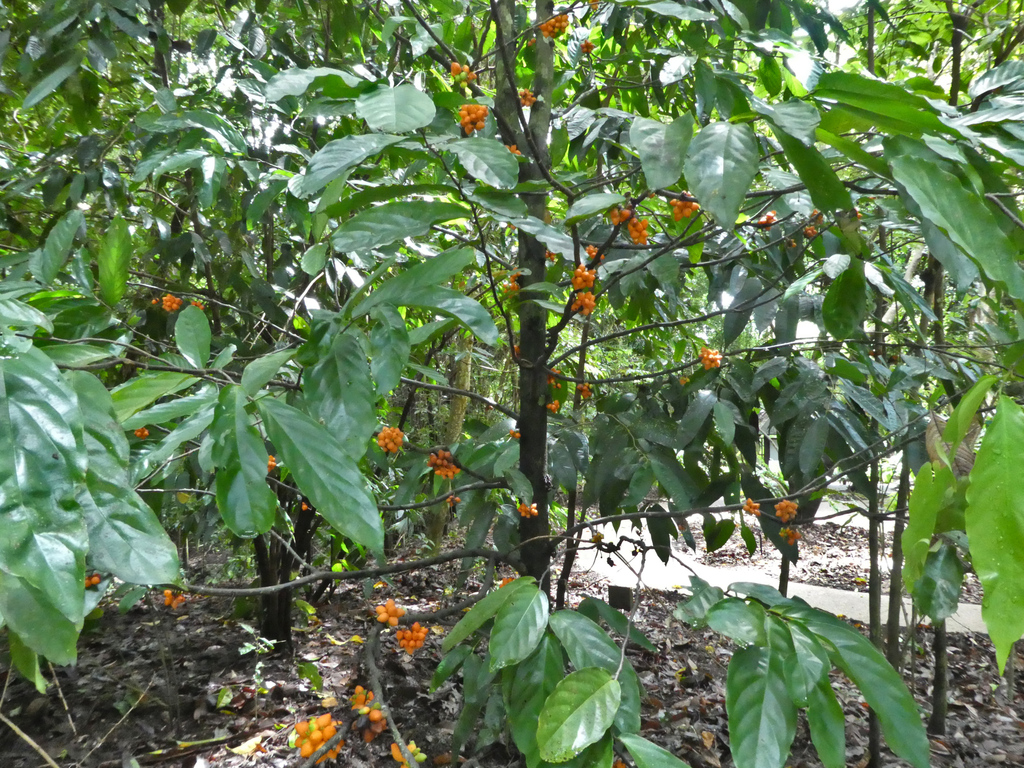
Pseuduvaria froggattii
Pseuduvaria froggattii is a rare species of tree which is restricted to a very small part of northeastern Queensland, Australia. It is a member of the custard apple and soursop family Annonaceae, and was first described in 1887. Despite the small range its status considered to be least concern.
From the article Pseuduvaria froggattii on Wikipedia (CC BY-SA), quoted section by section
Description
Pseuduvaria froggattii is a small rainforest tree reaching 15 m (49 ft) in height and a DBH (trunk diameter) of up to 15 cm (5.9 in). It has elliptic to lanceolate, membranous to papery leaves that measure up to 30 cm (12 in) long by 9 cm (3.5 in) wide. They are obtuse to rounded at the base and acuminate (tapering) at the tip, with the tapering portion 10–26 mm (0.4–1.0 in) long. They are glabrous (hairless) on their upper and lower surfaces and have 7–10 pairs of secondary veins branching from the rachis, or midrib. The hairless petiole is 4–10 mm (0.16–0.39 in) long with a narrow groove on the upper side. This species is dioecious, meaning that pistilate (functionally female) and staminate (functionally male) flowers are borne on separate plants. The inflorescences of both male and female plants are dense clusters produced from the trunk, branches and twigs. The male plants may also produce flowers in the leaf axils, in which case the inflorescence will consist of just one or few flowers. Flowers are held on pedicels that are minutely hairy, measure up to 32 mm (1.3 in) long, and are tapered with the thicker end attached to the flower. The individual flowers are very distinctive, with an appearance somewhat reminiscent of a jingle bell (see gallery). Each flower has six petals arranged in two rows, with the petals of one row alternating with the other. …
Range & habitat
This species is restricted to a small part of Queensland's Wet Tropics, from Melissa Creek near Cape Tribulation in the north, to the area around Black Mountain, southwest of Port Douglas. The total area of occupancy of this species is just 128 km2 (49 sq mi) with 145 observation records. It grows as an understory tree in rainforest on a variety of soil types including loose mixtures, moist substrates, loams and rocky soils in mature rainforests at elevations of 5–60 m (16–197 ft).
Wikipedia: “Distribution and habitat”
What it does
Pseuduvaria froggattii is the host species for the larvae of the green-spotted triangle and pale green triangle butterflies. The fruits are eaten by cassowaries.
Wikipedia: “Ecology”
In human culture
The genus name Pseuduvaria is derived from a combination of the Ancient Greek word pseúdō, meaning "false", and the name of the related genus Uvaria. The species epithet froggattii was given by Mueller to honour Froggatt as one of the collectors of specimens he examined.
Wikipedia: “Etymology”
Where it lives
Recorded sightings
—
geo-referenced records in GBIF, from museums, herbaria and field observers.
Drag the globe to turn it. Dots are where records exist, not a range map; darker means more records.
In the stacks
Searching the stacks…
Every page naming Pseuduvaria froggattii in the Biodiversity Heritage Library →
This page is assembled live from iNaturalist, GBIF, Wikipedia, the Source Library and the Internet Archive. It is not yet part of the hand-edited codex. iNaturalist taxon 901995.