On eBird ↗
Rufous-capped Antthrush
Live sightings near you, the range map, bar charts of when it is seen, and Macaulay Library photos and recordings.
Rufous-capped Antthrush
Formicarius colma
The rufous-capped antthrush (Formicarius colma) is a small species of bird in the family Formicariidae located in the order Passeriformes.
It is considered to be uncommon but widespread, found in Bolivia, Brazil, Colombia, Ecuador, French Guiana, Guyana, Peru, Suriname, and Venezuela.
From the article Rufous-capped antthrush on Wikipedia (CC BY-SA), quoted section by section
Description
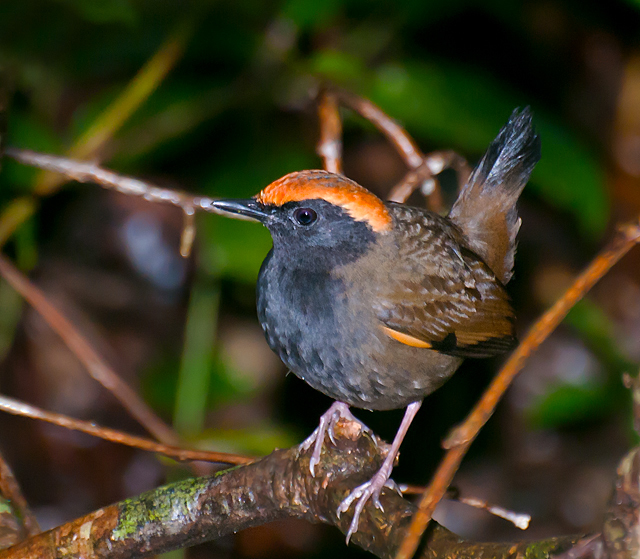
The Formicarius colma is generally a small bird, averaging around 18 cm with males weighing between 38 and 49 grams and females between 41 and 49 grams. Males are marked by a black forehead, rufous-colored (red-brown) crown and nape, with the crown including a variable amount of black feathers. Its back, rump, and wings are olive-brown color with a dusky brown tail and black on the neck, throat, and sides of the head. The upper breast is a dark black that merges into a dark gray on the lower breast while the belly and flanks are a paler gray with (occasionally) a brown wash. Underwing coverts are marked by a mix of black and cinnamon with the inner webs of remiges being dusky with a broad cinnamon bar across the base. Facial features include a brown iris and black bill while the tarsus vary from light gray-brown to a purplish-gray. The female is largely the same as the male, being marked with a white throat rather than the black seen in males. The four subspecies differ slightly from each other; the nigrifrons largely resemble colma but with more black on the head, the amazonicus resemble the nigrifrons but smaller with a deeper rufous head, short tail, and browner upperparts, and the ruficeps having an extensively rufous head. Juvenile rufous-capped antthrushes are marked by a white throat (like the female) and black spotting. …
Range & habitat
The F. colma is found in east Colombia (south of Vaupés), south and east Venezuela, the Guianas, and in Brazil north of the Amazon while the subspecies F. nigrifrons are found east of Ecuador, east of Peru, north of Bolivia (south to La Paz), and south of the Amazon. F. amazonicus is found in Brazil south of the Amazon, from east Madeira to north Maranhão, and south of Ji-Paranã and Mato Grosso. F. ruficeps is found on the coastal east and southeast of Brazil from Pernambuco to Rio Grande do Sul. The rufous-capped antthrush are widespread, predominately preferring the cooler, shady floor of terra firme forests, although they can occasionally be spotted inhabiting traditional forests and savanna forests. While they generally occupy the lowlands to 500m and locally to 1100m, interspecies aggression between the rufous-capped antthrush and F. analis has been observed to induce altitudinal displacement, with F. colma fleeing to higher and drier ravines and ridges while the F. analis occupy the lower lands. Additionally, in Manu, the black-faced antthrush, being both larger and more population-dense, dominate over the rufous-capped antthrush. While the two species frequently overlap due to F. colma's large distribution, the song of the F. …
Wikipedia: “Distribution and habitat”
What it does
The diet of a rufous-capped antthrush consists of ants (Attinae) and grasshoppers (Locustidae and Tettigoniidae). They hunt by walking slowly and tactfully on the forest floor, picking prey off of leaf litter before flicking it away with their beaks. They usually hunt alone but have been observed hunting near each other in small groups. They are frequently seen alone or in small groups on the periphery of ant swarms. Additionally, Formicarius have also been known to occasionally eat snakes.
Wikipedia: “Food and feeding”
Listen
Looking for field recordings…
Where it lives
Recorded sightings
—
geo-referenced records in GBIF, from museums, herbaria and field observers.
Drag the globe to turn it. Dots are where records exist, not a range map; darker means more records.
In the stacks
Searching the stacks…
Every page naming Formicarius colma in the Biodiversity Heritage Library →
This page is assembled live from iNaturalist, GBIF, Wikipedia, the Source Library and the Internet Archive. It is not yet part of the hand-edited codex. iNaturalist taxon 9014.