- Plants
- ›Vascular Plants
- ›flowering plants
- ›Dicots
- ›Roses, Elms, Figs, and Allies
- ›rose family
- ›Amygdaloideae
- ›Maleae
- ›Aria
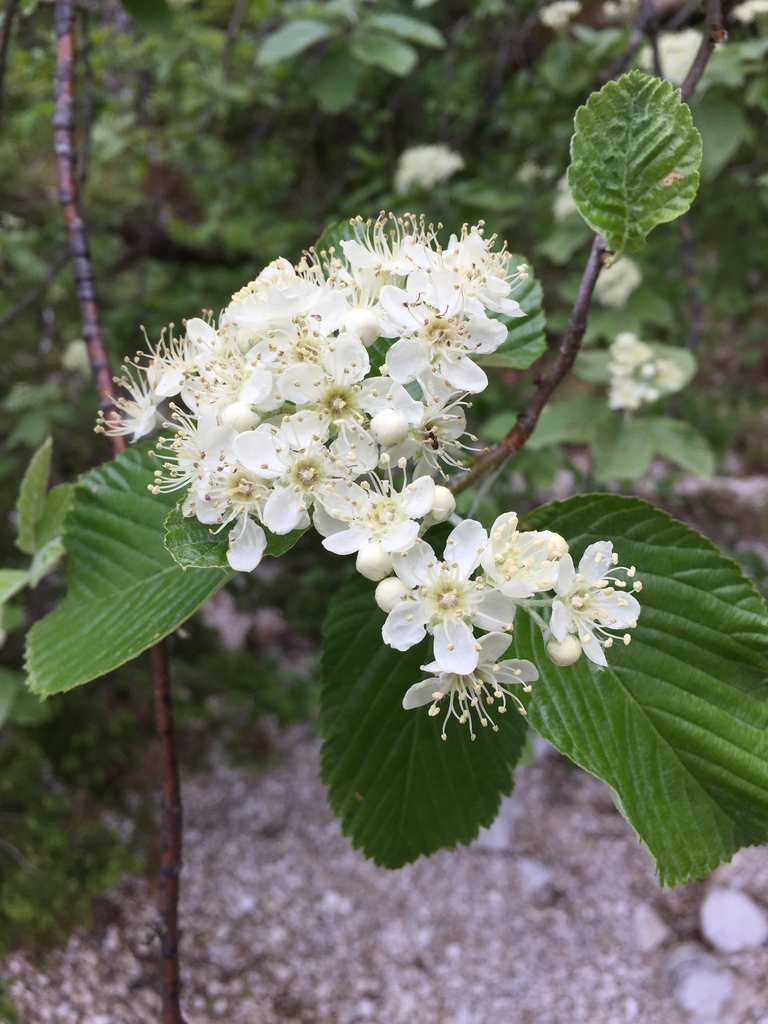
Whitebeam
Aria edulis
Aria edulis, the whitebeam or common whitebeam, is a species of deciduous tree in the family Rosaceae. It is native to most of Europe as well as North Africa (Algeria, Morocco, Tunisia) and temperate Asia (Eastern Turkey, Armenia, Georgia). Typically compact and domed, with few upswept branches and almost-white underside of the leaves, it generally favours dry limestone and chalk soils. The hermaphrodite cream-white flowers appear in May, are insect pollinated, and go on to produce...
From the article Aria edulis on Wikipedia (CC BY-SA), quoted section by section
Description
The tree often forms new shoots around the trunk. Typically compact and domed, the plant has a few upswept branches and the leaves have an almost-white underside. The hermaphrodite cream-white flowers appear in May, are insect pollinated, and go on to produce scarlet berries, which are often eaten by birds.
Range & habitat
It is native to most of Europe as well as North Africa (Algeria, Morocco, Tunisia) and temperate Asia (Eastern Turkey, Armenia, Georgia). It generally favours dry limestone and chalk soils.
Wikipedia: “Distribution and habitat”
At the table
The berries are edible when overripe (bletted). The cultivars A. edulis 'Lutescens', with very whitish-green early leaves, and A. edulis 'Majestica', with large leaves, have both gained the Royal Horticultural Society's Award of Garden Merit.
== References ==
Wikipedia: “Uses”
Where it lives
Recorded sightings
—
geo-referenced records in GBIF, from museums, herbaria and field observers.
Drag the globe to turn it. Dots are where records exist, not a range map; darker means more records.
In the old herbals & bestiaries

In the stacks
Searching the stacks…
Every page naming Aria edulis in the Biodiversity Heritage Library →
This page is assembled live from iNaturalist, GBIF, Wikipedia, the Source Library and the Internet Archive. It is not yet part of the hand-edited codex. iNaturalist taxon 900799.