- Animals
- ›Arthropods
- ›Hexapods
- ›Insects
- ›Winged and Once-winged Insects
- ›Ants, Bees, Wasps, and Sawflies
- ›Narrow-waisted Wasps, Ants, and Bees
- ›Ants, Bees, and Stinging Wasps
- ›Scoliid Wasp Superfamily
- ›Scoliid Wasps
- ›Campsomerini
- ›Dielis
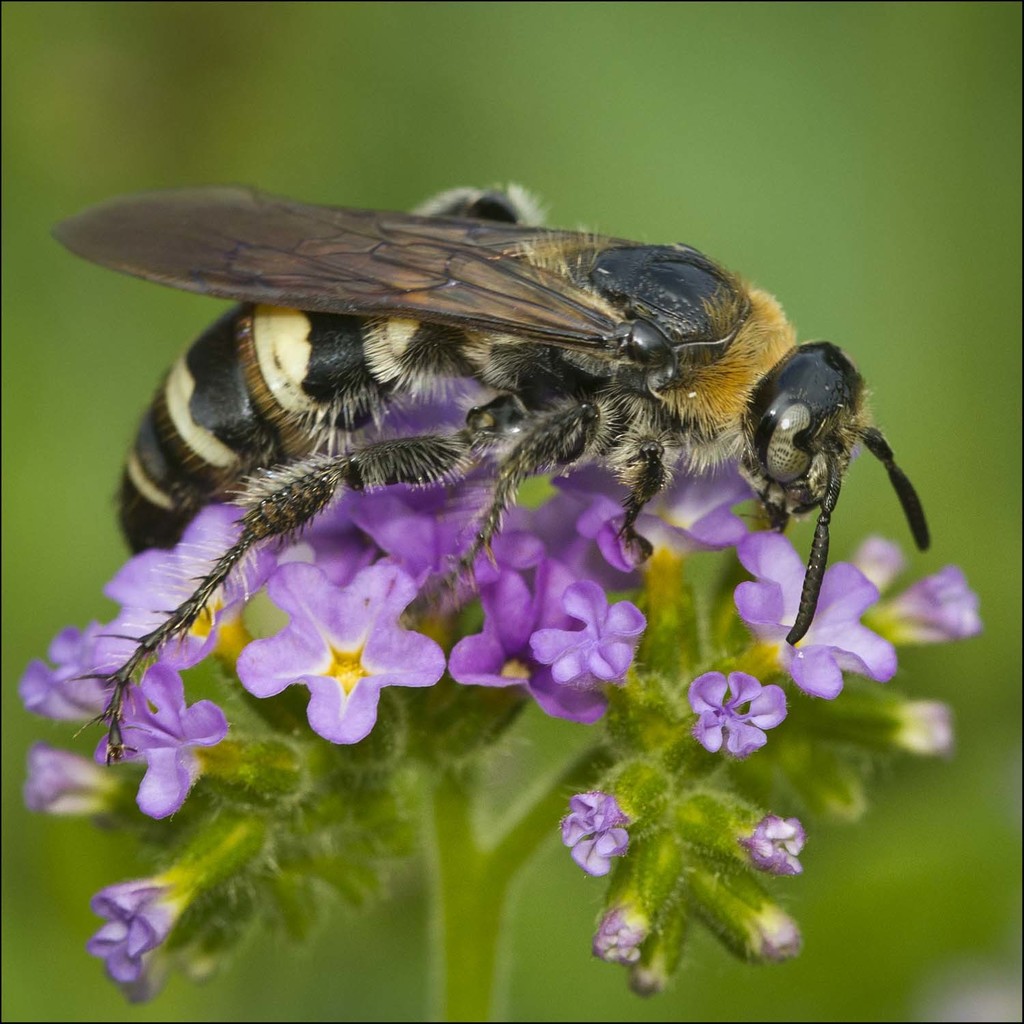
Feather-legged Scoliid Wasp
Dielis plumipes
Dielis plumipes, the feather-legged scoliid wasp, is a species of scoliid wasp in the family Scoliidae.
From the article Dielis plumipes on Wikipedia (CC BY-SA), quoted section by section
Description
Females of D. plumipes have a black scutellum and yellow bands on the first three or four tergites. The setae along the pronotal collar are usually orangish. Males, as in most species of the genus, have yellow bands on the first four tergites and primarily whitish setae on the body. They have the pronotum entirely black, or nearly so, and are distinguished chromatically from allied species by the entirely black clypeus and by the entirely black mid and hind legs.
Wikipedia: “Description and identification”
Range & habitat
D. plumipes occurs in the eastern and central United States. The largest populations are the central subspecies, D. p. confluenta, and the southeastern subspecies, D. p. fossulana. A third subspecies, the nominate D. p. plumipes, occurs in a small pocket along the eastern coast within the Carolinian life zone.
Wikipedia: “Distribution”
Listen
Looking for field recordings…
Where it lives
Recorded sightings
—
geo-referenced records in GBIF, from museums, herbaria and field observers.
Drag the globe to turn it. Dots are where records exist, not a range map; darker means more records.
In the stacks
Searching the stacks…
Every page naming Dielis plumipes in the Biodiversity Heritage Library →
This page is assembled live from iNaturalist, GBIF, Wikipedia, the Source Library and the Internet Archive. It is not yet part of the hand-edited codex. iNaturalist taxon 893823.