- Plants
- ›Vascular Plants
- ›flowering plants
- ›Dicots
- ›proteas, lotuses, planes, and allies
- ›Protea family
- ›Primitive Proteas
- ›Persoonieae
- ›Persoonia
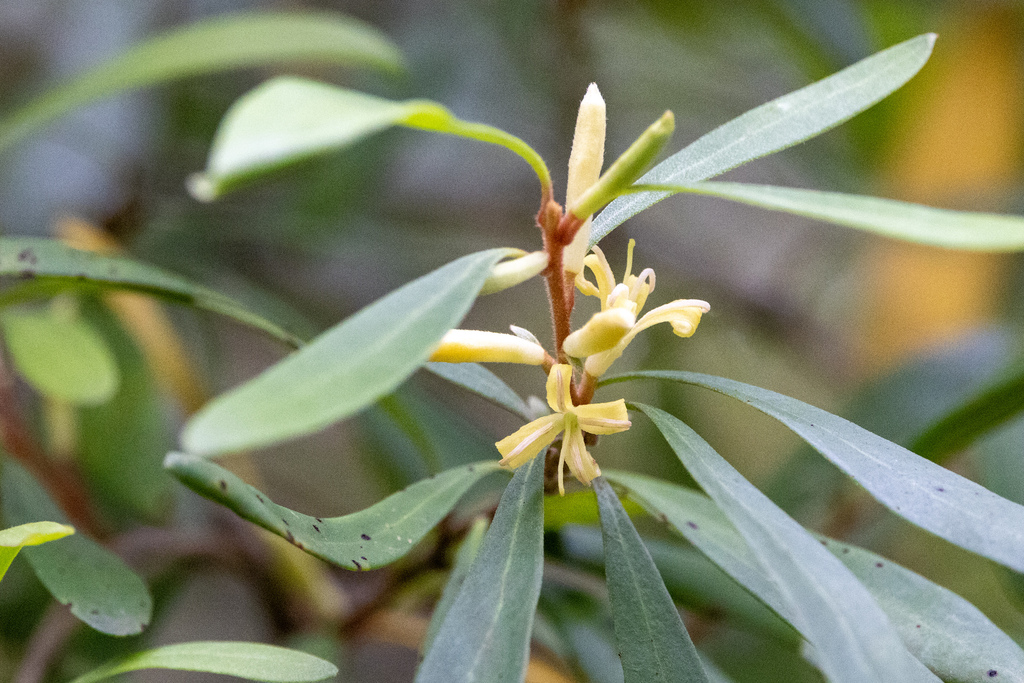
Persoonia arborea
Persoonia arborea, commonly known as tree geebung, is a species of large shrub or small tree that is endemic to Victoria, Australia.
From the article Persoonia arborea on Wikipedia (CC BY-SA), quoted section by section
Description
Persoonia arborea is a large shrub or small tree that typically grows to a height of 3–14 m (9.8–45.9 ft), its young branchlets densely covered with greyish to rust-coloured hairs. The leaves are narrow spatula-shaped to lance-shaped with the narrower end towards the base, 40–100 mm (1.6–3.9 in) long and 6–21 mm (0.24–0.83 in) wide. The flowers are arranged singly in the axils of leaves on a pedicel up to 5 mm (0.20 in) long, the tepals 16–20 mm (0.63–0.79 in) long, hairy on the outside with a spine 1–2 mm (0.039–0.079 in) long on the end and white anthers. Flowering occurs from December to March and the fruit is a yellowish green, oval drupe up to about 14 mm (0.55 in) long and 12 mm (0.47 in) wide.
Range & habitat
Tree geebung occurs in high rainfall mountain ash forest to the north-east of Melbourne at altitudes of 450–1,200 m (1,480–3,940 ft). It is listed as "vulnerable" on the Department of Sustainability and Environment's Advisory List of Rare Or Threatened Plants In Victoria. However, within its limited range it is relatively common, and is able to colonise disturbed areas. About 40% of its habitat lies within the Yarra Ranges National Park, while the remaining 60% occurs on public land utilised for logging.
== References ==
Wikipedia: “Distribution and habitat”
Where it lives
Recorded sightings
—
geo-referenced records in GBIF, from museums, herbaria and field observers.
Drag the globe to turn it. Dots are where records exist, not a range map; darker means more records.
In the stacks
Searching the stacks…
Every page naming Persoonia arborea in the Biodiversity Heritage Library →
This page is assembled live from iNaturalist, GBIF, Wikipedia, the Source Library and the Internet Archive. It is not yet part of the hand-edited codex. iNaturalist taxon 893095.