On eBird ↗
White-naped Xenopsaris
Live sightings near you, the range map, bar charts of when it is seen, and Macaulay Library photos and recordings.
White-naped Xenopsaris
Xenopsaris albinucha
The white-naped xenopsaris (; Xenopsaris albinucha), also known as the reed becard and white-naped becard, is a species of suboscine bird in the family Tityridae, the only member of the genus Xenopsaris. It is found in South America, in humid subtropical and tropical savanna climates in most of the countries east of the Andes: Venezuela, Brazil, Bolivia, Paraguay, Uruguay, and Argentina. Living in open woodland and other open forest habitats, it is mostly sedentary, though some populations may be migratory. The species, which is closely related to becards and tityras, was thought to be either a tyrant-flycatcher or cotinga, before it was placed in Tityridae.
The bird is 12.5 to 13 cm (4.9–5.1 in) in length, with whitish undersides, a black crown, and grey-brown upperparts. The sexes are similar in appearance, though the females have duller upperparts. It feeds on insects in the foliage of trees and bushes, and sometimes on the ground. Nesting occurs in a simple cup nest placed in the fork of a tree. Both parents incubate the eggs and help feed the chicks. When the chicks fledge, the parents may divide up the brood to continue helping. The species is not common and little is known about it, but it is not considered in danger of extinction, and has been classified as of least concern by the International Union for Conservation of Nature.
From the article White-naped xenopsaris on Wikipedia (CC BY-SA), quoted section by section
Description
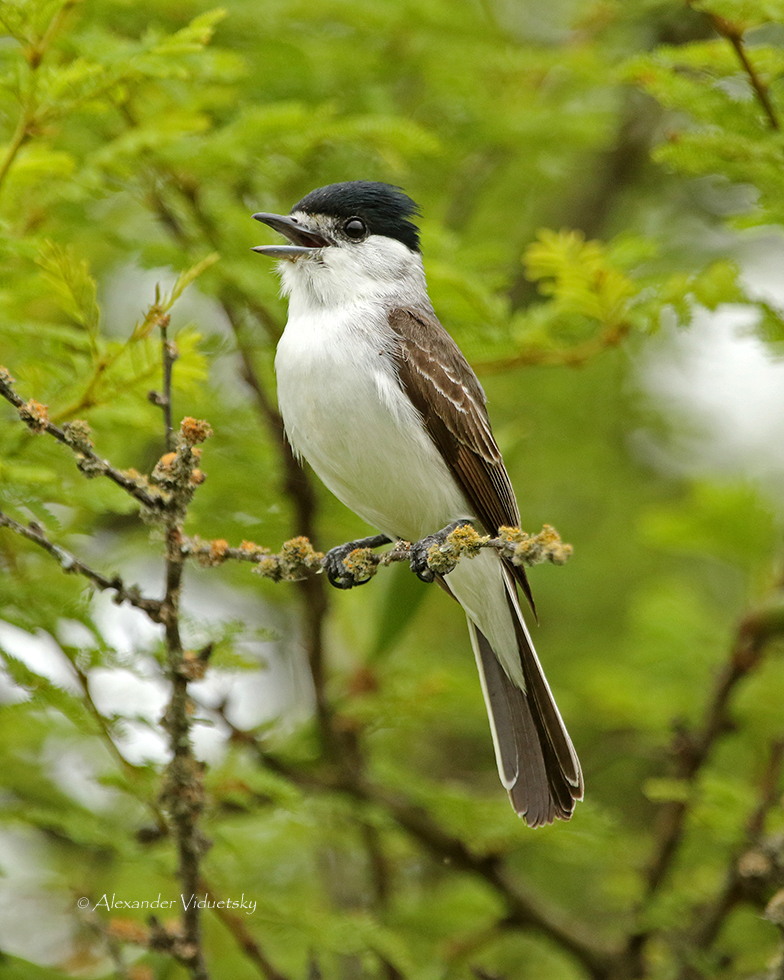
The white-naped xenopsaris is smaller than the closely related becards and tityras, measuring 12.5 to 13 cm (4.9–5.1 in) in length and weighing around 10 g (0.35 oz). The subspecies X. a. minor has the same plumage as the nominate subspecies, but is smaller; the wing-chord (measurement from the wrist-joint to the end of the wing) length of the nominate subspecies, for example, is 6.4 to 6.6 cm (2.5–2.6 in) compared to 6.0 to 6.2 cm (2.4–2.4 in) in X. a. minor. The face, lores, throat, breast, belly and rump of this species are white; the undersides are tinged with grey on the chest and yellow on the belly. The crown is glossy black in males. The nape is pale grey with a grey-white to white band separating the crown from the back. The wings are dusky greyish brown with white edging on the inner remiges and wing-coverts. The tail is dusky brown, and the stout bill, iris and legs are black. The female is similar to the male, but is duller overall and has a chestnut-tinged crown. Juvenile birds resemble adults but have greyish napes and more chestnut in the crown, and the feathers of the back, rump and primaries are scalloped with ochre. The secondaries on the wing and the tail feathers are edged with white.
The song of this species is delicate, and does not carry far. It is most commonly heard during the rainy season, but can be heard at any time of the day. …
Range & habitat
The white-naped xenopsaris has a disjunct distribution. The southern population of the nominate subspecies is widespread from north-eastern Brazil through to Bolivia, Paraguay and northern Argentina and Uruguay. A separate population of the nominate is found in Guyana. The subspecies X. a. minor is found in west and central Venezuela, and probably extends into north-eastern Colombia. The species is generally resident across its range, but sightings of solitary and silent birds have suggested that the species may be migratory in Bolivia and Brazil. A study published in 2005 suggested it was migratory in Santa Fe, Argentina, as the species was not observed in the area between March and September (the austral winter). In 2006 the species was reported for the first time in Peru, but it was unclear if this represented a vagrant escaping cold weather or a migrant, as the species is mostly uncommon across its range and that area is poorly studied ornithologically. They occupy a variety of habitats across their range, including Caatinga scrubland, riparian (river) woodland, lightly wooded areas, the borders of open gallery forest and open areas with scattered trees. They usually live near water or damp areas, and range from sea-level to 550 m (1,800 ft).
Wikipedia: “Distribution and habitat”
What it does
The white-naped xenopsaris feeds on insects, but no studies have yet been done on the diet of adults. Chicks in the nest are fed grasshoppers from the family Acrididae, mantidflies, praying mantises and mosquitoes. Adults typically hunt singly or sometimes in pairs, and breeding pairs can often be observed hunting well apart from each other. They are shy, generally quiet and inconspicuous. They typically hunt from a perch on the outer edge of the foliage of trees, watching for prey and then launching themselves 0.5 to 1.5 m (1.6–4.9 ft) to snatch prey off leaves. They also strike from a hovering position above foliage, and may chase prey acrobatically for some distance. They often feed near the ground and sometimes take prey from the ground as well as from vegetation.
Wikipedia: “Diet and feeding”
Listen
Looking for field recordings…
Where it lives
Recorded sightings
—
geo-referenced records in GBIF, from museums, herbaria and field observers.
Drag the globe to turn it. Dots are where records exist, not a range map; darker means more records.
In the stacks
Searching the stacks…
Every page naming Xenopsaris albinucha in the Biodiversity Heritage Library →
This page is assembled live from iNaturalist, GBIF, Wikipedia, the Source Library and the Internet Archive. It is not yet part of the hand-edited codex. iNaturalist taxon 8927.