On eBird ↗
Pompadour Cotinga
Live sightings near you, the range map, bar charts of when it is seen, and Macaulay Library photos and recordings.
Pompadour Cotinga
Xipholena punicea
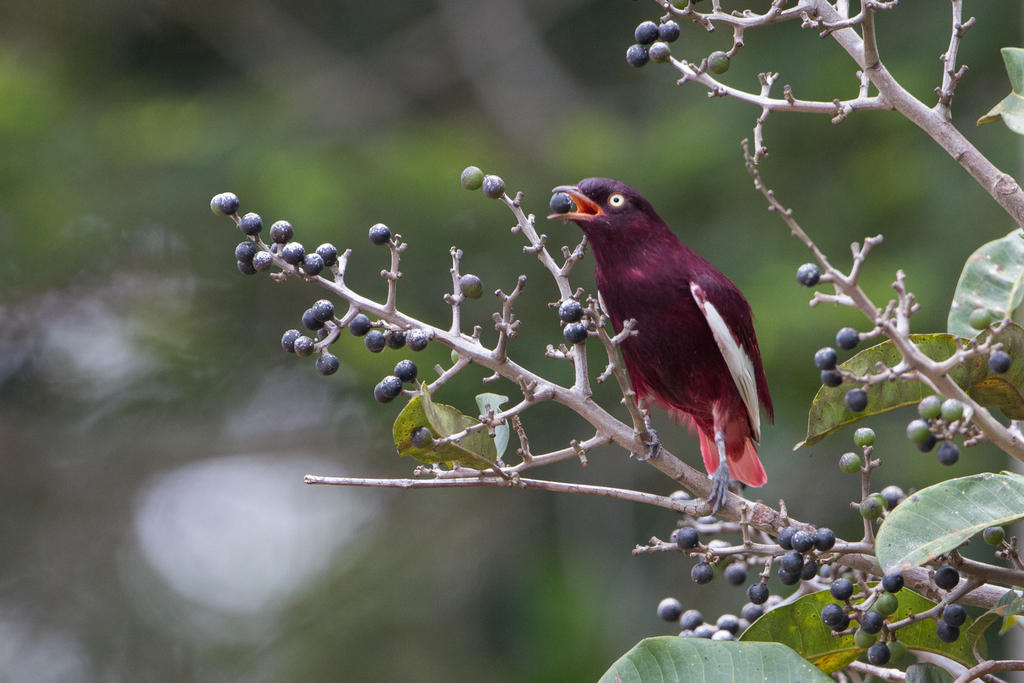
The pompadour cotinga (Xipholena punicea) is a species of bird in the family Cotingidae. This species lives in the Amazonian rainforest and has a range that extends across the Amazon Basin and includes Brazil, Peru, Colombia, Venezuela, and the Guianas. The pompadour cotinga is primarily a frugivore but has been known to consume insects on occasion. This species of cotinga is distinct in that the males have a burgundy head and body, bright white wings, and yellow eyes. Like other members of the Cotingidae, this species is sexually dimorphic and the females have a pale grey head and body. Although there are not many documented observations of the nesting behavior of these birds, the males are known to perform elaborate mating displays for the females who then raise the young alone.
Due to its arboreal habitat and generally remote distribution, behavior observations are rare. Pompadour cotinga coloration has been studied extensively, but little is known about the natural history of its behavior and existence in its habitat. Despite threats to Amazonian habitat in recent years, the pompadour cotinga remains a species of least concern.
From the article Pompadour cotinga on Wikipedia (CC BY-SA), quoted section by section
Description
Individuals of Xipholena punicea are sexually dimorphic, with males displaying bright, complex colorization and females appearing more pale and grey. Males of this species have yellow eyes, stark white primary coverts with black wing tips, and a glossy, wine-red head and body. The distinguished burgundy color of the male individuals was previously thought to be a combination of "blue structural color and red carotenoid," but recent experimentation has shown that this species of Cotingidae does not utilize structural coloration. This distinct colorization consists of pigments from eight different carotenoids, six of which are unique to the Xipholena punicea species itself. These six pigments were found to be "ring-substituted, methoxy carotenoids" and were likely formed through chemical reactions of other dietary carotenoids. These species-specific carotenoids are significant in the study of Xipholena punicea because other species of birds are not known to use the same pathways for carotenoid construction that are used by the pompadour cotinga. Additionally, the complexity of the creation of these pigments allows for an added diversity in the carotenoid products themselves and further distinguishes X. punicea from other members of the genus. Both male and female pompadour cotinga have a "short beak and wide gape". …
Range & habitat
Members of the X. punicea occupy the canopy layer of rainforests across South America, including regions in Brazil, Colombia, Venezuela, and the Guianas. In the Northern Peruvian Amazon, they live in the varillal (white sand forest) regions and forage in groups in the Caraipa tereticaulis trees along the Nanay River. Pompadour cotingas generally live in areas of thick vegetation and white, sandy soil which has been darkened and acidified by the decomposition of vegetative material. There have also been rare sightings of possible vagrants in Bolivia and eastern Ecuador outside of their established range.
Wikipedia: “Distribution and habitat”
What it does
The pompadour cotinga is primarily a frugivore, but it consumes insects opportunistically. Members of the species forage in small groupings, and use frequent vocalizations of a "PURP!" noise to communicate with one another. Captive pompadour cotingas have been observed occasionally consuming larger prey. One particular species account described a male pompadour cotinga grabbing an anole and hitting it on a perch before beginning to eat it. Pompadour cotingas may supplement their frugivorous diet with meat during the breeding season when there is increased energy expenditure and young birds to feed.
Wikipedia: “Diet”
Listen
Looking for field recordings…
Where it lives
Recorded sightings
—
geo-referenced records in GBIF, from museums, herbaria and field observers.
Drag the globe to turn it. Dots are where records exist, not a range map; darker means more records.
In the stacks
Searching the stacks…
Every page naming Xipholena punicea in the Biodiversity Heritage Library →
This page is assembled live from iNaturalist, GBIF, Wikipedia, the Source Library and the Internet Archive. It is not yet part of the hand-edited codex. iNaturalist taxon 8905.