On eBird ↗
Bare-necked Umbrellabird
Live sightings near you, the range map, bar charts of when it is seen, and Macaulay Library photos and recordings.
Bare-necked Umbrellabird
Cephalopterus glabricollis
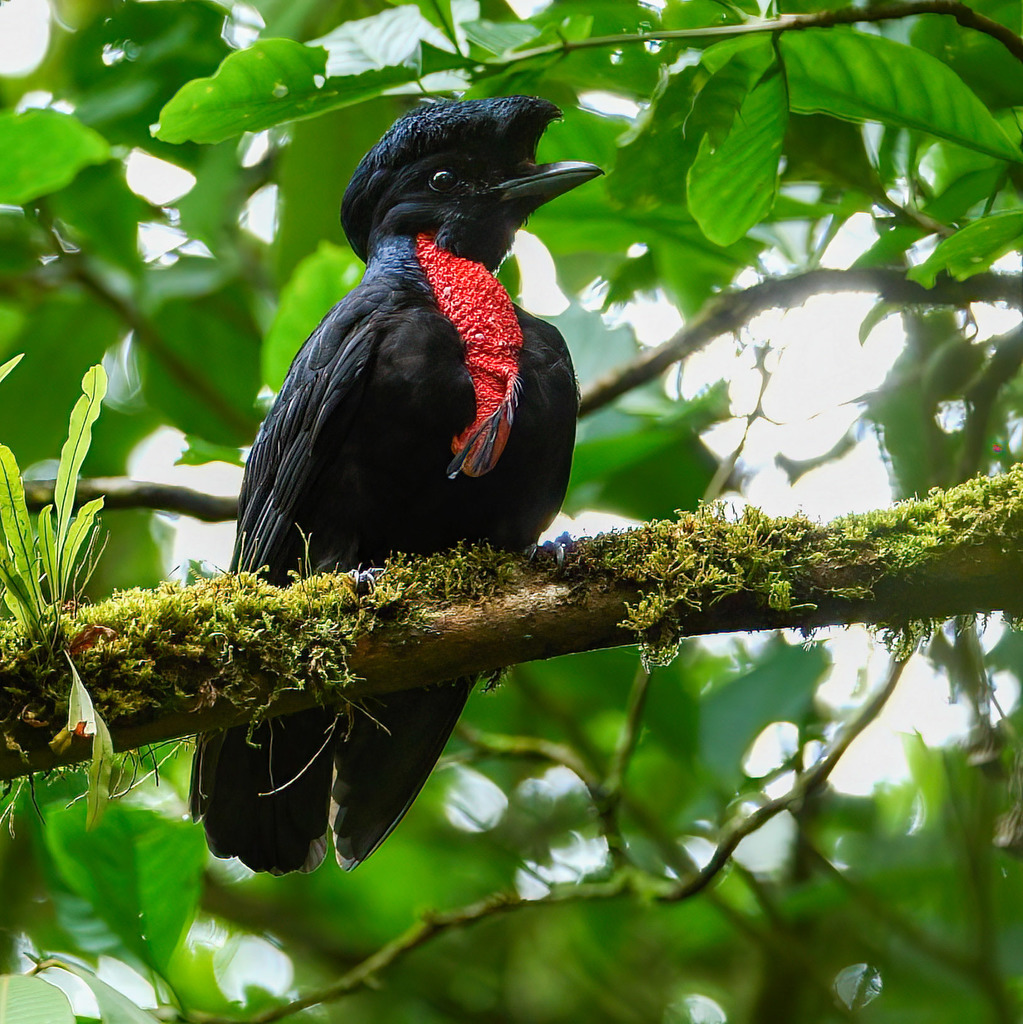
The bare-necked umbrellabird (Cephalopterus glabricollis) is a species of bird in the family Cotingidae. It is found in the Talamancan montane forests of Costa Rica and Panama. Bare-necked umbrellabirds live only in forests and their diet consists mainly of fruits.
Its natural habitats are subtropical or tropical moist lowland forest and subtropical or tropical moist montane forest. It is threatened by habitat loss.
From the article Bare-necked umbrellabird on Wikipedia (CC BY-SA), quoted section by section
Description
The bare-necked umbrellabird is a large, bulky, and crow-like bird, being the largest passerine in its range. It is also among the largest of the cotingas, with only the Amazonian umbrellabird being larger. The males are larger than the females, being 41 cm (16 in) in length and weighing 450 g (16 oz), compared to the females' 36 cm (14 in) and 320 g (11 oz).
Range & habitat
The bare-necked umbrellabird is found in Panama, Costa Rica, and southern Nicaragua. It inhabits the subcanopy to upper understory of primary forest throughout its range, although some birds have been seen foraging in secondary forest. It can also be found in areas with dense understory and near fruiting trees. The species follows an annual altitudinal migration based on fruit availability, with most of the year being spent in lowlands between elevations of 100–500 m (330–1,640 ft) for males and at 200 m (660 ft) for females. During the breeding season between March–June, umbrellabird populations move higher up to elevations of 1,000–1,500 m (3,300–4,900 ft), coinciding with the highest fruit availability in these areas.
Wikipedia: “Distribution and habitat”
What it does
The bare-necked umbrellabird is mainly frugivorous, feeding on Marcgraviaceae, Urticaceae, Arecaceae, Lauraceae and Annonaceae berries, along with other fruits. It has also been known to feed on lizards, frogs, insects and larvae. Fruits are plucked from vegetation in flight or gleaned with heavy hops. A juvenile was also observed eating arthropods that were flushed out by a swarm of army ants in Costa Rica.
Wikipedia: “Diet”
Listen
Looking for field recordings…
Where it lives
Recorded sightings
—
geo-referenced records in GBIF, from museums, herbaria and field observers.
Drag the globe to turn it. Dots are where records exist, not a range map; darker means more records.
In the stacks
Searching the stacks…
Every page naming Cephalopterus glabricollis in the Biodiversity Heritage Library →
This page is assembled live from iNaturalist, GBIF, Wikipedia, the Source Library and the Internet Archive. It is not yet part of the hand-edited codex. iNaturalist taxon 8810.