On eBird ↗
Dusky Piha
Live sightings near you, the range map, bar charts of when it is seen, and Macaulay Library photos and recordings.
Dusky Piha
Lipaugus fuscocinereus
The dusky piha (Lipaugus fuscocinereus) is a species of bird in the family Cotingidae, the cotingas. It is found in Colombia, Ecuador, and Peru.
From the article Dusky piha on Wikipedia (CC BY-SA), quoted section by section
Description
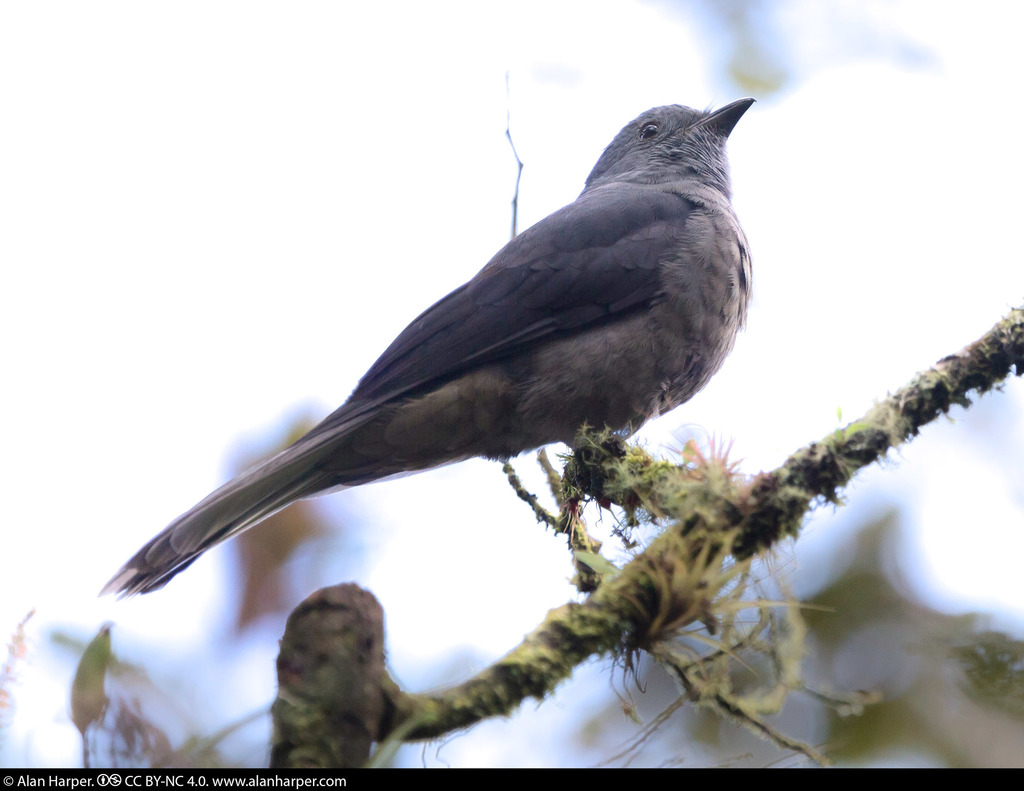
The dusky piha is the largest member and has the longest tail of genus Lipaugus. They are 31 to 33 cm (12 to 13 in) long and weigh 120 to 138 g (4.2 to 4.9 oz). The sexes have the same plumage. Adults have medium gray upperparts and duskier gray wings and tail. Their underparts are paler gray with a brownish wash on the breast and belly. They have a dark brown iris, a dark brown or blackish bill with a paler base to the mandible, and gray legs and feet. Immatures have rufous tips on the wing coverts.
Range & habitat
The dusky piha is a bird of the Andes. It is found along all three ranges of the Colombian Andes and south along the eastern slope through Ecuador slightly into far northern Peru north of the Marañón River valley. It inhabits the canopy and edges of montane forest and mature secondary forest in the subtropical and temperate zones. In elevation it ranges between 1,800 and 3,100 m (5,900 and 10,200 ft) in Colombia, between 1,700 and 2,600 m (5,600 and 8,500 ft) in Ecuador, and between 2,125 and 2,250 m (7,000 and 7,400 ft) in Peru.
Wikipedia: “Distribution and habitat”
What it does
The dusky piha is known to feed on fruit and probably eats insects as well. It usually forages in small groups that regularly join mixed-species feeding flocks. It plucks fruit with a brief sally from a perch.
Wikipedia: “Feeding”
Listen
Looking for field recordings…
Where it lives
Recorded sightings
—
geo-referenced records in GBIF, from museums, herbaria and field observers.
Drag the globe to turn it. Dots are where records exist, not a range map; darker means more records.
In the stacks
Searching the stacks…
Every page naming Lipaugus fuscocinereus in the Biodiversity Heritage Library →
This page is assembled live from iNaturalist, GBIF, Wikipedia, the Source Library and the Internet Archive. It is not yet part of the hand-edited codex. iNaturalist taxon 8753.