- Plants
- ›Vascular Plants
- ›flowering plants
- ›Dicots
- ›Roses, Elms, Figs, and Allies
- ›rose family
- ›brambles, roses, strawberries, and allies
- ›Brambles
- ›Rubus
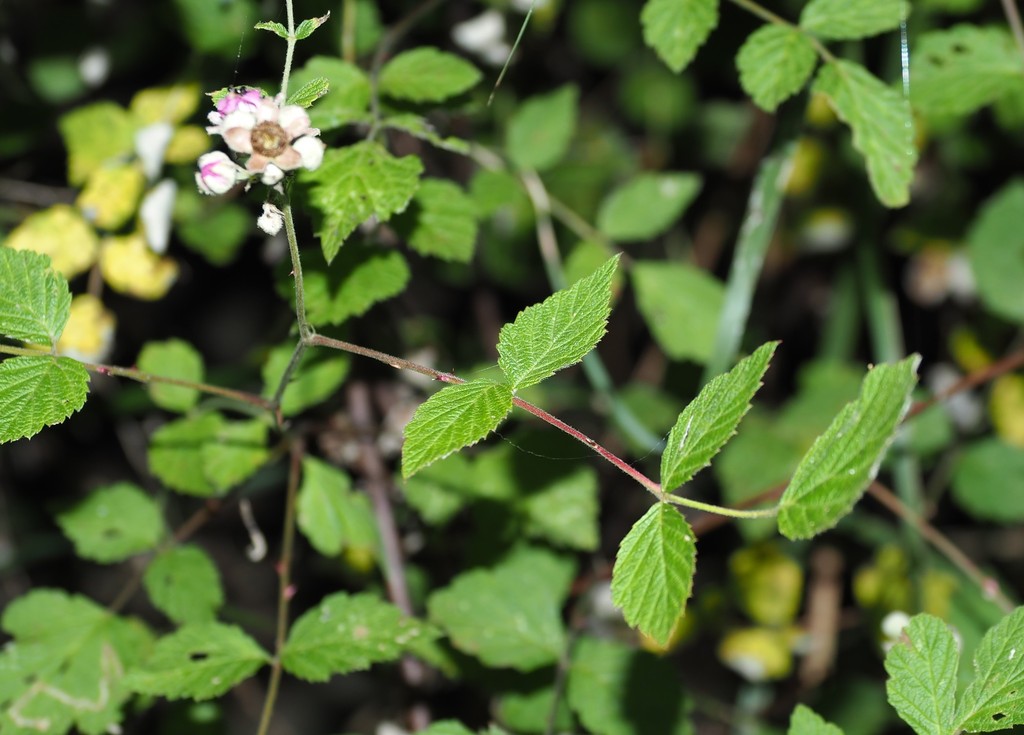
Rubus incanus
Rubus niveus (Mysore raspberry, Ceylon raspberry, hill raspberry; Chinese: 红泡刺藤, Hindi: काला हिसालू, translit. kala hinsalu) is a species of Rubus native to southern Asia, from Afghanistan east through India and China to Taiwan and the Philippines, south to Sri Lanka and Malaysia, and north to Gansu in China.
From the article Rubus niveus on Wikipedia (CC BY-SA), quoted section by section
Description
Rubus niveus is a shrub growing to 1–2.5 metres (3+1⁄2–8 ft) tall, the stems whitish, tomentose (densely covered with short, matted hairs) at first, later becoming glabrous green to purple. The leaves are pinnate with 5–11 leaflets (mostly 7 or 9) that are 2.5–8 centimetres (1–3+1⁄8 in) long and 1–4 cm (3⁄8–1+5⁄8 in) wide. The leaflets are dark green above and densely pale grey to white tomentose beneath. The flowers are about 1 cm in diameter, with five dark pink to red petals. The fruit is 8–12 cm (3+1⁄4–4+3⁄4 in) in diameter, densely grey tomentose, and dark red at first, ripening black.
Range & habitat
It is native to southern Asia; from Afghanistan, east through India—covering the Himalayas, Assam, Nepal, Pakistan, and Sri Lanka—and across to Tibet, southern and north-central China and Taiwan, and south to Indo-China (Laos, Myanmar, Thailand and Vietnam) and Malesia (in Java and). In the Philippines, several entrepreneurs have been found selling seedlings ang growing them in the cities and municipaities of Tuba, Baguio, and La Trinidad in the province of Benguet It has been introduced into various countries and regions including; south America (in Bolivia, southern Brazil, Ecuador, El Salvador, Guatemala, Nicaragua, Trinidad and Tobago), United States (in the states of Florida and Hawaii), Africa (Ethiopia, Galápagos, Kenya, Malawi, Tanzania, Zambia and Zimbabwe) and South Africa (in the Cape Provinces, the Northern Provinces and Swaziland). It has become naturalised and invasive in Hawaii and the Galápagos Islands. It grows in temperate regions.
Wikipedia: “Distribution and habitat”
At the table
Rubus niveus is cultivated for its edible fruit, which potentially have gastroprotective, antioxidative, and nutraceutical properties.
Wikipedia: “Uses”
Where it lives
Recorded sightings
—
geo-referenced records in GBIF, from museums, herbaria and field observers.
Drag the globe to turn it. Dots are where records exist, not a range map; darker means more records.
In the stacks
Searching the stacks…
Every page naming Rubus incanus in the Biodiversity Heritage Library →
This page is assembled live from iNaturalist, GBIF, Wikipedia, the Source Library and the Internet Archive. It is not yet part of the hand-edited codex. iNaturalist taxon 874868.