On eBird ↗
Olivaceous Piha
Live sightings near you, the range map, bar charts of when it is seen, and Macaulay Library photos and recordings.
Olivaceous Piha
Snowornis cryptolophus
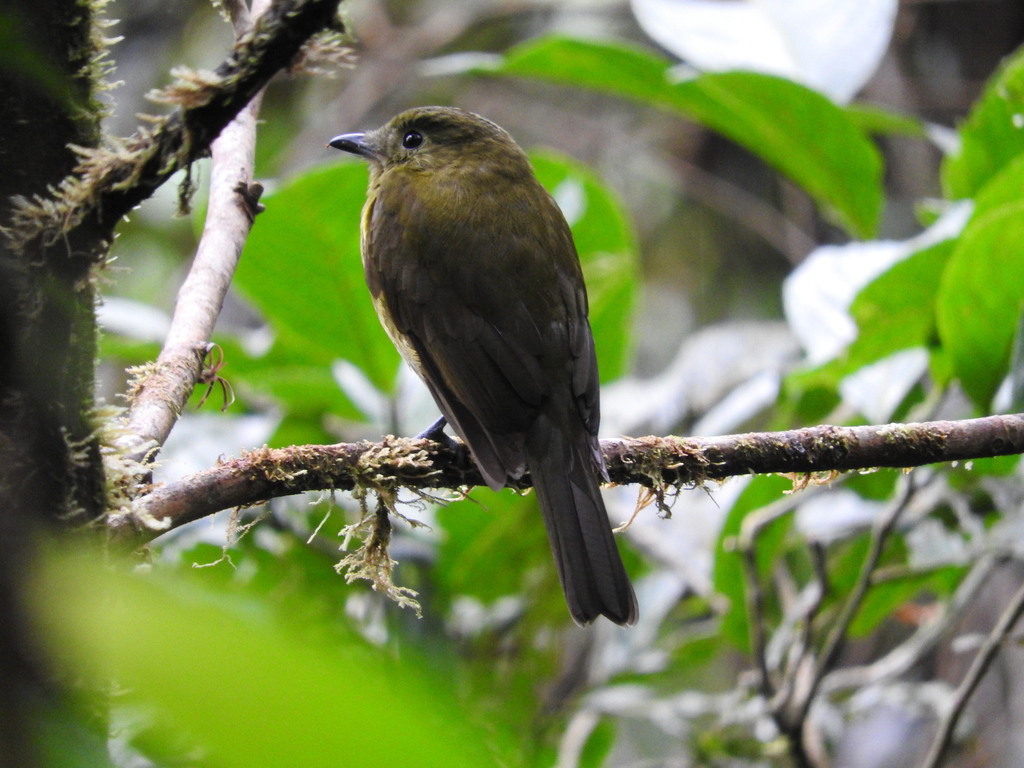
The olivaceous piha (Snowornis cryptolophus) is a species of bird in the family Cotingidae. It is found in Colombia, Ecuador, and Peru. In regard to population density and range this species is not considered vulnerable.
From the article Olivaceous piha on Wikipedia (CC BY-SA), quoted section by section
Description
The olivaceous piha is 23 to 24 cm (9.1 to 9.4 in) long; three males weighed about 72 to 76 g (2.5 to 2.7 oz). The sexes have similar plumage. Adult males of the nominate subspecies have a mostly olive head with brighter olive ear coverts and a partially hidden black crest in the middle of the crown. Their upperparts are olive green that is brightest on the rump. Their tail is a browner to grayer olive than their upperparts with thin olive edges on the feathers. Their wings are mostly brown with thin olive edges on the flight feathers. Their underparts are mostly olive with thin white streaks from the lower throat to the belly and some lemon yellow undertail coverts. Adult females are much more brownish than males and have little or no crest on the crown. Subspecies S. c. mindoensis is smaller than the nominate with hidden creamy white bases to the crest feathers. Both sexes of both subspecies have a dark brown iris, a dark horn to black bill with a paler base to the mandible, and bluish gray to gray legs and feet.
Range & habitat
The olivaceous piha has a disjunct distribution. Subspecies S. c. mindoensis has the smaller and more northerly range of the two. It is found on the western slope of Colombia's Western Andes from Antioquia Department south into northwestern Ecuador's Pichincha Province. The nominate subspecies is found from the upper valley of the Magdalena River in far southern Colombia south on the eastern slope of the Andes through Ecuador slightly into Peru and separately in Peru from central Amazonas Department south to Huánuco Department. It inhabits humid montane forest in the subtropical zone, where it mostly occurs from the forest's understory to its mid-story. In elevation it ranges between 1,000 and 2,300 m (3,300 and 7,500 ft) in Colombia, between 1,000 and 1,800 m (3,300 and 5,900 ft) in Ecuador, and between 1,350 and 2,300 m (4,400 and 7,500 ft) in Peru.
Wikipedia: “Distribution and habitat”
What it does
The olivaceous piha feeds on fruit and large arthropods but details are lacking. It usually forages singly and occasionally joins mixed-species feeding flocks. It perches and moves quietly and inconspicuously, taking prey and plucking fruit while perched or while briefly hovering after a short flight. It also takes prey in mid-air.
Wikipedia: “Feeding”
Listen
Looking for field recordings…
Where it lives
Recorded sightings
—
geo-referenced records in GBIF, from museums, herbaria and field observers.
Drag the globe to turn it. Dots are where records exist, not a range map; darker means more records.
In the stacks
Searching the stacks…
Every page naming Snowornis cryptolophus in the Biodiversity Heritage Library →
This page is assembled live from iNaturalist, GBIF, Wikipedia, the Source Library and the Internet Archive. It is not yet part of the hand-edited codex. iNaturalist taxon 8742.