On eBird ↗
Cinereous Mourner
Live sightings near you, the range map, bar charts of when it is seen, and Macaulay Library photos and recordings.
Cinereous Mourner
Laniocera hypopyrra
The cinereous mourner (Laniocera hypopyrra) is a species of bird in the family Tityridae. The term cinereous describes its colouration. It has traditionally been placed in the cotinga family, but evidence strongly suggest it is better placed in Tityridae, where now placed by SACC. It is found in Bolivia, Brazil, Colombia, Ecuador, French Guiana, Guyana, Peru, Suriname, and Venezuela. Its natural habitat is subtropical or tropical moist lowland forests.
From the article Cinereous mourner on Wikipedia (CC BY-SA), quoted section by section
Description
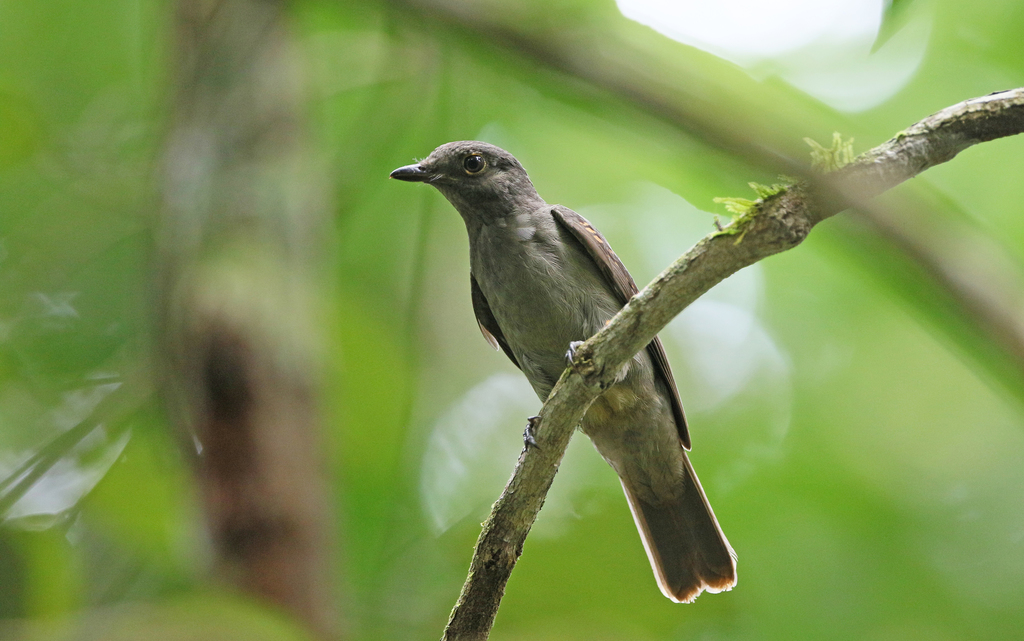
The cinereous mourner is 20 to 21 cm (7.9 to 8.3 in) long and weighs 41 to 51 g (1.4 to 1.8 oz). The sexes have the same plumage. Adults have a thin orange ring around the eye. The rest of their head, upperparts, wings, and tail are mostly gray. Their primaries have a brown tinge and two rows of cinnamon spots that show as broken wing bars. Their tertials and the tips of their tail feathers have smaller cinnamon spots. Their underparts are a slightly paler gray than their upperparts. Their breast and crissum sometimes have black-tipped orange spots. They have pectoral tufts that are often hidden; in one variant the tufts are orange and in a second one they are pale yellow. Both variants have a dark iris, a dark bill, and gray legs. Nestlings of this species are orange with long filoplumes that end in white tips and have a resemblance to hairy caterpillars of a moth belonging to the family Megalopygidae. The young birds move their heads slowly from side to side which are thought to enhance the impression by resembling a moving caterpillar. It is thought that this may be the first case of Batesian mimicry involving a harmless bird mimic and a toxic insect model, although another species, the Brazilian laniisoma (Laniisoma elegans), also has young that share a similar downy appearance; however, detailed observations of the latter are unavailable.
Range & habitat
The cinereous mourner is found throughout the entire Orinoco River and Amazon River basins with a disjunct population in eastern Brazil. Its main range spans from southeastern Colombia south through eastern Ecuador and eastern Peru into northwestern Bolivia. From there it extends east across southern and eastern Venezuela and the Guianas and all of Amazonian Brazil. The isolated population is found in southeastern Bahia and northern Espírito Santo. The cinereous mourner primarily inhabits humid terra firme and igapó forest. It seems to favor sloping terrain and areas near ravines. In some areas it also occurs in forest on sandy soil and in woodlands in savanna. In elevation it occurs up to 600 m (2,000 ft) in Colombia, mostly up to 400 m (1,300 ft) in Ecuador, up to 900 m (3,000 ft) in Peru, and up to 500 m (1,600 ft) in Venezuela.
Wikipedia: “Distribution and habitat”
What it does
The cinereous mourner feeds on arthropods and fruit. It forages from the forest's understory to its midstory, usually singly, and sometimes joins mixed-species feeding flocks. It perches silently and makes short sallies, sometimes with a brief hover, to glean from foliage or branches.
Wikipedia: “Feeding”
Listen
Looking for field recordings…
Where it lives
Recorded sightings
—
geo-referenced records in GBIF, from museums, herbaria and field observers.
Drag the globe to turn it. Dots are where records exist, not a range map; darker means more records.
In the stacks
Searching the stacks…
Every page naming Laniocera hypopyrra in the Biodiversity Heritage Library →
This page is assembled live from iNaturalist, GBIF, Wikipedia, the Source Library and the Internet Archive. It is not yet part of the hand-edited codex. iNaturalist taxon 8740.