- Plants
- ›Vascular Plants
- ›flowering plants
- ›Dicots
- ›Legumes, Milkworts, and Allies
- ›Legumes
- ›Acacias, Mimosas, Mesquites, and Allies
- ›Acacia
- ›Juliflorae
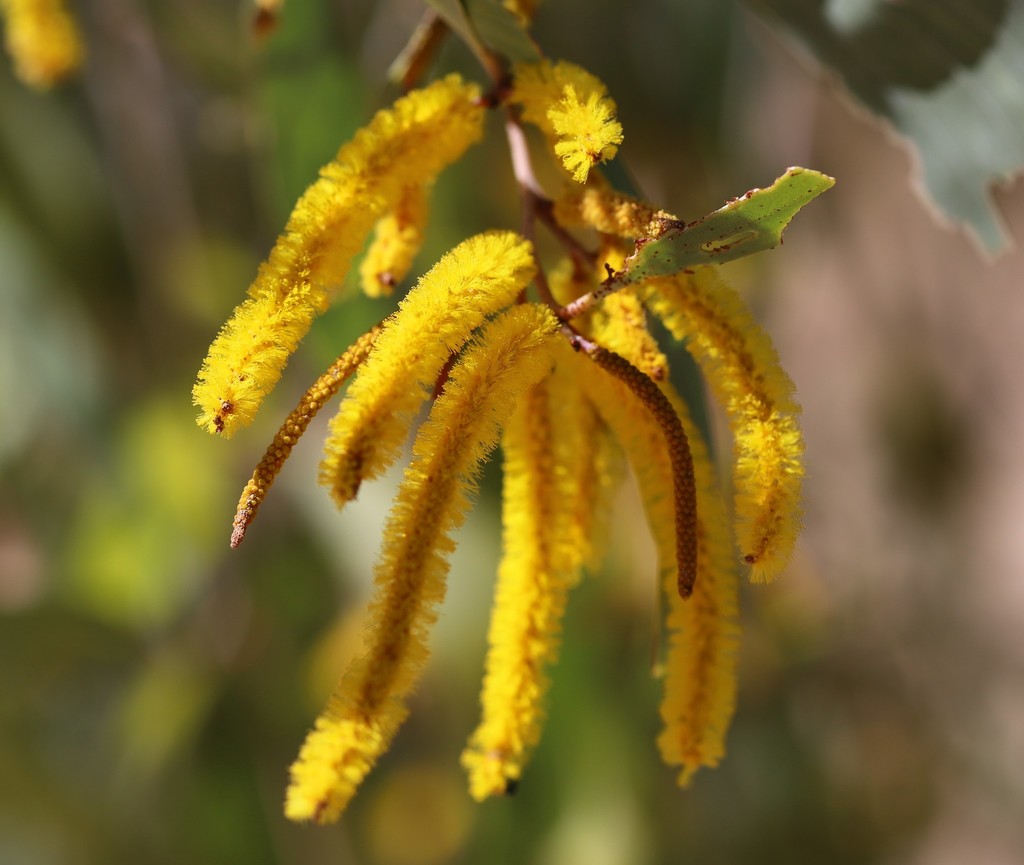
Pindan Wattle
Acacia tumida
Acacia tumida, known colloquially as pindan wattle, spear wattle or wongai, is a species of Acacia native to northern and western Australia.
From the article Acacia tumida on Wikipedia (CC BY-SA), quoted section by section
Description
The openly branched spreading tree or shrub typically grows to a height of 5 to 15 metres (16 to 49 ft) with a well developed canopy. It has hard grey glossy bark that is occasionally fissured with pruinose orange to yellow branchlets. It has falcate to subfalcate glaucous green phyllodes that are 6 to 25 centimetres (2 to 10 in) long and 0.7 to 6 cm (0.3 to 2.4 in) wide. It produces between April and October and produces yellow inflorescences, usually racemose or axillary or terminal panicles 20 cm (7.9 in) long. These eventually develop into narrow oblong woody glabrous seed pods that are 3 to 12 cm (1.2 to 4.7 in) in length containing glossy black seeds. A. tumida grows quickly but has a short lifespan, usually less than 10 years.
Range & habitat
A. tumida has a range that extends from the Kimberley, Pilbara and north eastern Goldfields regions of Western Australia including much of the Great Sandy Desert. It also extends into the Victoria River district of the Northern Territory. It grows well in sandplain areas in red sandy or pindan soils over sandstone. They often form dense thickets with spinifex. It is also cultivated in Yemen, Vietnam, Senegal and Niger.
Wikipedia: “Range”
At the table
Indigenous Australians used the trunk of young trees to fashion spears and boomerangs. The green seed pods were cooked over coals and the seeds then eaten. Fully ripened black seeds were ground into flour mixed with water and consumed as a paste or cooked and eaten as a damper. Other traditional uses include making string from the bark and using the gum exudate as a food source. It is cultivated in Senegal and Niger, where it is used as good quality firewood and to create low windbreaks. It is also used with slower growing plants for binding soil.
Wikipedia: “Uses”
Where it lives
Recorded sightings
—
geo-referenced records in GBIF, from museums, herbaria and field observers.
Drag the globe to turn it. Dots are where records exist, not a range map; darker means more records.
In the stacks
Searching the stacks…
Every page naming Acacia tumida in the Biodiversity Heritage Library →
This page is assembled live from iNaturalist, GBIF, Wikipedia, the Source Library and the Internet Archive. It is not yet part of the hand-edited codex. iNaturalist taxon 869825.