On eBird ↗
Jamaican Becard
Live sightings near you, the range map, bar charts of when it is seen, and Macaulay Library photos and recordings.
Jamaican Becard
Pachyramphus niger
The Jamaican becard (Pachyramphus niger) is a species of bird in the family Tityridae. Its genus, Pachyramphus, has traditionally been placed in Cotingidae or Tyrannidae, but evidence strongly suggest it is better placed in Tityridae.
From the article Jamaican becard on Wikipedia (CC BY-SA), quoted section by section
Description
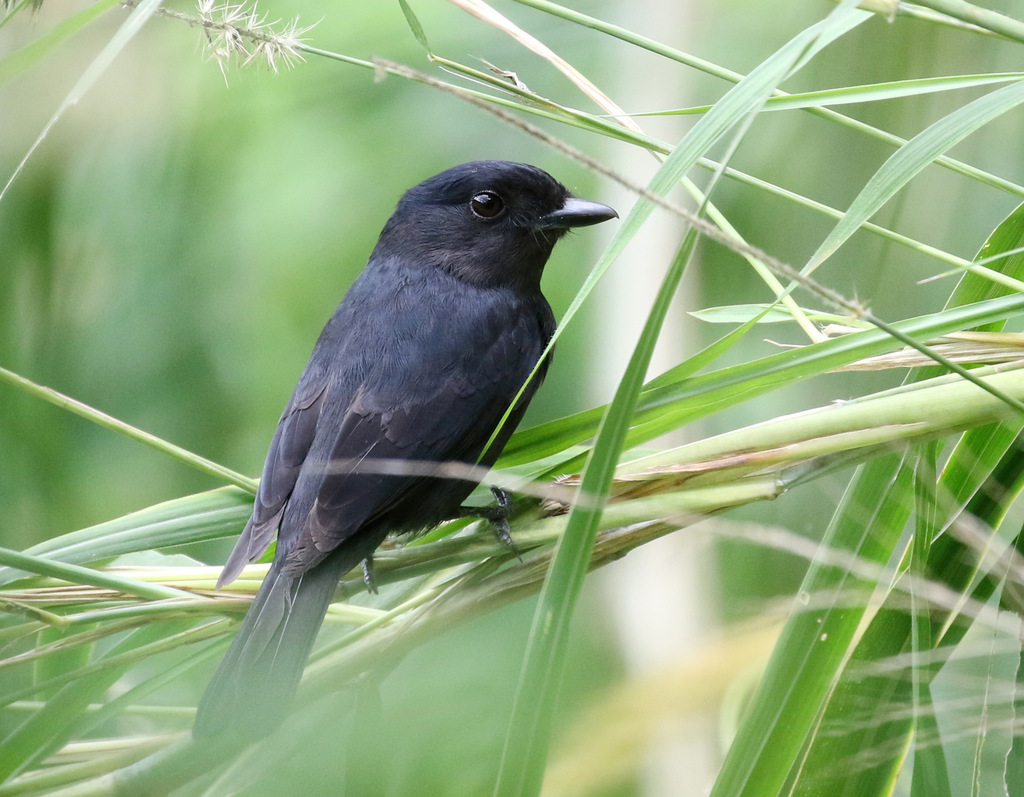
The Jamaican becard is about 18 cm (7.1 in) long and weighs about 39 to 41.5 g (1.4 to 1.5 oz). Adult males are entirely black except for some white at the base of the wing that shows only in flight. Adult females have a deep brown crown. Their upperparts are reddish brown. Their cheeks, throat, neck, and upper breast are cinnamon and their lower breast and the rest of their underparts are pale gray.
Range & habitat
The Jamaican becard is found throughout the island of Jamaica. It inhabits a variety of landscapes in the tropical and lower subtropical zones, most of which are somewhat open. These include mature open forest, woodlands, and pastures with trees. It also inhabits gardens and the interior and edges of more closed forest. In elevation it ranges from sea level to 1,800 m (5,900 ft).
Wikipedia: “Distribution and habitat”
What it does
The Jamaican becard feeds on insects and fruit. It gleans both with short sallies that sometimes include a brief hover. It also takes insects in mid-air.
Wikipedia: “Feeding”
Listen
Looking for field recordings…
Where it lives
Recorded sightings
—
geo-referenced records in GBIF, from museums, herbaria and field observers.
Drag the globe to turn it. Dots are where records exist, not a range map; darker means more records.
In the stacks
Searching the stacks…
Every page naming Pachyramphus niger in the Biodiversity Heritage Library →
This page is assembled live from iNaturalist, GBIF, Wikipedia, the Source Library and the Internet Archive. It is not yet part of the hand-edited codex. iNaturalist taxon 8687.