On eBird ↗
Pink-throated Becard
Live sightings near you, the range map, bar charts of when it is seen, and Macaulay Library photos and recordings.
Pink-throated Becard
Pachyramphus minor
The pink-throated becard (Pachyramphus minor) is a species of bird in the family Tityridae. It has traditionally been placed in Cotingidae or Tyrannidae, but evidence strongly suggest it is better placed in Tityridae, where now placed by SACC. It is found in Bolivia, Brazil, Colombia, Ecuador, French Guiana, Guyana, Peru, Suriname, and Venezuela.
From the article Pink-throated becard on Wikipedia (CC BY-SA), quoted section by section
Description
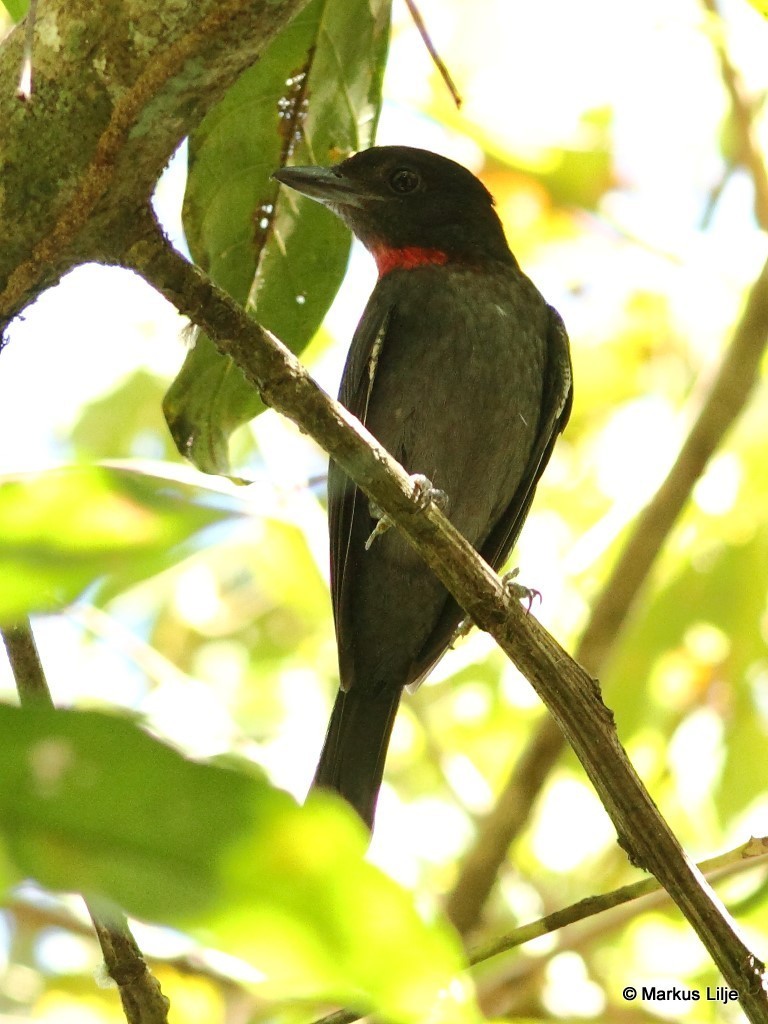
The pink-throated becard is 16.5 to 17.5 cm (6.5 to 6.9 in) long and weighs 31 to 44 g (1.1 to 1.6 oz). The species is sexually dimorphic. Adult males are mostly black to dark sooty gray. Their face and underparts are slightly paler than their back. They have the eponymous pink patch on the lower throat and upper breast, though sometimes it is indistinct. They have some white at the bend of the wing that is usually visible only in flight. Adult females have somewhat individually variable plumage. In general they have a grayish brown crown and nape. They have a small buff spot above the lores on an otherwise buff face. Their back is gray, their rump gray with a rufous tinge, and their wings and tail rufous. Their throat and underparts are buff. Both sexes have a brown to dark brown iris, a bill that can be all black or have a black maxilla and a gray mandible, and blackish to gray legs and feet.
Range & habitat
The pink-throated becard is a bird of the Amazon Basin and the Guiana Shield. It is found from southeastern Colombia south through eastern Ecuador and eastern Peru into northern Bolivia. From there its range extends east across southern and eastern Venezuela, the Guianas, and Brazil north of a line roughly from southern Mato Grosso do Sul northeast to the Atlantic in Maranhão. It inhabits a variety of forested landscapes, especially evergreen terra firme. It also is found in várzea, swamp, and savanna forests. In elevation it ranges from sea level to 800 m (2,600 ft) in Brazil. It reaches 500 m (1,600 ft) in Colombia, 600 m (2,000 ft) in Ecuador, 1,000 m (3,300 ft) in Peru, 1,300 m (4,300 ft) in Bolivia, and 800 m (2,600 ft) in Venezuela.
Wikipedia: “Distribution and habitat”
What it does
The pink-throated becard is believed to feed mostly on insects and also include fruits in its diet. It usually forages in pairs though sometimes in small family groups and regularly joins mixed-species feeding flocks. It forages from the forest's mid-story to its canopy, taking food from foliage with sallies from a perch that may include a short hover.
Wikipedia: “Feeding”
Listen
Looking for field recordings…
Where it lives
Recorded sightings
—
geo-referenced records in GBIF, from museums, herbaria and field observers.
Drag the globe to turn it. Dots are where records exist, not a range map; darker means more records.
In the stacks
Searching the stacks…
Every page naming Pachyramphus minor in the Biodiversity Heritage Library →
This page is assembled live from iNaturalist, GBIF, Wikipedia, the Source Library and the Internet Archive. It is not yet part of the hand-edited codex. iNaturalist taxon 8680.