- Plants
- ›Vascular Plants
- ›flowering plants
- ›monocots
- ›grasses, sedges, cattails, and allies
- ›grasses
- ›Pooideae
- ›Poeae
- ›fescues and ryegrasses
- ›Lolium
- ›Schedonorus
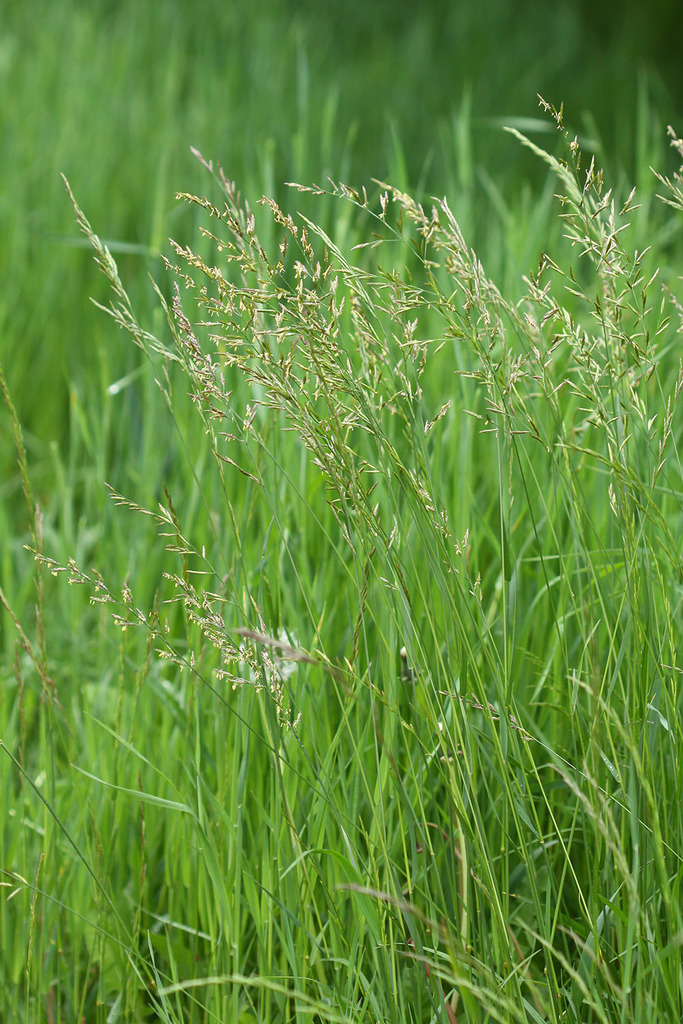
meadow fescue
Lolium pratense
Lolium pratense, meadow fescue is a perennial species of grass, which is often used as an ornamental in gardens, and is also an important forage crop.
It grows in meadows, roadsides, old pastures, and riversides on moist, rich soils, especially on loamy and heavy soils.
From the article Lolium pratense on Wikipedia (CC BY-SA), quoted section by section
Description
Meadow fescue is a tuft-forming perennial (called a bunchgrass in the US), with erect to spreading hollow flowering stems up to about 1 m (3 ft) tall (exceptionally up to 120 cm) which are quite hairless (glabrous), including the leaf sheaths. At the top of the sheath is a short (1 mm) ligule and pointed auricles that can wrap slightly around the stem. The leaf blade is flat, up to about 8 mm wide, and also glabrous, but rough on the top and the margins. The tillers (non-flowering stems) are typically shorter but otherwise similar to the culms.
Flowering typically occurs from June until August, with an erect to slightly nodding open panicle about 30 cm (1 ft) long, which is more-or-less one-sided. The branches are normally in pairs, the shorter of which bears only 1 or 2 spikelets, whereas the larger one has 4 or more. The spikelets are 11–17 mm long and comprise 5-10 (sometimes up to 16) bisexual florets and two short, unequal glumes. The lower glume has only 1 nerve whereas the upper one has up to 3. The lemmas are awnless or just shortly pointed. Each floret has 3 stamens with anthers about 3 mm long. The fruit is a nut or caryopsis with the seed tightly enclosed by the hardened lemma and palea.
Range & habitat
Meadow fescue is found in damp grasslands such as water-meadows, pastures and road verges, where it was formerly widely sown as a component of grass-clover seed mixes for improving the productivity of agricultural grasslands. The degree to which it has been planted obscures its natural distribution and has probably extended its range far beyond where it would previously have occurred. The British National Vegetation Classification lists it as a component of all types of mesotrophic (MG) grasslands but it is not characteristic, or even a constant, in any of them. By contrast, it is not recorded in any calcareous (CG) or acid (U) grasslands. There is some evidence of it occurring in more natural habitats such as M22 blunt-flowered rush and M23 sharp-flowered rush communities by lakes and rivers. Its Ellenberg values in Britain are L = 7, F = 6, R = 6, N = 6, and S = 1, which show that it favours damp, sunny places with neutral soils and moderate fertility, and that it can occur in slightly brackish situations.
Wikipedia: “Habitat and ecology”
Where it lives
Recorded sightings
—
geo-referenced records in GBIF, from museums, herbaria and field observers.
Drag the globe to turn it. Dots are where records exist, not a range map; darker means more records.
In the stacks
Searching the stacks…
Every page naming Lolium pratense in the Biodiversity Heritage Library →
This page is assembled live from iNaturalist, GBIF, Wikipedia, the Source Library and the Internet Archive. It is not yet part of the hand-edited codex. iNaturalist taxon 866252.