Stresemann's Bush-Crows
Zavattariornis
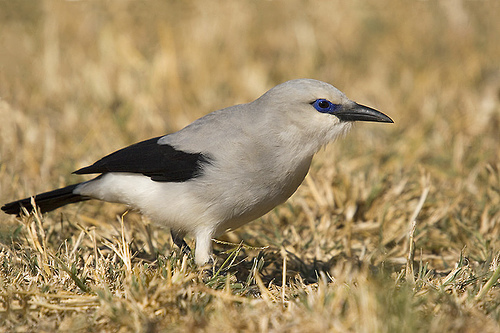
The Ethiopian bushcrow (Zavattariornis stresemanni), also known as the Stresemann's bushcrow, Abyssinian pie, bush crow, or by its generic name Zavattariornis, is a rather starling-like bird, which is a member of the crow family, Corvidae. It is slightly larger than the North American blue jay and is a bluish-grey in overall colour which becomes almost white on the forehead. The throat and chest are creamy-white with the tail and wings a glossy black. The black feathers have a tendency to bleach to brown at their tips. The iris of the bird is brown and the eye is surrounded by a band of naked bright blue skin. The bill, legs, and feet are black.
Feeding is usually in small groups and the bird takes mainly insects. Breeding usually starts in March, with the birds building their nest high in an acacia tree. The birds usually lay five to six cream eggs with lilac blotches. The nest itself is globular in shape with a tubular entrance on top. It is possible that more than just the breeding pair visit the nest and that the young of previous years help in rearing the young.
1 branches of this genus, most-observed first · about 1 known species
See this branch on the Wheel of Life →
Where it lives
Recorded sightings
—
geo-referenced records in GBIF, from museums, herbaria and field observers.
Drag the globe to turn it. Dots are where records exist, not a range map; darker means more records.
In the stacks
Searching the stacks…
Every page naming Zavattariornis in the Biodiversity Heritage Library →
This page is assembled live from iNaturalist, GBIF, Wikipedia, the Source Library and the Internet Archive. It is not yet part of the hand-edited codex. iNaturalist taxon 8637.