On eBird ↗
Western Parotia
Live sightings near you, the range map, bar charts of when it is seen, and Macaulay Library photos and recordings.
Western Parotia
Parotia sefilata
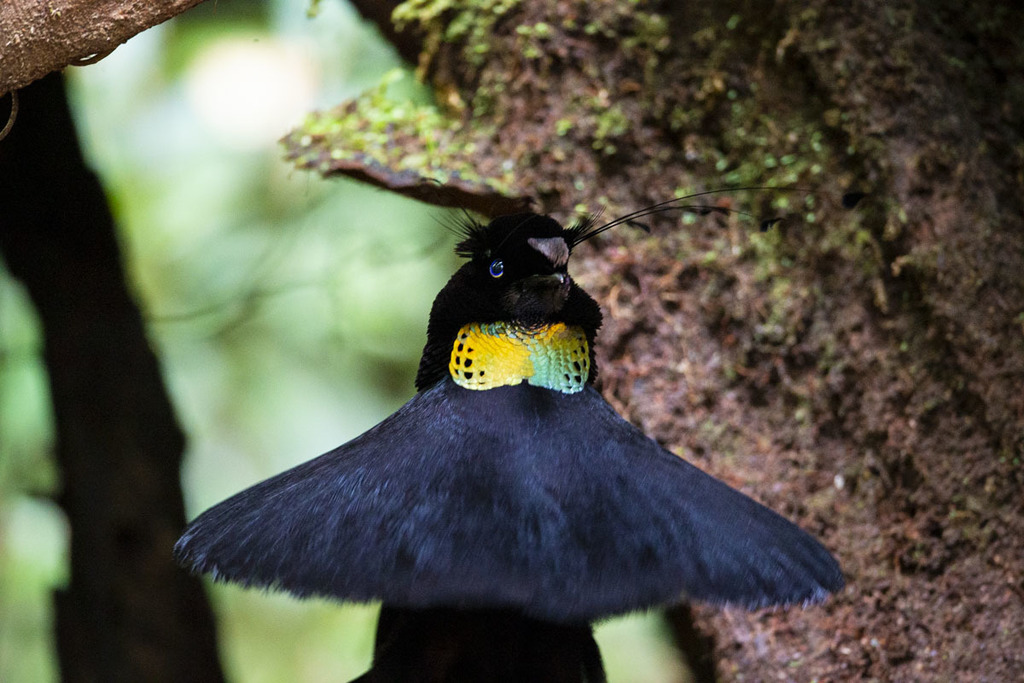
The western or Arfak parotia (Parotia sefilata) is a medium-sized, approximately 33 cm long, bird-of-paradise with a medium-length tail.
Parotia comes from the Greek parotis, a lock or curl of hair by the ear, alluding to the head wires. The specific name sefilata is derived from the Latin word 'sex', meaning six, and filum, a thread or filament.
From the article Western parotia on Wikipedia (CC BY-SA), quoted section by section
Description
Like other birds-of-paradise, the western parotia is sexually dimorphic. The male has jet black plumage, with striking iridescent scale-like golden-green breast shields and triangular silver feathers on its crown. The occipital plumes (or head wires) arise from above and behind the eyes, with three long erectile wire-like plumes with smaller spatulate tips, above and behind each eye. As with most members of the family, the female is unadorned and has brown plumage. The species is similar to Lawes's parotia (Parotia lawesii).
Range & habitat
The western parotia is found only in the mountain forests of Vogelkop and the Wandammen Peninsula of Western New Guinea.
Wikipedia: “Distribution”
What it does
The species is polygynous. Males presumably perform a series of courtship displays likely on terrestrial courts in exploded leks. In courtship display, the male performs a ballerina-like dance with its elongated black plumes spread skirt-like, right below the iridescent breast shield. During the spectacular dance, he shakes his head and neck rapidly to show the brilliance of his inverted silver triangle-shaped head adornment to attending females. The nest is built and attended by the female alone; the breeding season is largely unknown. The diet consists mainly of fruits such as figs, and arthropods.
Wikipedia: “Behaviour”
Listen
Looking for field recordings…
Where it lives
Recorded sightings
—
geo-referenced records in GBIF, from museums, herbaria and field observers.
Drag the globe to turn it. Dots are where records exist, not a range map; darker means more records.
In the old herbals & bestiaries

In the stacks
Searching the stacks…
Every page naming Parotia sefilata in the Biodiversity Heritage Library →
This page is assembled live from iNaturalist, GBIF, Wikipedia, the Source Library and the Internet Archive. It is not yet part of the hand-edited codex. iNaturalist taxon 8608.