- Plants
- ›Vascular Plants
- ›flowering plants
- ›Dicots
- ›pinks, cactuses, and allies
- ›cacti
- ›globular cacti, moonlight cacti, torch cacti, and allies
- ›Pachycereae
- ›Echinocereus
- ›Triglochidiatus
- ›Triglochidiati
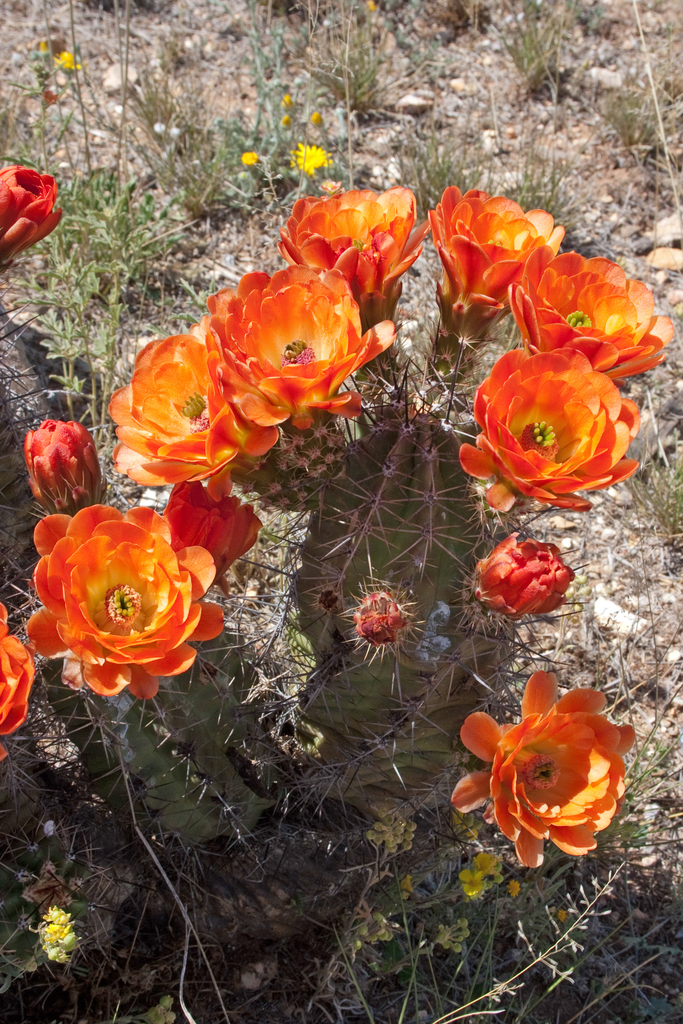
Echinocereus gurneyi
Echinocereus gurneyi is a species of cactus native to Texas.
From the article Echinocereus gurneyi on Wikipedia (CC BY-SA), quoted section by section
Description
Echinocereus gurneyi forms small clumps consisting of 10 or more stems. The dark green plant body is ovate to cylindrical and reaches heights of up to 20–35 cm (7.9–13.8 in) with a diameter of 5 to 10 cm (2.0 to 3.9 in). The 8 to 12 ribs often form warts. The spines are yellow brown and difficult to distinguish between radial and central spines. The areoles have 1-2 central spines, have an angular cross section and are up to 7.5 cm (3.0 in) long and 5-12 radial spines that are the same length. The broad, funnel-shaped, dioecious, orange-red to salmon flowers appear below the shoot tip. They have a diameter of 8 cm (3.1 in).
Range & habitat
This species is found growing rocky hillsides and limestone rock in pine oak and juniper woodlands of New Mexico and Texas in the United States and Chihuahua, Mexico at elevations between 1200 and 1500 meters. Plants are found growing along Dasylirion leiophyllum, Pelecyphora sneedii subsp. sneedii, Echinocereus viridiflorus var. cylindricus, and Agave parryi subsp. neomexicana.
Wikipedia: “Distribution”
Where it lives
Recorded sightings
—
geo-referenced records in GBIF, from museums, herbaria and field observers.
Drag the globe to turn it. Dots are where records exist, not a range map; darker means more records.
In the stacks
Searching the stacks…
Every page naming Echinocereus gurneyi in the Biodiversity Heritage Library →
This page is assembled live from iNaturalist, GBIF, Wikipedia, the Source Library and the Internet Archive. It is not yet part of the hand-edited codex. iNaturalist taxon 858362.