- Plants
- ›Vascular Plants
- ›flowering plants
- ›Dicots
- ›Roses, Elms, Figs, and Allies
- ›rose family
- ›Amygdaloideae
- ›Amygdaleae
- ›Prunus
- ›Prunus
- ›Armeniaca
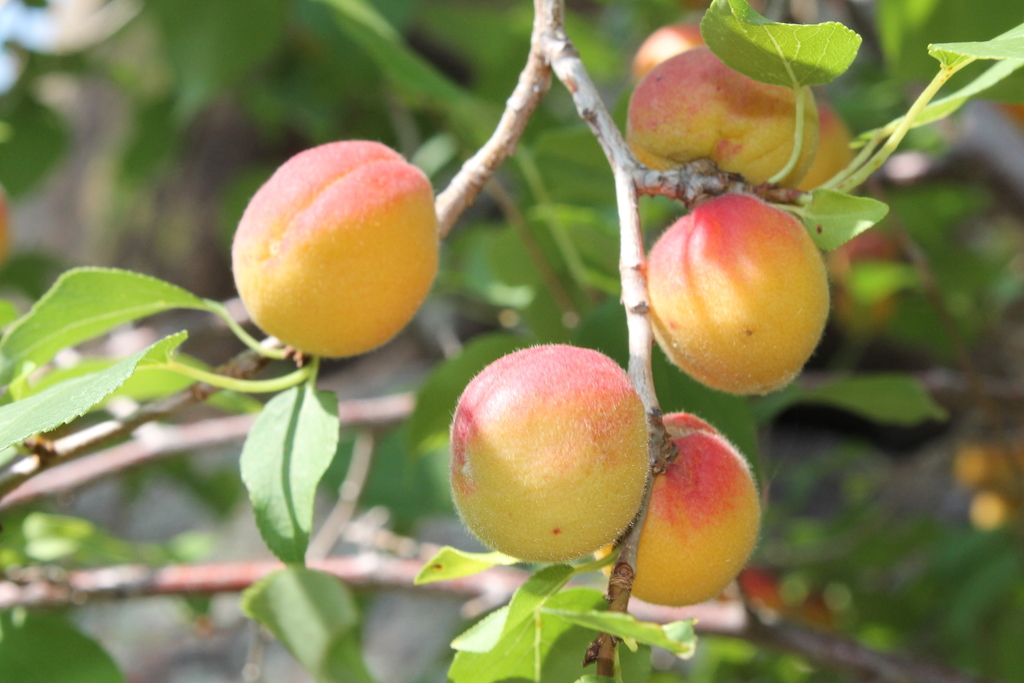
Siberian Apricot
Prunus sibirica
Prunus sibirica, called Siberian apricot (Chinese: 山杏; pinyin: shān xìng), is a species of shrub or small tree native to northern China, Korea, Mongolia, and eastern Siberia. It is in the genus Prunus in the rose family, Rosaceae, one of several species whose fruit are called apricot, although this species is rarely cultivated for its fruit. The species was named by Carl Linnaeus in 1753.
From the article Prunus sibirica on Wikipedia (CC BY-SA), quoted section by section
Description
The species is highly genetically diverse. It grows in the form of a small tree with spreading branches and reaches a height of 3 meters (10 ft). It is very frost resistant and can survive temperatures down to −45 °C (−49 °F). The tree's bark is dark grey, while the bark of the branches is reddish to dark brown, sparsely hairy at first, but soon glabrous. The reddish-brown winter buds are ovoid to conical, 2–4 mm long and the edges of the bud scales are hairy. The simple leaves have stipules. The petiole of the leaves is initially hairy, but soon bald, and is red with a length of 2 to 3.5 cm and few if any glands. The simple, ovate to almost circular, pointed leaf blade has a length of 5 to 10 centimeters and a width of 3 to 7 centimeters with a rounded to heart-shaped base. Leaf surfaces are initially reddish, hairy and downy, later glossy green and glabrous. The leaf edge is serrate (not double serrate). Blossoms appear in early spring as solitary flowers. The flower stalk is about 1 to 2 mm long, and the bell-shaped flower cup is purple outside and hairy at the base, glabrous, or slightly downy. The flowers are hermaphrodite, with a diameter of 1.5 to 3.5 cm. The five free petals, almost circular to ovoid in shape, are white with pink veins. …
At the table
Seed oil from P. sibirica has been studied as a source of biodiesel. The oil content of Prunus mandshurica seeds is significantly higher and also has potential as a source of biodiesel.
Wikipedia: “Uses”
Where it lives
Recorded sightings
—
geo-referenced records in GBIF, from museums, herbaria and field observers.
Drag the globe to turn it. Dots are where records exist, not a range map; darker means more records.
In the stacks
Searching the stacks…
Every page naming Prunus sibirica in the Biodiversity Heritage Library →
This page is assembled live from iNaturalist, GBIF, Wikipedia, the Source Library and the Internet Archive. It is not yet part of the hand-edited codex. iNaturalist taxon 858118.