- Plants
- ›Vascular Plants
- ›flowering plants
- ›Dicots
- ›laurels, spicebushes, and allies
- ›southern sassafras family
- ›Doryphora
Sassafras
Doryphora sassafras
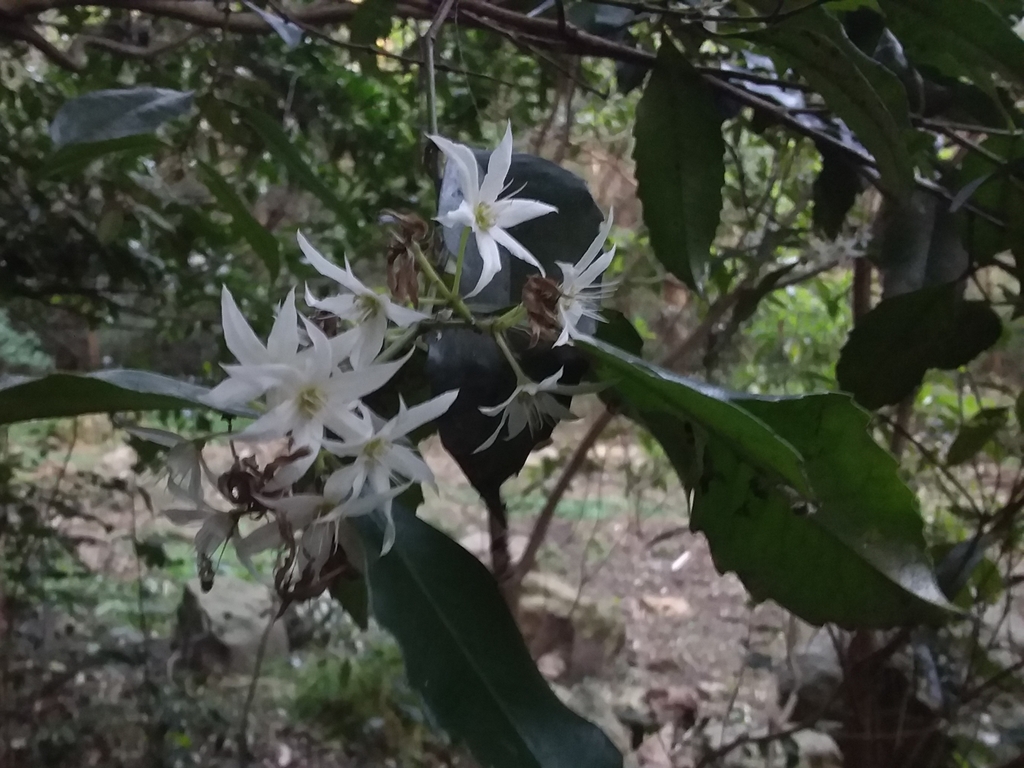
Doryphora sassafras, commonly known as sassafras, yellow-, canary- or golden sassafras, or golden deal, is a species of evergreen tree of the family Atherospermataceae native to the subtropical and temperate rainforests of eastern New South Wales and Queensland, Australia. It is a tall tree with green foliage and contrasting white flowers which occur in Autumn and Winter.
From the article Doryphora sassafras on Wikipedia (CC BY-SA), quoted section by section
Description
Doryphora sassafras is a shrub or tree that typically grows to 2.5–36 m (10–120 ft). Its leaves are arranged in opposite pairs, elliptic to lanceolate or ovate, 30–110 mm (1.2–4.3 in) long and 15–40 mm (0.6–1.6 in) wide on a petiole 3–6 mm (0.1–0.2 in) long. The edges of the leaves are shallowly to deeply toothed, glabrous and glossy, and both surfaces have a prominent midvein. All parts of the tree have a spicy smell, but should be treated with "some caution", since the plant contains the poisonous alkaloid doryphorine. Each individual leaf on a sassafras has a lifespan up to 12 years, and exceptionally to 19 years. The flowers are white with 6 tepals in 2 whorls mostly 7–13 mm (0.3–0.5 in) long and 2.5–4 mm (0.1–0.2 in) wide, the androecium with usually 4 whorls with 6 stamens and 14 to 18 staminodes, and there are 8 to 12 carpels. Flowering occurs from May to October and the achenes are 3.5–5 mm (0.1–0.2 in) long and 2–3 mm (0.08–0.12 in) in diameter.
Range & habitat
The distribution is from Nambour in southern Queensland through eastern New South Wales to Wolumla Peak in Yurammie State Forest. It is found in temperate rainforest on basalt soils at higher elevations and sedimentary soils at lower elevations, commonly associated with coachwood (Ceratopetalum apetalum) and native crabapple (Schizomeria ovata).
Wikipedia: “Distribution and habitat”
What it does
Male mosquitoes and crane flies are attracted to the flowers of sassafras, but although they are nectarivores, in their struggle to feed, they pollinate the flowers.
Wikipedia: “Ecology”
How it is grown
It is used in reforestation but generally grows too big to be used in home gardens. It has been thought to have potential as a potted specimen. It has been planted in Dublin area in Ireland
Wikipedia: “Use in horticulture”
Where it lives
Recorded sightings
—
geo-referenced records in GBIF, from museums, herbaria and field observers.
Drag the globe to turn it. Dots are where records exist, not a range map; darker means more records.
In the old herbals & bestiaries

Medicinal History of the Things Brought from Our West Indies
Nicolás Monardes · 1574 · p.115

The Natural History of Carolina, Florida and the Bahama Islands, Vol. 1
Mark Catesby · 1777 · p.182

Treasury of Medical Matters of New Spain
Francisco Hernández · 1651 · p.102

De Indiae utriusque re naturali et medica
Willem Piso · 1658 · p.174

Christoph Jakob Trew — Uitgezochte planten (1771)
Christoph Jakob Trew · 1771 · p.226

Christoph Jakob Trew — Uitgezochte planten (1771)
Christoph Jakob Trew · 1771 · p.228
In the stacks
Searching the stacks…
Every page naming Doryphora sassafras in the Biodiversity Heritage Library →
This page is assembled live from iNaturalist, GBIF, Wikipedia, the Source Library and the Internet Archive. It is not yet part of the hand-edited codex. iNaturalist taxon 856905.