- Plants
- ›Vascular Plants
- ›flowering plants
- ›Dicots
- ›Soapberries, Cashews, Mahoganies, and Allies
- ›soapberry family
- ›Diploglottis
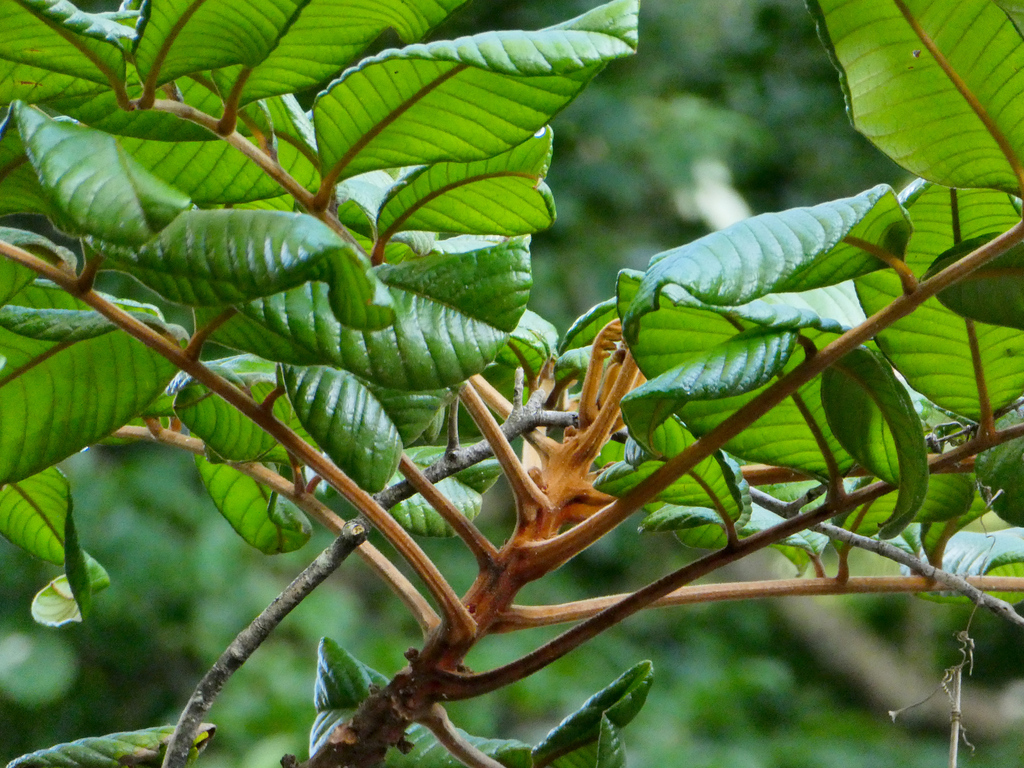
Diploglottis bernieana
Diploglottis bernieana, commonly known as Bernie's tamarind or large leaf tamarind, is a plant in the maple and lychee family Sapindaceae. It was first described in 1987 by the Australian botanist Sally T. Reynolds and is found only the Wet Tropics region of northeastern Queensland, Australia.
From the article Diploglottis bernieana on Wikipedia (CC BY-SA), quoted section by section
Description
Diploglottis bernieana is a medium-sized tree growing to about 20 m (66 ft) tall and 20 cm (7.9 in) circumference, with a fluted trunk and buttress roots. New growth is covered in a fine brown indumentum. The compound leaves may reach up to 82 cm (32 in) in length (including the petiole which may itself be 20 cm or 7.9 in long) and has 4 or 5 pairs of leaflets. The coriaceous (stiff, leathery) leaflets are generally oblong in shape with both ends truncate, and they are quite large, measuring up to 35 cm (14 in) long by 20 cm (7.9 in) wide. They are mostly glabrous but pubescent along the midrib, with 18 to 25 pairs of lateral veins, bullate between the veins, shiny. The inflorescence is a panicle produced in the leaf axils measuring up to 50 cm (20 in) long and 30 cm (12 in) wide. The individual flowers are about 8 mm (0.31 in) wide and held on pedicels about 5 mm (0.20 in) long. The calyx is 5-lobed, green, and densely covered in red-brown hairs; the 5 white petals are about 5 mm (0.20 in) long with one petal slightly smaller than the rest. There are 8 stamens about 6 mm (0.24 in) long, the style is about 3 mm (0.12 in) long. The fruit is a yellow-brown capsule with thick fleshy walls and 1 to 3 segments known as valves, one of which is usually aborted. It is densely rusty pubescent on the outside and has long soft hairs on the internal surfaces. …
Range & habitat
The natural range of Bernie's tamarind is from about Rossville, near Cooktown, south to Innisfail, including the Atherton Tableland southwest of Cairns. It grows in well developed rainforest, from sea level to 600 m (2,000 ft) altitude.
Wikipedia: “Distribution and habitat”
In human culture
The genus name Diploglottis comes from the Neo-Latin words diplo- meaning double, and glottis meaning tongue, which is a reference to the two tongue-like scales on the petals. The species epithet bernieana was chosen by Reynolds to honour the highly respected Queensland botanist Bernard Hyland, who first recognised this as an undescribed species. In Reynolds' protologue, the species epithet was misspelled as berniana, this was corrected in a later corrigendum.
Wikipedia: “Etymology”
Where it lives
Recorded sightings
—
geo-referenced records in GBIF, from museums, herbaria and field observers.
Drag the globe to turn it. Dots are where records exist, not a range map; darker means more records.
In the stacks
Searching the stacks…
Every page naming Diploglottis bernieana in the Biodiversity Heritage Library →
This page is assembled live from iNaturalist, GBIF, Wikipedia, the Source Library and the Internet Archive. It is not yet part of the hand-edited codex. iNaturalist taxon 854964.