- Animals
- ›Arthropods
- ›Hexapods
- ›Insects
- ›Winged and Once-winged Insects
- ›Grasshoppers, Crickets, and Katydids
- ›Katydids, Crickets, and Allies
- ›Katydids, wētā, and allies
- ›Wētā, Jerusalem Crickets, and Allies
- ›Wētā and King Crickets
- ›Hemiandrus
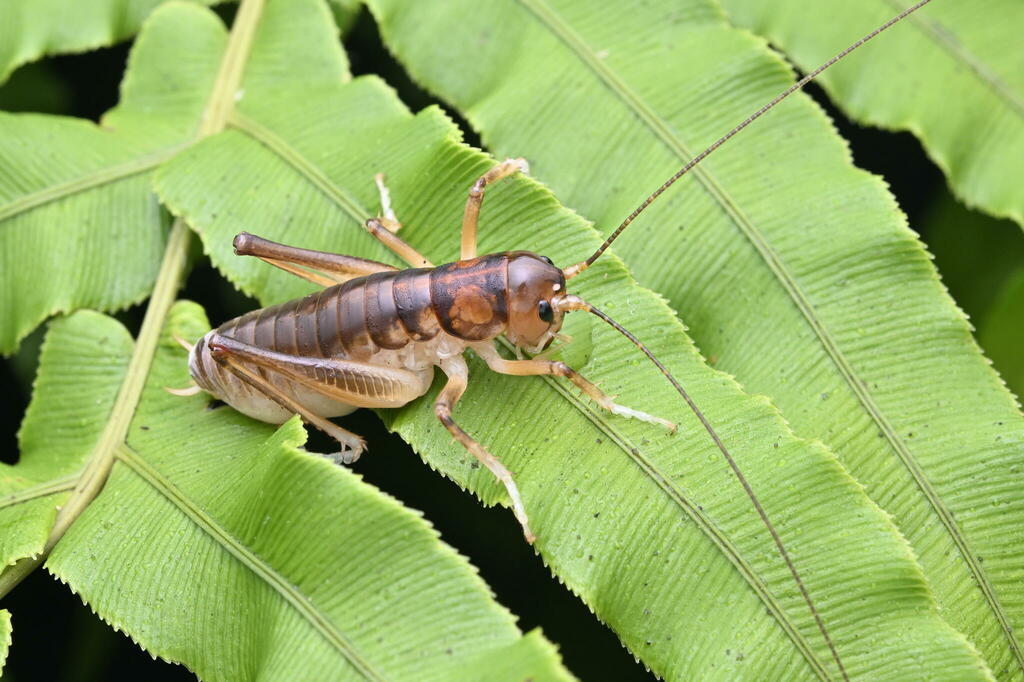
Hemiandrus pallitarsis
Hemiandrus pallitarsis is a species of ground weta endemic to New Zealand. This nocturnal species hides in burrows during the day, and can be an important food for kiwi. They can be identified by a single foretibial spine, three prolateral spines, and four retrolateral spines on the mesotibia, and their tibia lacks a tympanal membrane (they hear only through vibrations in the ground). The female has an unusual appendage on her abdomen, and the male has blackened hooks on his last tergite. They have a two-year life cycle, and their diet is largely unknown. Unusually for an insect, the female shows maternal care towards her eggs and nymphs.
From the article Hemiandrus pallitarsis on Wikipedia (CC BY-SA), quoted section by section
Description
Hemiandrus pallitarsis is morphologically identified by having a single foretibial spine, three prolateral spines, and four retrolateral spines on the mesotibia. Males can be identified by blackened hooks on the last tergite. Adult females have an elbow-like, forked appendage on their abdomen, formed from one of the sternites; this is the only Hemiandrus to have such an enlarged appendage. Females are also distinguished by their short ovipositor, so short it can be overlooked and females mistaken for males, The genus Hemiandrus contains species of widely varying overpositor lengths, which can distinguish between species. H. pallitarsus has no tympanum, and instead can detect sound through its cuticle, which is adaptive for their underground lifestyle. The tibia lack the tympanal membranes or vestiges of other Orthoptera legs.
Wikipedia: “Morphology”
Range & habitat
Hemiandrus pallitarsis is endemic to the North Island of New Zealand. They are widespread throughout this distribution and are relatively abundant. They are often found in burrows in the ground during the day, as they are nocturnal . During the night they are quite active on the ground, but are also found in vegetation such as beech trees, kanuka bushes and on leaves of plants such as kawakawa. H. pallitarsis is often found at elevations below 200 metres.
Wikipedia: “Habitat/Distribution”
What it does
The diet of this species is unknown; other Hemiandrus species vary from carnivorous, to omnivorous (fruit, invertebrates, and seeds), to herbivorous (apricots and grasses), During the summer in the Ōrongorongo forest (southern North Island) this species of ground wētā is commonly caught climbing tree trunks, with large numbers climbing into hard beech trees (Fuscospora truncata) . At the same time of year moth caterpillars feeding on hard beech are abundant which might explain this behaviour.
Wikipedia: “Diet”
Listen
Looking for field recordings…
Where it lives
Recorded sightings
—
geo-referenced records in GBIF, from museums, herbaria and field observers.
Drag the globe to turn it. Dots are where records exist, not a range map; darker means more records.
In the stacks
Searching the stacks…
Every page naming Hemiandrus pallitarsis in the Biodiversity Heritage Library →
This page is assembled live from iNaturalist, GBIF, Wikipedia, the Source Library and the Internet Archive. It is not yet part of the hand-edited codex. iNaturalist taxon 85206.