On eBird ↗
Clark's Nutcracker
Live sightings near you, the range map, bar charts of when it is seen, and Macaulay Library photos and recordings.
Clark's Nutcracker
Nucifraga columbiana
Clark's nutcracker (Nucifraga columbiana), also known as Clark's crow, is a passerine bird in the family Corvidae, native to the mountains of western North America. The nutcracker is an omnivore, but subsists mainly on pine nuts, burying seeds in the ground in the late summer and fall, and then retrieving them in the winter and spring by memory. The bird was described by the Lewis and Clark Expedition, with William Clark first observing it in 1805 along the banks of the Salmon River, a tributary of the Columbia River.
From the article Clark's nutcracker on Wikipedia (CC BY-SA), quoted section by section
Description
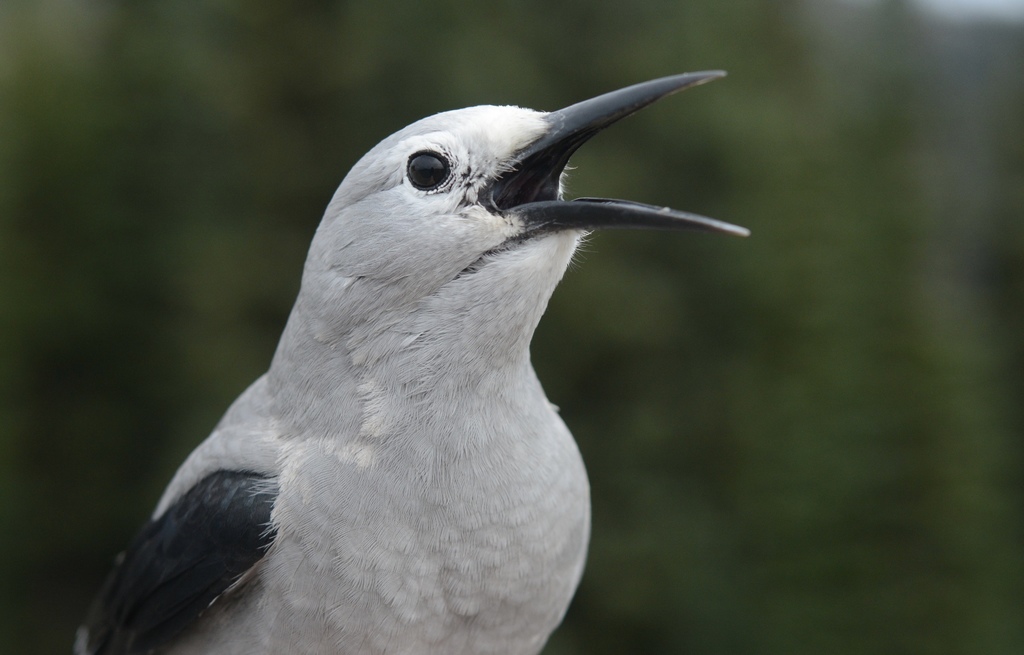
Nucifraga columbiana is roughly the size of a jay, and slightly smaller than its Eurasian congenerics (northern, southern, and Kashmir nutcrackers). Its head, back, belly, and ventrum are covered in gray feathers, and it sports black wings with white tips on secondary feathers. Its tail feathers are easily distinguishable in flight, with central black feathers bordered by white feathers on either side. It has a long, black, pointed bill whose shape is specialized for removing the scales of pinecones.
Measurements. Length: 27–30 cm (11–12 in) Weight: 106–161 g (3.7–5.7 oz) Wingspan: 60 cm (24 in)
Range & habitat
This species is present in western North America from British Columbia and western Alberta in the north to Baja California and central New Mexico in the south. There is also a small isolated population on the peak of Cerro Potosí (elevation 3,700 m (12,100 ft)), in Nuevo León, northeast Mexico. It is mainly found in mountains at altitudes of 900–3,900 m (3,000–12,800 ft) in conifer forest. It is not typically migratory, but does seasonally move between higher elevations in the summer breeding season and lower elevations in the winter. Some populations of Clark's nutcracker will remain year-round at high elevations if they have sufficient food caches. In years where pine mast production is particularly poor, Clark's nutcracker may leave its normal range and travel as far north as Alaska, and east as the Great Plains. Vagrants have occurred as far east as Pennsylvania and Ontario.
Wikipedia: “Distribution and habitat”
At the table
The most important food resources for this species are the seeds of pines (Pinus sp.), principally two cold-climate (high-altitude) species of white pine with large seeds: the whitebark pine (P. albicaulis) and limber pine (P. flexilis). Seeds of other high-altitude pine species are also eaten, including the foxtail pine (P. balfouriana), bristlecone pine (P. longaeva) western white pine (P. monticola), and ponderosa pine (P. ponderosa). Douglas fir (Pseudotsuga menziesii) is one of the few non-pine conifers whose seeds Clark's nutcracker regularly eats. During migrations to lower altitudes, it also extensively uses the seeds of pinyon pines. The isolated Cerro Potosí population is strongly associated with the local endemic Potosi pinyon (Pinus culminicola). All Clark's nutcrackers have a sublingual pouch capable of holding around 50–150 seeds, depending on the size of the seeds, which helps the birds more easily transport seeds between caches. Clark's nutcrackers store seeds, usually in the ground for later consumption, in caches of 1–15 seeds (average of 3–4 seeds). They favor cache sites on steep, south-facing mountain slopes, as snow will melt here earliest in the year. Depending on the cone crop as well as the tree species, a single Clark's nutcracker can cache as many as 98,000 seeds per season. …
Wikipedia: “Food”
In human culture
In William Clark's initial description of the bird, he mistakenly described it as a woodpecker, writing "I saw today [a] bird of the woodpecker kind, which fed on pine burrs. Its bill and tail white; the wings black; every other part of a light brown, and about the size of a robin."
Clark's nutcracker's scientific name literally means "nutcracker of the Columbia". In 1806, Meriwether Lewis recorded a more detailed description from specimens collected along the Clearwater River in Idaho. A skin collected by the expedition was obtained by the ornithologist Alexander Wilson, who used it to produce an engraving for his American Ornithology work.
Wikipedia: “Etymology and history”
Listen
Looking for field recordings…
Where it lives
Recorded sightings
—
geo-referenced records in GBIF, from museums, herbaria and field observers.
Drag the globe to turn it. Dots are where records exist, not a range map; darker means more records.
In the stacks
Searching the stacks…
Every page naming Nucifraga columbiana in the Biodiversity Heritage Library →
This page is assembled live from iNaturalist, GBIF, Wikipedia, the Source Library and the Internet Archive. It is not yet part of the hand-edited codex. iNaturalist taxon 8520.