- Plants
- ›Vascular Plants
- ›flowering plants
- ›Dicots
- ›begonias, gourds, and allies
- ›Begonia family
- ›Begonia
- ›Parvibegonia
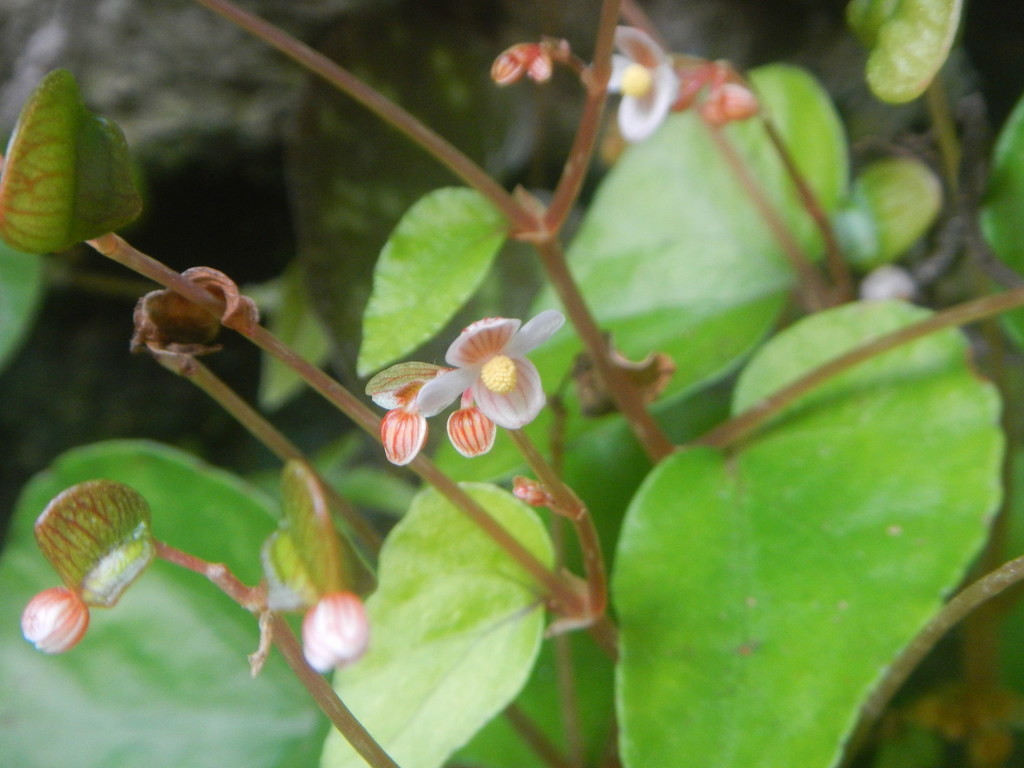
Begonia phoeniogramma
Begonia phoeniogramma, also known as the red striped begonia, is a species of tuberous flowering plant in the family Begoniaceae found in Peninsular Malaysia. It was described by Henry Nicholas Ridley in 1917.
From the article Begonia phoeniogramma on Wikipedia (CC BY-SA), quoted section by section
Description
Begonia phoeniogramma is a small herbaceous plant around 10-15 cm tall with a small tuber that is 12 mm long by 14 mm wide. Plants consist of erect, slender and succulent stems without hairs that are a pale translucent reddish brown, bearing similar coloured ovate tipped stipules with smooth margins around 5-6 mm by 3-4 mm. Leaves measure to about 8.5-19 cm by 6.5-12 cm and are strongly asymmetric, glossy, ovate with acuminate to acute to elongate tips and a rounded, heart-shaped base. The margins of the leaves are undulate, while leaf venation is palmate-pinnate. B. phoeniogramma leaves exhibit polymorphism, varying from being plain green on both sides of the leaf, being dark green dorsally with blue iridescence and pale white, deep red or magenta ventrally, to having pale green or dark green leaves with grey-green silvery spots on top. Plants possess a pale reddish brown cyme inflorescence held up by a 5-9 cm long peduncle bearing both male and female flowers (monoecy). Both sexes bear lanceolate or ovate greenish red bracts with red stripes. Male flowers consist of four hairless white tepals with the two outer obovate tepals having red veins that are raised as ribs on the outer surface; the inner two tepals narrowly obovate and purely white. …
Range & habitat
Begonia phoeniogramma is restricted to the lowland forests of Selangor, mainly the forested areas of Gombak, Sungai Lalang and Sungai Buloh, with the exception of a population in Bentong, Pahang and a population in Mount Tampin, Negeri Sembilan. In Batu Caves, it inhabits steep earth-covered slopes and shaded scree. In the wild, pollination is presumed to be carried out by stingless bees that visit the flowers. Individual plants produce their first true leaves three to four weeks after sowing, and are considered to be mature once the leaves reach a width of 5 cm. Variegation in the form of silver-grey leaf spots displayed by some individuals in Batu Caves and Gabai Waterfall seems to be selectively neutral and play no adaptive role.
Threats. Begonia phoeniogramma is considered as near threatened by the Malaysia Plant Red List due to a combination of threats stemming from human development and tourism.
Wikipedia: “Habitat and ecology”
Where it lives
Recorded sightings
—
geo-referenced records in GBIF, from museums, herbaria and field observers.
Drag the globe to turn it. Dots are where records exist, not a range map; darker means more records.
In the stacks
Searching the stacks…
Every page naming Begonia phoeniogramma in the Biodiversity Heritage Library →
This page is assembled live from iNaturalist, GBIF, Wikipedia, the Source Library and the Internet Archive. It is not yet part of the hand-edited codex. iNaturalist taxon 851946.