- Plants
- ›Vascular Plants
- ›flowering plants
- ›Dicots
- ›Sunflowers, Bellflowers, Fanflowers, and Allies
- ›fanflower family
- ›Dampiera
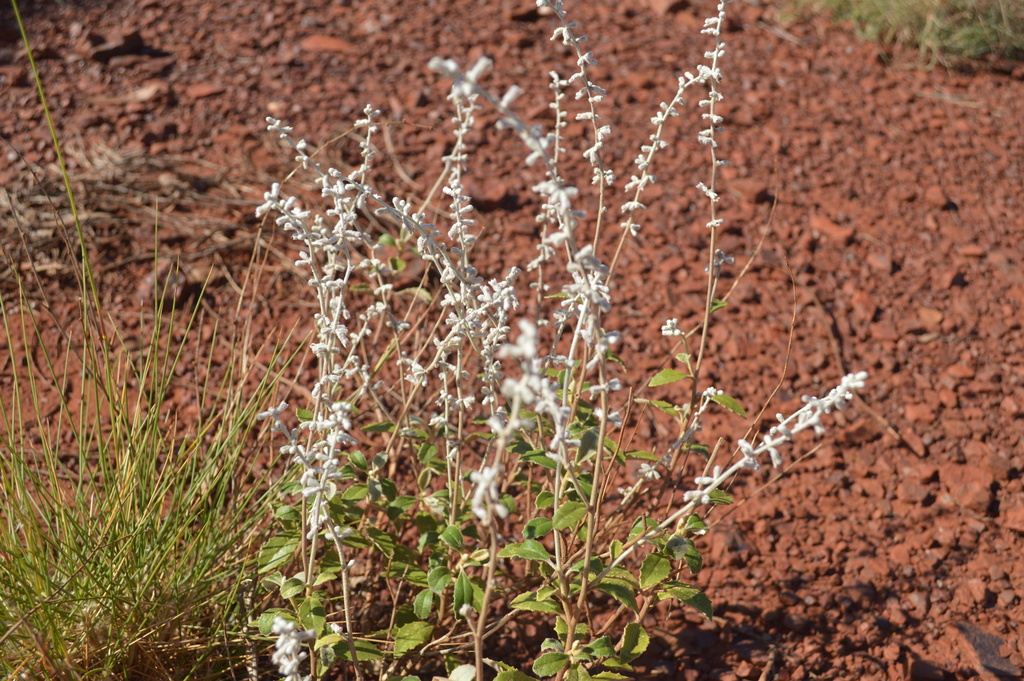
Dampiera candicans
Dampiera candicans is a plant in the family Goodeniaceae, native to Western Australia and the Northern Territory.
From the article Dampiera candicans on Wikipedia (CC BY-SA), quoted section by section
Description
Dampiera candicans is an erect shrub growing to a height of 70 cm tall, with stems covered in brownish or greyish dense intertwined hairs. The upper surface of the leaves usually lose their covering but may have a few large coarse hairs. The lower leaf surface is always has a covering of dense intertwined hairs. The leaf lamina is 3–35 mm by 6–19 mm wide on a stalk (petiole) which is 3–10 mm long. The flowers occur in spikes which are 13–28 cm long. The sepals are about 0.1 mm long and hidden beneath hairs. The fruit is ellipsoidal to obovoid and about 2 mm long. It flowers from April to August, and is distinguished from Dampiera cinerea by its dentate leaf margins and its longer flower spikes.
Range & habitat
It is found in north-western Western Australia and the west of the Northern Territory, growing on sandy and lateritic soils.
Wikipedia: “Distribution & habitat”
In human culture
It was first described by Ferdinand von Mueller in 1876. The specific epithet, candicans, is a Latin adjective, candicans, meaning "white", "whitish" or "having white woolly hairs".
Wikipedia: “Taxonomy & etymology”
Where it lives
Recorded sightings
—
geo-referenced records in GBIF, from museums, herbaria and field observers.
Drag the globe to turn it. Dots are where records exist, not a range map; darker means more records.
In the stacks
Searching the stacks…
Every page naming Dampiera candicans in the Biodiversity Heritage Library →
This page is assembled live from iNaturalist, GBIF, Wikipedia, the Source Library and the Internet Archive. It is not yet part of the hand-edited codex. iNaturalist taxon 851240.