On eBird ↗
White-tailed Jay
Live sightings near you, the range map, bar charts of when it is seen, and Macaulay Library photos and recordings.
White-tailed Jay
Cyanocorax mystacalis
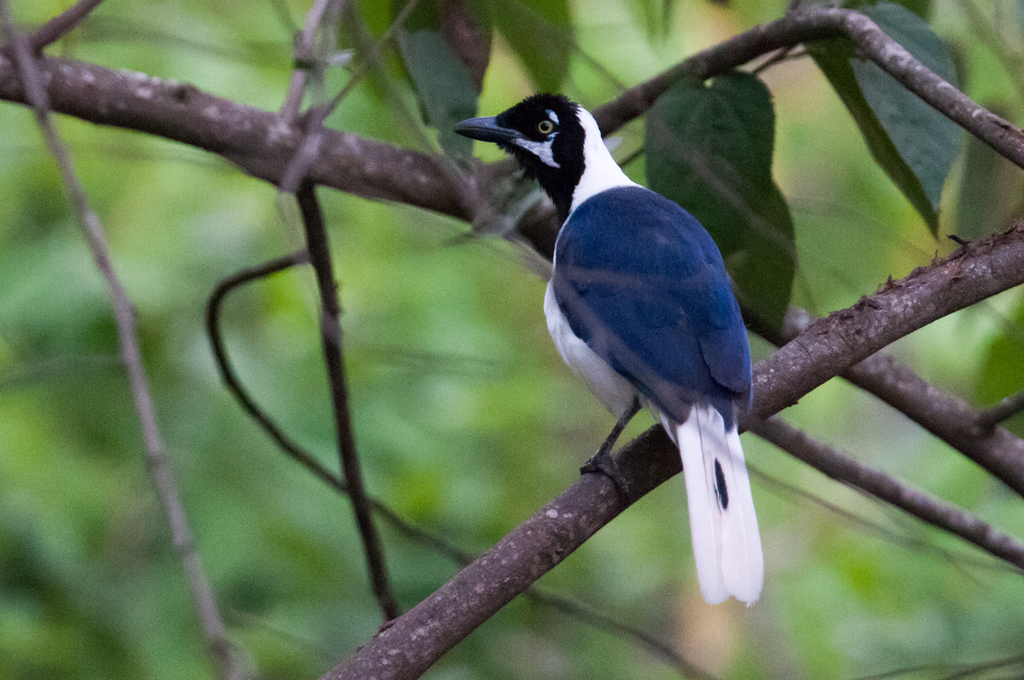
The white-tailed jay (Cyanocorax mystacalis), also known as the moustached jay, is a species of bird in the crow family Corvidae. It is found in Ecuador and Peru. It has a black face with white spots above and below the eyes, and a small white moustachial stripe. It has a white nape, belly, and underparts. Its back and wings are greyish-blue, extending most of the way down the tail. The rectrices and tail tip are white. It has several calls, the most common being described as "cha-cha-cha-cha".
The white-tailed jay was first described by the French ornithologist Louis Ernest Gustave de Sparre in 1835 and was given the scientific name Pica mystacalis. It was later placed in the genus Cyanocorax. It is visually very similar to the tufted jay, which is found in Mexico over 4,800 km (3,000 mi) away, and the two species were incorrectly thought to be close relatives. The white-tailed jay's relationship to others in the genus Cyanocorax is still unclear.
From the article White-tailed jay on Wikipedia (CC BY-SA), quoted section by section
Description
The white-tailed jay is overall white and bluish, with a black head. Its face is mostly black, with a small white spot above the eye, a small white moustachial stripe, and a somewhat larger white spot on the cheek. It has a white nape and belly. The back and wings are a greyish-blue, which extends down the top of the tail. The rectrices, tail tip, and underside of the tail are white. It has bright yellow irises. There are no visual differences between the sexes. Juveniles have brown irises and lack both the white spot above the eye and the moustachial stripe. These features last until the first moult. The white-tailed jay is roughly 33 cm (13 in) in length. One individual measured had a wing length of 146 mm (5.7 in), a 147 mm (5.8 in) tail, 40 mm (1.6 in) tarsi, and a 40 mm (1.6 in) beak. Weight measurements come from a single pair, with the male weighing 160 g (5.6 oz) and the female weighing 149 g (5.3 oz). Little is known of the vocalizations of the white-tailed jay. Their most common call is described as "cha-cha-cha-cha", varying in pitch throughout. It is thought that this may be used socially. They also make a high-pitched "clewp-clewp" call. The white-tailed jay has fewer vocalizations than other species in its genus. …
Range & habitat
The white-tailed jay is non-migratory and can be found from northwestern Peru to southwestern Ecuador. In Ecuador, it ranges as far north as the province of Guayas, down through El Oro and Loja. In Peru, it can be found as far south as La Libertad. It lives in several different types of semi-humid, semi-open woodlands throughout its range, such as mesquite woodlands and cactus steppe. Within these areas, it prefers to remain near thick patches of vegetation close to rivers and streams. In parts of Ecuador, it can be seen in cloud forests at higher elevations. It can be found from sea level up to 1,200 m (3,900 ft).
Wikipedia: “Distribution and habitat”
What it does
The white-tailed jay feeds on insects, such as beetles and ants, and on seeds. It is also known to feed on eggs from other birds. It will approach human settlements and steal eggs from domestic ducks and chickens, and one pair has been observed raiding the nest of a pale-legged hornero. It also steals eggs from the endangered Peruvian plantcutter. The white-tailed jay forages in flocks of up to ten individuals, but can also commonly be seen singly or in a pair. It forages throughout all levels of the forest; however, it can be found on the ground more often than other species in its genus. This is thought to be because of its habitat, as it prefers semi-open areas. It can also be found near human settlements and will forage through gardens. The white-tailed jay may be predated upon by the bicoloured hawk.
Wikipedia: “Diet and feeding”
Listen
Looking for field recordings…
Where it lives
Recorded sightings
—
geo-referenced records in GBIF, from museums, herbaria and field observers.
Drag the globe to turn it. Dots are where records exist, not a range map; darker means more records.
In the stacks
Searching the stacks…
Every page naming Cyanocorax mystacalis in the Biodiversity Heritage Library →
This page is assembled live from iNaturalist, GBIF, Wikipedia, the Source Library and the Internet Archive. It is not yet part of the hand-edited codex. iNaturalist taxon 8472.