- Plants
- ›Vascular Plants
- ›flowering plants
- ›Dicots
- ›Buttercups, Poppies, and Allies
- ›barberry family
- ›Berberidoideae
- ›Berberideae
- ›Berberis
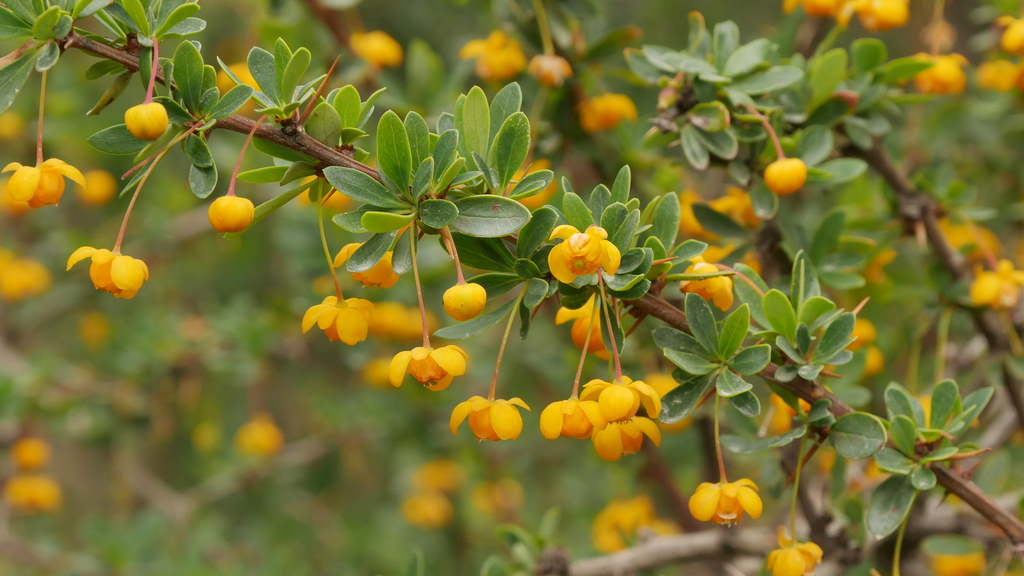
Calafate
Berberis microphylla
Berberis microphylla, common name box-leaved barberry and Magellan barberry, in Spanish calafate and michay and other names, is an evergreen shrub, with simple, shiny box-like leaves. The calafate is native to southern Argentina and Chile and is a symbol of Patagonia.
Berberis microphylla should not be confused with Mahonia microphylla, native to China.
From the article Berberis microphylla on Wikipedia (CC BY-SA), quoted section by section
Description
The bush grows to a height of 1.0 to 1.5 m (3 ft 3 in to 4 ft 11 in). It has many arching branches, each covered in many tripartite spines. The bush has many small yellow flowers in summer. It produces blue-black berries.
At the table
Its edible blue-black berries are harvested for jams, but are eaten fresh too - a legend tells that anyone who eats a calafate berry will be certain to return to Patagonia. It is also used as an additive in alcoholic beverages such as calafate beer. The calafate is grown commercially for its fruit, potential medical uses and as a garden plant or bonsai. Its wood is used to make a red dye. The cultivar Berberis microphylla 'Nana' is widely available as a garden shrub, and is also used in commercial plantings as a low spiny hedge to discourage intruders, but it does not fruit.
Wikipedia: “Uses”
Where it lives
Recorded sightings
—
geo-referenced records in GBIF, from museums, herbaria and field observers.
Drag the globe to turn it. Dots are where records exist, not a range map; darker means more records.
In the stacks
Searching the stacks…
Every page naming Berberis microphylla in the Biodiversity Heritage Library →
This page is assembled live from iNaturalist, GBIF, Wikipedia, the Source Library and the Internet Archive. It is not yet part of the hand-edited codex. iNaturalist taxon 84707.