- Animals
- ›Arthropods
- ›Hexapods
- ›Insects
- ›Winged and Once-winged Insects
- ›Ants, Bees, Wasps, and Sawflies
- ›Narrow-waisted Wasps, Ants, and Bees
- ›Ichneumonid and Braconid Wasps
- ›Ichneumonid Wasps
- ›Ichneumoninae
- ›Ichneumonini
- ›Gnamptopelta
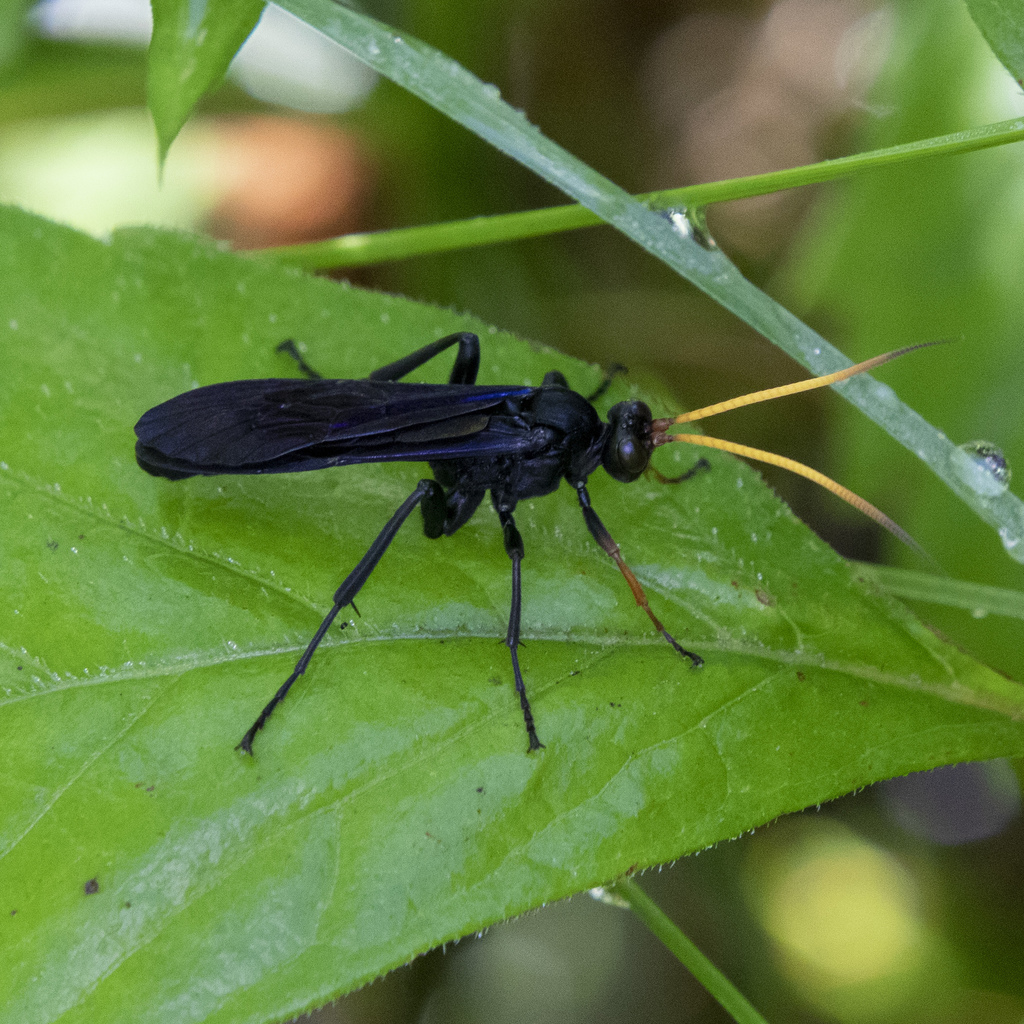
Bent-shielded Besieger Wasp
Gnamptopelta obsidianator
Gnamptopelta obsidianator is a species of wasp in the family Ichneumonidae and the only species in the monotypic genus Gnamptopelta.
From the article Gnamptopelta on Wikipedia (CC BY-SA), quoted section by section
Description
Gnamptopelta obsidianator can be distinguished from allied genera by the concave structure of the clypeus. They are large wasps with a body length of 20 to 23 millimetres (13⁄16 to 7⁄8 in). The scutellum is high and conical. Typically, the body is almost entirely black, including the wings, except for the fore and mid legs, of which the tibiae and tarsi are yellowish-brown. In some specimens, the orbits may be yellow. The antennae are orange-yellow, sometimes with the tips blackish. Specimens from the southern extent of the species' range may have parts of the head and thorax more or less ferruginous. This species is very similar in appearance to Conocalma brullei but can be distinguished by the lack of an elevated structure on the petiole of the abdomen and by the shape of the clypeus.
Wikipedia: “Description and identification”
Range & habitat
Gnamptopelta obsidianator is found across eastern North America from Quebec south to Florida and as far west as Manitoba and New Mexico.
Wikipedia: “Distribution and habitat”
What it does
Adults fly in the spring from March to May. Females are associated with grapevines and parasitize caterpillars of the subfamily Macroglossinae that feed on Vitis aestivalis. Known hosts include Darapsa myron, Amphion floridensis, and Eumorpha achemon. Eggs are laid inside third through fifth instars.
Wikipedia: “Behavior”
In human culture
The genus name Gnamptopelta is derived from the Greek γναμπτός (gnamptós) meaning 'bent' or 'curved' plus the Greek πέλτη (péltē) meaning 'shield'. This refers to the concave shape of the clypeus found in this genus.
Wikipedia: “Etymology”
Listen
Looking for field recordings…
Where it lives
Recorded sightings
—
geo-referenced records in GBIF, from museums, herbaria and field observers.
Drag the globe to turn it. Dots are where records exist, not a range map; darker means more records.
In the stacks
Searching the stacks…
Every page naming Gnamptopelta obsidianator in the Biodiversity Heritage Library →
This page is assembled live from iNaturalist, GBIF, Wikipedia, the Source Library and the Internet Archive. It is not yet part of the hand-edited codex. iNaturalist taxon 84682.