- Plants
- ›Vascular Plants
- ›flowering plants
- ›Dicots
- ›Heathers, Balsams, Primroses, and Allies
- ›heath family
- ›blueberries, cranberries, huckleberries, and allies
- ›Vaccinieae
- ›Vaccinium
- ›Cyanococcus
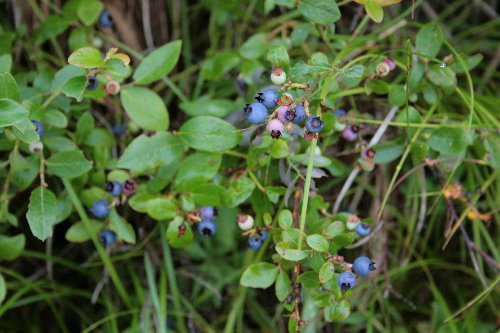
lowbush blueberry
Vaccinium angustifolium
Vaccinium angustifolium, commonly known as the wild lowbush blueberry, is a species of blueberry native to eastern and central Canada (from Manitoba to Newfoundland) and the northeastern United States, growing as far south as the Great Smoky Mountains and west to the Great Lakes region....
From the article Vaccinium angustifolium on Wikipedia (CC BY-SA), quoted section by section
Description
Vaccinium angustifolium is a low spreading deciduous shrub growing 5 to 60 centimetres (2 to 23+1⁄2 in) tall. Its rhizomes can lie dormant up to 100 years, sprouting when given the adequate amount of sunlight, soil moisture, and oxygen content. The leaves are glossy blue-green in summer, turning a variety of reds in the fall. The leaf shape is broad to elliptical, with the buds brownish red in stem axils. The flowers are white or pink, bell-shaped, 4 to 6 millimetres (1⁄8 to 1⁄4 in) long. The fruit is a small sweet dark blue to black berry, full of antioxidants and flavonoids. Several buds may be on a healthy stem, and each bud can open up and have several blossoms. A blueberry field that has full plant coverage can have as many as 150 million blossoms per acre. Chromosome number is 2n = 48.
Range & habitat
The lowbush blueberry is native to central and eastern Canada (from Manitoba to Newfoundland) as well as north-central and eastern United States (growing as far south as the Great Smoky Mountains and west to the Great Lakes region). In its native habitat the plant grows in open conifer woods, old fields, and sandy or rocky balds. Glacier ice from the Ice Age sculpted the Maine landscape and is responsible for creating some of the most productive V. angustifolium habitats. The species is fire-tolerant, and its numbers often increase in an area following a forest fire. This plant grows best in wooded areas, old abandoned farmyards or open areas with well-drained acidic soils. In some areas it produces natural blueberry barrens, where it is practically the only species covering large areas.
Wikipedia: “Distribution and habitat”
What it does
Many animals feed on the fruit and foliage of the lowbush berry, some of which include black bears, raccoons, foxes, white-tailed deer and birds. Its leaves are also popular among caterpillars. It is a larval host to the pale tiger moth, the peppered moth, the chain-dotted geometer, the saw-wing moth, the blueberry gray moth, the mousy angle moth, Caloptilia vacciniella, Andromeda underwing, the shadowy arches, the two-spot dart, the dingy cutworm moth, the speckled cutworm, the decorated owlet, the pirate looper, Norman's dart, the gray swordgrass moth, the pink-edged sulphur butterfly, the pawpaw sphinx moth, and the blueberry leaftier moth.
Wikipedia: “Ecology”
How it is grown
Vaccinium angustifolium has a two-year production cycle. The first year is known as the vegetative year and the second is known as the fruit-bearing year. In order to be productive each year, most farmers divide their land to have half their crop in the vegetative year while the other half is in the fruit-bearing year. Traditionally, blueberry growers burn their fields every few years to eliminate shrubs and fertilize the soil. In Acadian French, a blueberry field is known as a brûlis (from brûlé 'burnt') because of that technique, which is still in use.
Pruning. Native Americans regularly burned away trees and shrubs in parts of eastern Maine to stimulate blueberry production. Modern farmers use various methods of burning or mowing to accomplish this. There are several methods growers use to stimulate blueberry production on their land, such as burning the land or using a flail mower, brush hog, lawnmower, etc. to cut the plants off as close to the ground as possible without scalping the land. These procedures are used to promote the spreading of rhizomes under the soil. Some growers use a sickle mower in the fall after the crop has been harvested to mow the plants off, leaving about 1–2 inches of stem so the growers can burn the remainder of the plants in the spring, using less fuel for the fire. Farmers then treat their crops with pesticides to control weeds and insects. …
Wikipedia: “Cultivation”
In human culture
The species epithet angustifolium is a combination of the Latin words angustum meaning 'narrow', and folium meaning 'leaf'.
Wikipedia: “Etymology”
Where it lives
Recorded sightings
—
geo-referenced records in GBIF, from museums, herbaria and field observers.
Drag the globe to turn it. Dots are where records exist, not a range map; darker means more records.
In the stacks
Searching the stacks…
Every page naming Vaccinium angustifolium in the Biodiversity Heritage Library →
This page is assembled live from iNaturalist, GBIF, Wikipedia, the Source Library and the Internet Archive. It is not yet part of the hand-edited codex. iNaturalist taxon 84542.