- Animals
- ›Arthropods
- ›Hexapods
- ›Insects
- ›Winged and Once-winged Insects
- ›Butterflies and Moths
- ›Owlet Moths and Allies
- ›Cutworm Moths and Allies
- ›Cutworms and Dart Moths
- ›Noctuini
- ›Agrotina
- ›Agrotis
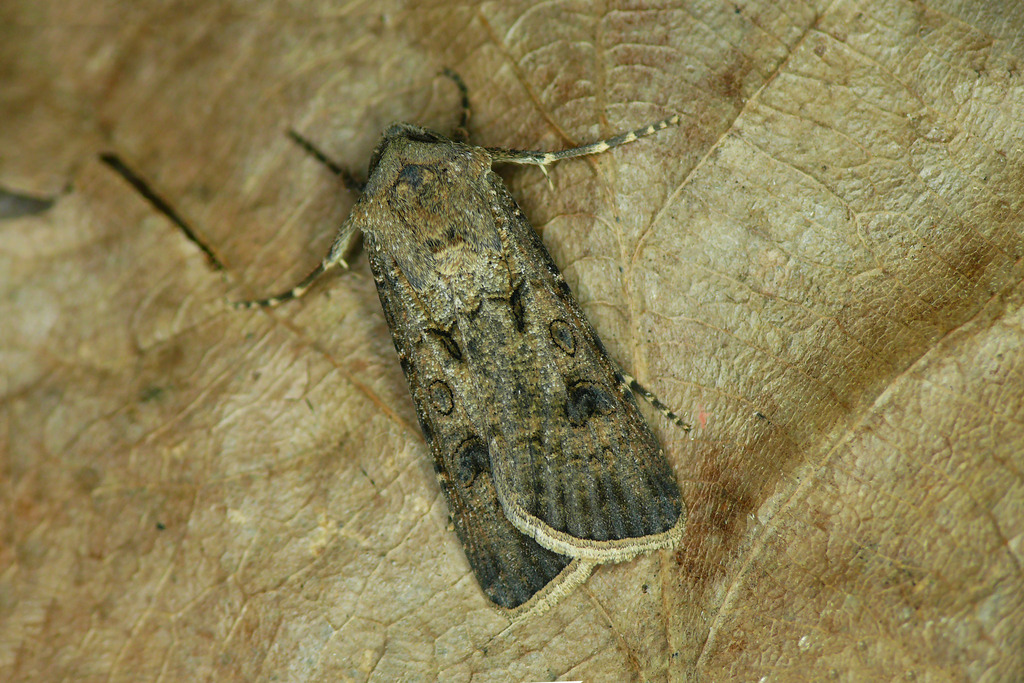
Turnip Moth
Agrotis segetum
Agrotis segetum, sometimes known as the turnip moth, is a moth of the family Noctuidae. The species was first described by Michael Denis and Ignaz Schiffermüller in 1775. It is a common European species and it is found in Africa and across Eurasia except for the northernmost parts.
It is a cutworm in the genus Agrotis, which possibly is the genus that includes the largest number of species of cutworms.
From the article Turnip moth on Wikipedia (CC BY-SA), quoted section by section
Description
This is a very variable species with the fore-wings ranging from pale buff through to almost black. The paler forms have three dark-bordered stigmata on each fore-wing. Antennae of male bipectinated (comb like on both sides) with moderate length branches. The main feature distinguishing it from other Agrotis species is the shade of the hind-wings, pure white in the males and pearly grey in the females. The wingspan is 32–42 mm. Edward Meyrick, an English schoolteacher who is especially notable for his study of the microlepidoptera, had this to say about the species:
Wingspan 33–41 mm. Antennae in male bipectinated. Fore-wings brownish, sometimes reddish tinged, with darker fuscous strigulae mixed with black scales, sometimes wholly darker suffused; sub-basal, first, and second lines edged with dark fuscous, second sometimes with dots only; spots outlined with black, orbicular and reniform centred with fuscous; subterminal line faint or whitish sprinkled, followed by darker suffusion. Hind-wings white, termen brownish. Larva pale grey or greyish ochreous, sometimes pinkish tinged; dorsal, subdorsal, and spiracular lines usually indicated by dark edges, subdorsal sometimes grey head pale, with two brown marks; plate of 2 more or less brown. Agrotis segetum is difficult to certainly distinguish from its congeners. …
What it does
In the British Isles, two broods are produced each year, the adults flying in May and June and again in August and September. It is known to migrate some distances. The species is nocturnal and is attracted to light and nectar-rich flowers. The species overwinters as a caterpillar.
Wikipedia: “Behaviour”
Listen
Looking for field recordings…
Where it lives
Recorded sightings
—
geo-referenced records in GBIF, from museums, herbaria and field observers.
Drag the globe to turn it. Dots are where records exist, not a range map; darker means more records.
In the stacks
Searching the stacks…
Every page naming Agrotis segetum in the Biodiversity Heritage Library →
This page is assembled live from iNaturalist, GBIF, Wikipedia, the Source Library and the Internet Archive. It is not yet part of the hand-edited codex. iNaturalist taxon 84455.