- Plants
- ›Vascular Plants
- ›flowering plants
- ›monocots
- ›Agaves, Orchids, Irises, and Allies
- ›agave and allies
- ›Century plant subfamily
- ›Manfreda
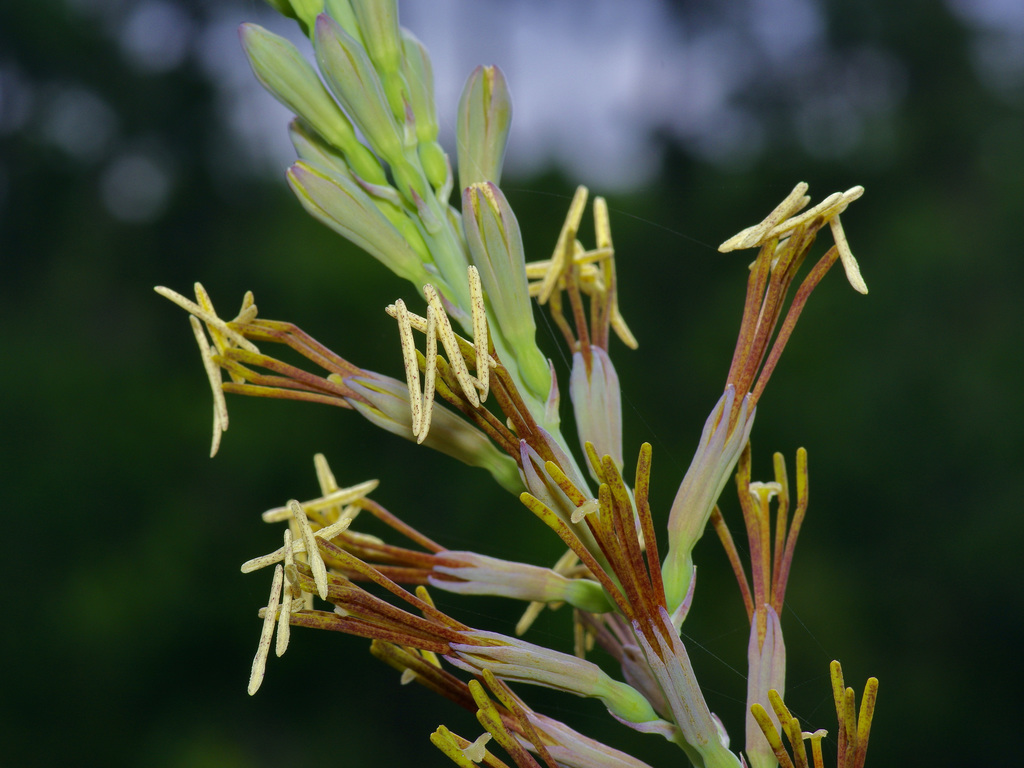
Eastern False Aloe
Manfreda virginica
Agave virginica, synonym Manfreda virginica, commonly known as the false aloe, American aloe, Virginia agave, and eastern agave, is a species of agave. Older references occasionally used rattlesnake master to refer to Manfreda virginica, though current usage of rattlesnake master primarily refers to Eryngium yuccifolium. It is native to the central and southeastern United States and northeastern Mexico, where it is found in prairies, upland rocky glades, and sandy open woods.
From the article Agave virginica on Wikipedia (CC BY-SA), quoted section by section
Description
False aloe is acaulescent, meaning the stem is extremely short. Leaves and flowering stems grow from a bulbous herbaceous caudex. The fleshy green leaves, usually spotted or speckled with maroon, are 10–46 cm (4–18 in) long and 1–6 cm (0.5–2.25 in) across. The leaf margins have fine teeth and leaves taper to a non-spiny tip. Leaf shape and size in Agave virginica vary with soil type, amount of shade, length of cold period, and position of leaf in the rosette. Speckles and spots occur frequently on some leaves in most populations, and some authors have used the informal designation "forma tigrina" for such variants. In early summer, leafless flower stalks emerge from the basal rosettes of leaves, growing rapidly up to 2.1 m (7 ft) tall. The inflorescence appears June to August, with 10–61 closely spaced flowers grouped in a spike that is about 15–61 cm (6–24 in) long. Each flower, 2–3 cm (0.75–1.25 in) long, is whitish green or yellowish green, essentially tubular, nearly erect, and slender, with a fragrant sweet fruity odor. Seed capsules are spherical and 1–1.7 cm (0.4–0.7 in) in diameter.
Range & habitat
It is native to an area stretching from North Carolina west to Texas and north to Illinois in the United States and south to Nuevo León and Tamaulipas in Mexico. Its habitat is sunny, well-drained areas in prairies, upland rocky glades, and sandy open woods. It is the only Agave species north of Texas.
Wikipedia: “Distribution and habitat”
What it does
Agave virginica is adapted primarily to nocturnal pollination by medium-sized moths and larger sphinx moths. Diurnal pollination by large bees results in significantly less seed set than nocturnal and open pollination. Ruby-throated hummingbirds are also attracted to the blooms.
Wikipedia: “Ecology”
Where it lives
Recorded sightings
—
geo-referenced records in GBIF, from museums, herbaria and field observers.
Drag the globe to turn it. Dots are where records exist, not a range map; darker means more records.
In the stacks
Searching the stacks…
Every page naming Manfreda virginica in the Biodiversity Heritage Library →
This page is assembled live from iNaturalist, GBIF, Wikipedia, the Source Library and the Internet Archive. It is not yet part of the hand-edited codex. iNaturalist taxon 84367.