- Plants
- ›Vascular Plants
- ›flowering plants
- ›Dicots
- ›Roses, Elms, Figs, and Allies
- ›elm family
- ›Ulmus
- ›Oreoptelea
- ›Chaetoptelea
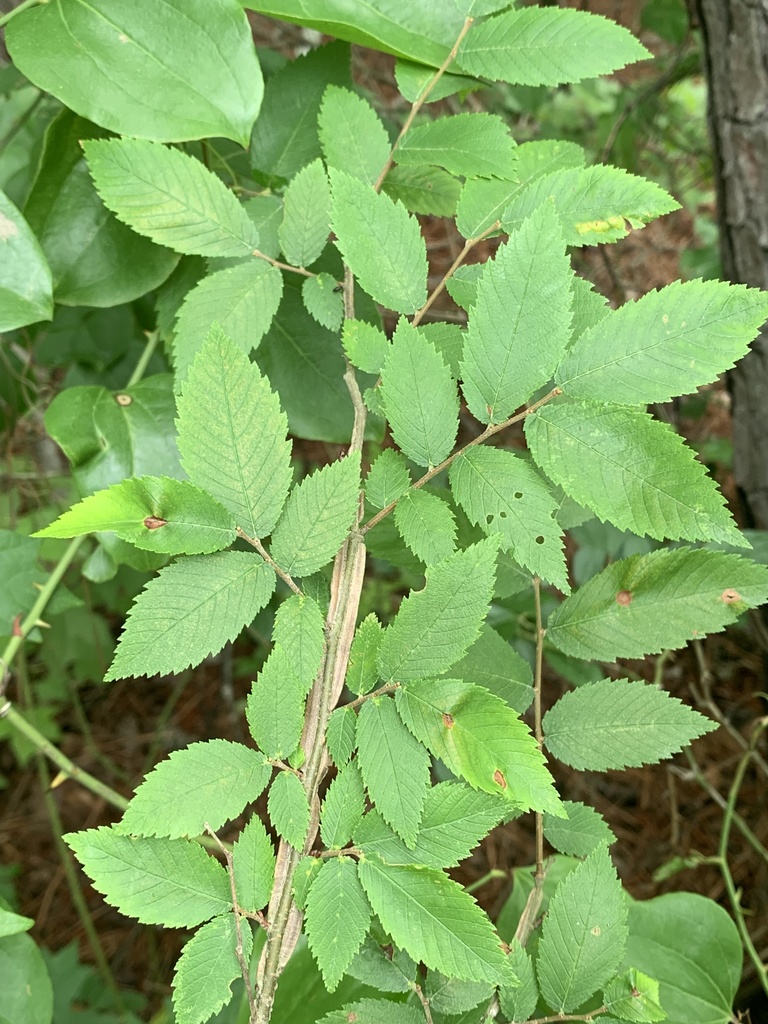
Winged Elm
Ulmus alata
Ulmus alata, the winged elm or wahoo, is a small- to medium-sized deciduous tree endemic to the woodlands of the southeastern and south-central United States. The species is tolerant of a wide range of soils, and of ponding, but is the least shade-tolerant of the North American elms. Its growth rate is often very slow, the trunk increasing in diameter by less than 5 mm (3⁄16 in) per year. The tree is occasionally considered a nuisance as it readily invades old fields, forest clearings, and rangelands, proving particularly difficult to eradicate with herbicides.
From the article Ulmus alata on Wikipedia (CC BY-SA), quoted section by section
Description
As its common and scientific names imply, winged elm is most easily recognized by the very broad, thin pair of corky wings that form along the branchlets after a couple of years. The tree generally grows to a maximum height and breadth of about 13 m × 13 m (43 ft × 43 ft), although on fertile alluvial soils such as those of the Mississippi River Delta, some specimens have reached double this height (see 'Notable trees' below). The crown can be either rounded or pyramidal; the branches are pendulous. The leaves are comparatively small for the genus, less than 6.5 cm (2+1⁄2 in) long and less than 2.0 cm (3⁄4 in) broad, oblong-lanceolate to narrowly elliptic, thin in texture, and smooth above with serrate or doubly serrate margins. The leaves turn bright yellow in Autumn. The wind-pollinated perfect apetalous flowers are borne on long pedicels in March and April before the leaves appear. The reddish samaras are also relatively small, less than 8 mm (5⁄16 in) long, narrowly elliptic with two long incurving stigmas at the tip, and usually disperse before the end of April.
At the table
Ulmus alata is of minimal commercial significance, its hard timber considered no more remarkable than that of other American elms, and of limited use because of the commonly small size of the trees. However, owing to its resistance to splitting, it is used to make high-quality hockey sticks.
Wikipedia: “Other uses”
How it is grown
Ulmus alata is rarely cultivated beyond its natural range. It remains in commercial production in the US, and is occasionally available in Europe. At the beginning of the 19th century, the tree was one of the three American elm species cultivated in ornamental plantations in Britain, but is now rare there. Several specimens are grown in New Zealand.
Wikipedia: “Cultivation”
Where it lives
Recorded sightings
—
geo-referenced records in GBIF, from museums, herbaria and field observers.
Drag the globe to turn it. Dots are where records exist, not a range map; darker means more records.
In the stacks
Searching the stacks…
Every page naming Ulmus alata in the Biodiversity Heritage Library →
This page is assembled live from iNaturalist, GBIF, Wikipedia, the Source Library and the Internet Archive. It is not yet part of the hand-edited codex. iNaturalist taxon 84292.