- Animals
- ›Chordates
- ›Vertebrates
- ›Birds
- ›Perching Birds
- ›Woodswallows, Butcherbirds, and Currawongs
- ›Strepera
On eBird ↗
Pied Currawong
Live sightings near you, the range map, bar charts of when it is seen, and Macaulay Library photos and recordings.
Pied Currawong
Strepera graculina
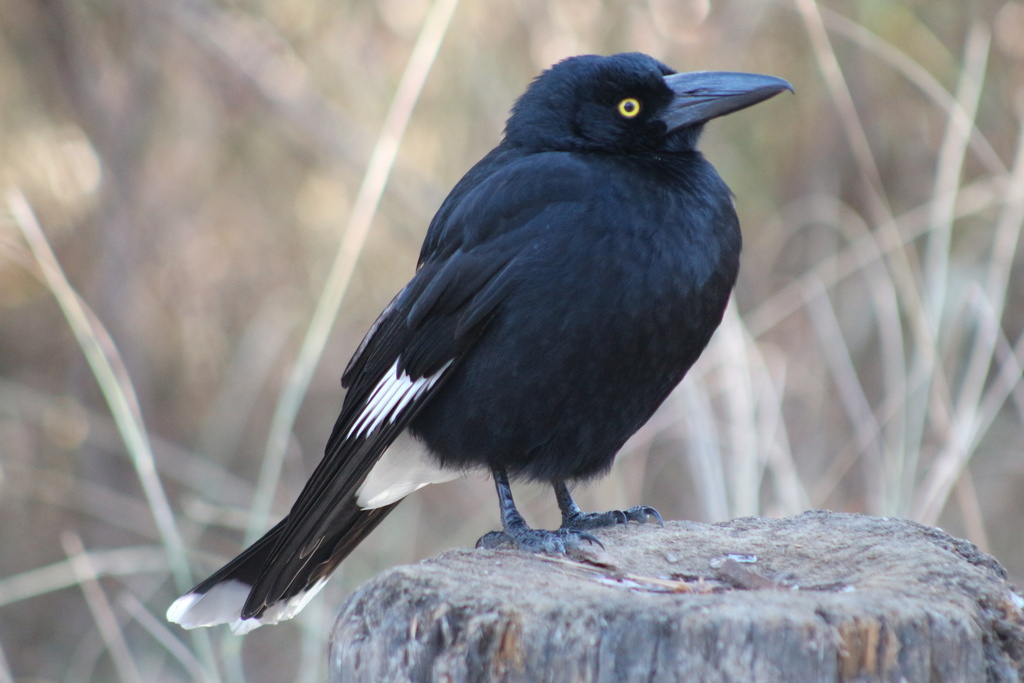
The pied currawong (Strepera graculina) is a black passerine bird native to eastern Australia and Lord Howe Island. One of three currawong species in the genus Strepera, it is closely related to the butcherbirds and Australian magpie of the family Artamidae. Six subspecies are recognised. It is a robust crowlike bird averaging around 48 cm (19 in) in length, black or sooty grey-black in plumage with white undertail and wing patches, yellow irises, and a heavy bill. The male and female are similar in appearance. Known for its melodious calls, the species' name currawong is believed to be of indigenous origin.
Within its range, the pied currawong is generally sedentary, although populations at higher altitudes relocate to lower areas during the cooler months. It is omnivorous, with a diet that includes a wide variety of berries and seeds, invertebrates, bird eggs, juvenile birds and young marsupials. It is a predator which has adapted well to urbanisation and can be found in parks and gardens as well as rural woodland. The habitat includes every kind of forested area, although mature forests are preferred for breeding. Roosting, nesting and the bulk of foraging take place in trees, in contrast with the ground-foraging behaviour of its relative, the Australian magpie.
From the article Pied currawong on Wikipedia (CC BY-SA), quoted section by section
Description
The pied currawong is generally a black bird with white in the wing, undertail coverts, the base of the tail and most visibly, the tip of the tail. It has yellow eyes. Adult birds are 44–50 cm (17–20 in) in length, with an average of around 48 cm (19 in); the wingspan varies from 56 to 77 cm (22 to 30 in), averaging around 69 cm (27 in). Adult males average around 320 g (11 oz), females 280 g (10 oz). The wings are long and broad. The long and heavy bill is about one and a half times as long as the head and is hooked at the end. Juvenile birds have similar markings to adults but have softer and brownish plumage overall, although the white band on the tail is narrower. The upperparts are darker brown with scallops and streaks over the head and neck, and the underparts lighter brown. The eyes are dark brown and the bill dark with a yellow tip. The gape is a prominent yellow. Older birds grow darker until adult plumage is achieved, but juvenile tail markings only change to adult late in development. Birds appear to moult once a year in late summer after breeding. The pied currawong can live for over 20 years in the wild.
Voice. Pied currawongs are vocal birds, calling when in flight and at all times of the day. They are noisier early in the morning and in the evening before roosting, as well as before rain. …
Range & habitat
The pied currawong is common in both wet and dry sclerophyll forests, rural and semi-urban environments throughout eastern Australia, from Cape York Peninsula to western Victoria and Lord Howe Island, where it occurs as an endemic subspecies. It has more recently become prevalent in South-East South Australia, in and around Mount Gambier. It has adapted well to European presence, and has become more common in many areas of eastern Australia, with surveys in Nanango, Queensland, Barham, New South Wales, Geelong, Victoria, as well as the Northern Tablelands and South West Slopes regions in New South Wales, all showing an increase in population. This increase has been most marked, however, in Sydney and Canberra since the 1940s and 1960s, respectively. In both cities, the species had previously been a winter resident only, but now remains year-round and breeds there. They are a dominant species and common inhabitant of Sydney gardens. In general, the pied currawong is sedentary, although some populations from higher altitudes move to areas of lower elevation in winter. However, evidence for the extent of migration is conflicting, and the species' movements have been little studied to date. …
Wikipedia: “Distribution and habitat”
What it does
Pied currawongs are generally tree-dwelling, hunting and foraging some metres above the ground, and thus able to share territory with the ground-foraging Australian magpie. Birds roost in forested areas or large trees at night, disperse to forage in the early morning and return in the late afternoon. Although often solitary or encountered in small groups, the species may form larger flocks of fifty or more birds in autumn and winter. On the ground, a pied currawong hops or struts. During the breeding season, pied currawongs will pair up and become territorial, defending both nesting and feeding areas. A 1994 study in Sydney's leafy northern suburbs measured an average distance of 250 m (820 ft) between nests, while another in Canberra in 1990 had three pairs in a 400 m (1,300 ft) segment of pine-tree lined street. Territories have been measured around 0.5–0.7 ha in Sydney and Wollongong, although these were restricted to nesting areas and did not include a larger feeding territory, and 7.9 ha in Canberra. Pied currawongs vigorously drive off threats such as ravens, and engage in bill-snapping, dive-bombing and aerial pursuit. They adopt a specific threat display against other currawongs by lowering the head so the head and body are parallel to the ground and pointing the beak out forward, often directly at the intruder. …
Wikipedia: “Behaviour”
Listen
Looking for field recordings…
Where it lives
Recorded sightings
—
geo-referenced records in GBIF, from museums, herbaria and field observers.
Drag the globe to turn it. Dots are where records exist, not a range map; darker means more records.
In the stacks
Searching the stacks…
Every page naming Strepera graculina in the Biodiversity Heritage Library →
This page is assembled live from iNaturalist, GBIF, Wikipedia, the Source Library and the Internet Archive. It is not yet part of the hand-edited codex. iNaturalist taxon 8423.